
United States
Securities and Exchange Commission
Washington, D.C. 20549
Form 10-K
Annual report pursuant to Section 13 or 15(d) of the Securities Exchange Act of 1934
for the fiscal year ended December 31 , 2024
Commission file number 001-06351
(Exact name of Registrant as specified in its charter)
| (State or other jurisdiction of | (I.R.S. Employer | |||||||||||||||||||
| incorporation or organization) | Identification No.) | |||||||||||||||||||
(Address and zip code of principal executive offices)
Registrant's telephone number, including area code (317 ) 276-2000
Securities registered pursuant to Section 12(b) of the Exchange Act:
| Title of Each Class | Trading Symbol(s) | Name of Each Exchange On Which Registered | ||||||
Securities registered pursuant to Section 12(g) of the Exchange Act: None
Indicate by check mark if the Registrant is a well-known seasoned issuer, as defined in Rule 405 of the Securities Act. Yes ☒ No ☐
Indicate by check mark if the Registrant is not required to file reports pursuant to Section 13 or 15(d) of the Exchange Act. Yes ☐ No ☒
Indicate by check mark whether the Registrant (1) has filed all reports required to be filed by Section 13 or 15(d) of the Exchange Act during the preceding 12 months (or for such shorter period that the Registrant was required to file such reports) and (2) has been subject to such filing requirements for the past 90 days. Yes ☒ No ☐
Indicate by check mark whether the Registrant has submitted electronically every Interactive Data File required to be submitted pursuant to Rule 405 of Regulation S-T (§ 232.405 of this chapter) during the preceding 12 months (or for such shorter period that the Registrant was required to submit such files).
Indicate by check mark whether the Registrant is a large accelerated filer, an accelerated filer, a non-accelerated filer, a smaller reporting company, or an emerging growth company. See the definitions of "large accelerated filer," "accelerated filer," "smaller reporting company," and "emerging growth company" in Rule 12b-2 of the Exchange Act.
| ☒ | Accelerated filer | ☐ | |||||||||||||||||||||
| Non-accelerated filer | ☐ | Smaller reporting company | |||||||||||||||||||||
| Emerging growth company | |||||||||||||||||||||||
If an emerging growth company, indicate by check mark if the Registrant has elected not to use the extended transition period for complying with any new or revised financial accounting standards provided pursuant to Section 13(a) of the Exchange Act. ☐
Indicate by check mark whether the Registrant has filed a report on and attestation to its management's assessment of the effectiveness of its internal control over financial reporting under Section 404(b) of the Sarbanes-Oxley Act (15 U.S.C. 7262(b)) by the registered public accounting firm that prepared or issued its audit report. ☒
If securities are registered pursuant to Section 12(b) of the Act, indicate by check mark whether the financial statements of the registrant included in the filing reflect the correction of an error to previously issued financial statements. ☐
Indicate by check mark whether any of those error corrections are restatements that required a recovery analysis of incentive-based compensation received by any of the registrant’s executive officers during the relevant recovery period pursuant to § 240.10D-1(b). ☐
Indicate by check mark whether the Registrant is a shell company (as defined in Rule 12b-2 of the Exchange Act): Yes ☐ No ☒
Aggregate market value of the common equity held by non-affiliates computed by reference to the price at which the common equity was last sold as of the last business day of the Registrant's most recently completed second fiscal quarter: approximately $769,792,000,000 .
Number of shares of common stock outstanding as of February 14, 2025: 948,169,999
Portions of the Registrant's Proxy Statement for the 2025 Annual Meeting of Shareholders have been incorporated by reference into Part III of this Annual Report on Form 10-K.
Eli Lilly and Company
Form 10-K
For the Year Ended December 31, 2024
Table of Contents
| Page | ||||||||||||||
2
Forward-Looking Statements
This Annual Report on Form 10-K and our other publicly available documents include forward-looking statements within the meaning of Section 27A of the Securities Act of 1933 and Section 21E of the Securities Exchange Act of 1934 (Exchange Act), and are subject to the safe harbor created thereby under the Private Securities Litigation Reform Act of 1995. Forward-looking statements include all statements that do not relate solely to historical or current facts, and generally can be identified by the use of words such as "may," "could," "aim," "seek," "believe," "will," "expect," "project," "estimate," "intend," "target," "anticipate," "plan," "continue," or similar expressions or future or conditional verbs.
Forward-looking statements inherently involve many risks and uncertainties that could cause actual results to differ from those expressed in forward-looking statements. Forward-looking statements are based on management's current plans and expectations, expressed in good faith and believed to have a reasonable basis. However, we can give no assurance that any expectation or belief will result or will be achieved or accomplished. Investors therefore should not place undue reliance on forward-looking statements. The following include some but not all of the factors that could cause actual results or events to differ from those anticipated:
•the significant costs and uncertainties in the pharmaceutical research and development process, including with respect to the timing and process of obtaining regulatory approvals;
•the impact and uncertain outcome of acquisitions and business development transactions and related costs;
•intense competition affecting our products, pipeline, or industry;
•market uptake of launched products and indications;
•continued pricing pressures and the impact of actions of governmental and private payers affecting pricing of, reimbursement for, and patient access to pharmaceuticals, or reporting obligations related thereto;
•safety or efficacy concerns associated with our or competitive products;
•dependence on relatively few products or product classes for a significant percentage of our total revenue and a consolidated supply chain;
•the expiration of intellectual property protection for certain of our products and competition from generic and biosimilar products;
•our ability to protect and enforce patents and other intellectual property and changes in patent law or regulations related to data package exclusivity;
•information technology system inadequacies, inadequate controls or procedures, security breaches, or operating failures;
•unauthorized access, disclosure, misappropriation, or compromise of confidential information or other data stored in our information technology systems, networks, and facilities, or those of third parties with whom we share our data and violations of data protection laws or regulations;
•issues with product supply and regulatory approvals stemming from manufacturing difficulties, disruptions, or shortages, including as a result of unpredictability and variability in demand, labor shortages, third-party performance, quality, cyber-attacks, or regulatory actions related to our and third-party facilities;
•reliance on third-party relationships and outsourcing arrangements;
•the use of artificial intelligence or other emerging technologies in various facets of our operations may exacerbate competitive, regulatory, litigation, cybersecurity, and other risks;
•the impact of global macroeconomic conditions, including uneven economic growth or downturns or uncertainty, trade disruptions, international tension, conflicts, regional dependencies, or other costs, uncertainties, and risks related to engaging in business globally;
•devaluations in foreign currency exchange rates, changes in interest rates, and inflation or deflation;
•significant and sudden declines or volatility in the trading price of our common stock and market capitalization;
•litigation, investigations, or other similar proceedings involving past, current, or future products or activities;
•changes in tax law and regulation, tax rates, or events that differ from our assumptions related to tax positions;
3
•regulatory changes and developments;
•regulatory oversight and actions regarding our operations and products;
•regulatory compliance problems or government investigations;
•risks from the proliferation of counterfeit, misbranded, adulterated, or illegally compounded products;
•actual or perceived deviation from environmental-, social-, or governance-related requirements or expectations;
•asset impairments and restructuring charges; and
•changes in accounting and reporting standards.
Investors should also carefully read the factors described under Item 1A, "Risk Factors" in this Annual Report on Form 10-K for a description of certain risks that could, among other things, cause our actual results to differ from those expressed in forward-looking statements. Investors should understand that it is not possible to predict or identify all such factors and should not consider the risks described above and under Item 1A, "Risk Factors" to be a complete statement of all potential risks and uncertainties.
All forward-looking statements speak only as of the date of this Annual Report and are expressly qualified in their entirety by the risk factors and cautionary statements included in this Annual Report. Except as is required by law, we expressly disclaim any obligation to publicly release any revisions to forward-looking statements to reflect events after the date of this Annual Report.
Trademarks and Trade Names
All trademarks or trade names referred to in this Annual Report on Form 10-K are the property of the company, or, to the extent trademarks or trade names belonging to other companies are referenced in this Annual Report on Form 10-K, the property of their respective owners. Solely for convenience, the trademarks and trade names in this Annual Report on Form 10-K are referred to without the ® and ™ symbols, but such references should not be construed as any indicator that the company or, to the extent applicable, their respective owners will not assert, to the fullest extent under applicable law, the company’s or their rights thereto. We do not intend the use or display of other companies’ trademarks and trade names to imply a relationship with, or endorsement or sponsorship of us by, any other companies.
4
Part I
Item 1.Business
Eli Lilly and Company (referred to as the company, Lilly, we, or us) was incorporated in 1901 in Indiana to succeed to the drug manufacturing business founded in Indianapolis, Indiana, in 1876 by Colonel Eli Lilly. We discover, develop, manufacture, and market products in a single business segment—human pharmaceutical products.
Our purpose is to unite caring with discovery to create medicines that make life better for people around the world. Our long-term success depends on our ability to continually discover or acquire, develop, and commercialize innovative medicines.
We manufacture and distribute our products through facilities in the United States (U.S.), including Puerto Rico, and in Europe and Asia. Our products are sold in approximately 95 countries.
Products
Our products include:
Therapeutic area | Products | Certain Indications | ||||||
Cardiometabolic Health products | Basaglar | In collaboration with Boehringer Ingelheim, a long-acting human insulin analog for the treatment of diabetes. | ||||||
Humalog, Humalog Mix 75/25, Humalog U-100, Humalog U-200, Humalog Mix 50/50, insulin lispro, insulin lispro protamine, and insulin lispro mix 75/25 | Human insulin analogs for the treatment of diabetes. | |||||||
Humulin, Humulin 70/30, Humulin N, Humulin R, and Humulin U-500 | Human insulins of recombinant DNA origin for the treatment of diabetes. | |||||||
Jardiance | In collaboration with Boehringer Ingelheim, for the treatment of type 2 diabetes; to reduce the risk of cardiovascular death in adult patients with type 2 diabetes and established cardiovascular disease; to reduce the risk of cardiovascular death and hospitalizations for heart failure in adults; and to reduce the risk of sustained decline in estimated glomerular filtration rate (eGFR), end-stage kidney disease, cardiovascular death and hospitalization in adults with chronic kidney disease (CKD) at risk of progression. | |||||||
Mounjaro | A glucose-dependent insulinotropic polypeptide and glucagon-like peptide-1 receptor agonist, for the treatment of adults with type 2 diabetes in combination with diet and exercise to improve glycemic control. | |||||||
Trulicity | For the treatment of type 2 diabetes in adults and pediatric patients 10 years of age and older; and to reduce the risk of major adverse cardiovascular events in adult patients with type 2 diabetes and established cardiovascular disease or multiple cardiovascular risk factors. | |||||||
Zepbound | For the treatment of adults with obesity or overweight with at least one weight-related comorbid condition in combination with a reduced-calorie diet and increased physical activity; and for the treatment of moderate to severe obstructive sleep apnea in adults with obesity in combination with a reduced-calorie diet and increased physical activity (relevant indications marketed under Mounjaro in various markets outside the U.S.). | |||||||
5
Therapeutic area | Products | Certain Indications | ||||||
Oncology products | Cyramza | For use as monotherapy or in combination with another agent as a second-line treatment of advanced or metastatic gastric cancer or gastro-esophageal junction adenocarcinoma; in combination with another agent as a second-line treatment of metastatic non-small cell lung cancer (NSCLC); in combination with another agent as a second-line treatment of metastatic colorectal cancer; as a monotherapy as a second-line treatment of hepatocellular carcinoma; and in combination with another agent as a first-line treatment of adult patients with metastatic NSCLC with activating epidermal growth factor receptor (EGFR) mutations. | ||||||
Erbitux | Indicated both as monotherapy and in combination with another agent for the treatment of certain types of colorectal cancers; and as monotherapy, in combination with chemotherapy, or in combination with radiation therapy for the treatment of certain types of head and neck cancers. | |||||||
Jaypirca | For the treatment of adult patients with relapsed or refractory mantle cell lymphoma (MCL) after at least two lines of systemic therapy, including a BTK inhibitor; and for the treatment of adult patients with chronic lymphocytic leukemia or small lymphocytic lymphoma who have received at least two prior lines of therapy, including a BTK inhibitor and a BCL-2 inhibitor. | |||||||
Retevmo | For the treatment of metastatic NSCLC with a rearranged during transfection (RET) gene fusion in adult patients; for the treatment of advanced metastatic medullary thyroid cancer with a RET mutation who require systemic therapy in adult and pediatric patients; for the treatment of advanced or metastatic thyroid cancer with a RET gene fusion in adult and pediatric patients who require systemic therapy and are radioactive iodine-refractory; and for the treatment of adult patients with locally advanced or metastatic solid tumors with a RET gene fusion who have progressed on or following prior systemic treatment or who have no satisfactory alternative treatment options. | |||||||
Tyvyt | In collaboration with Innovent Biologics, Inc., for the treatment of relapsed or refractory classic Hodgkin's lymphoma; for the first-line treatment of non-squamous NSCLC in combination with Alimta and another agent; for the first-line treatment of squamous NSCLC in combination with two other agents; for the first-line treatment of hepatocellular carcinoma in combination with another agent; for the first-line treatment of esophageal squamous cell carcinoma in combination with certain other agents; for the first-line treatment of gastric cancer in combination with two other agents; and, in combination with two other agents, for patients with EGFR-mutated non-squamous NSCLC that progressed after EGFR-tyrosine kinase inhibitor therapy, each in China. | |||||||
Verzenio | For use as monotherapy or in combination with endocrine therapy for the treatment of HR+, HER2- metastatic breast cancer, and in combination with endocrine therapy for treatment of HR+, HER2-, node positive, early breast cancer at high risk of recurrence. | |||||||
6
Therapeutic area | Products | Certain Indications | ||||||
Immunology products | Ebglyss | For the treatment of adult and adolescent patients 12 years or older with moderate to severe atopic dermatitis (in Europe, in collaboration with Almirall S.A.). | ||||||
Olumiant | In collaboration with Incyte Corporation, for the treatment of adults with moderately to severely active rheumatoid arthritis after treatment with one or more tumor necrosis factor (TNF) blockers that did not work well enough or could not be tolerated; moderate to severe atopic dermatitis; severe alopecia areata; and for the treatment of hospitalized adults with COVID-19 who require supplemental oxygen, mechanical ventilation, or extracorporeal membrane oxygenation. | |||||||
Omvoh | For the treatment of moderately to severely active ulcerative colitis in adults and for the treatment of moderately to severely active Crohn's disease in adults. | |||||||
Taltz | For the treatment of adults and pediatric patients aged 6 years or older with moderate to severe plaque psoriasis; adults with active psoriatic arthritis; adults with ankylosing spondylitis; and adults with active non-radiographic axial spondyloarthritis. | |||||||
Neuroscience products | Emgality | For migraine prevention and the treatment of episodic cluster headache in adults. | ||||||
Kisunla | For adults with early symptomatic Alzheimer's disease with confirmed amyloid pathology and with mild cognitive impairment or mild dementia stage of disease. | |||||||
Marketing and Distribution
We sell most of our products worldwide. We adapt our marketing methods and product emphasis in various countries to meet local customer needs and comply with local regulations.
U.S.
We educate healthcare providers about our products in various ways, including promoting in online channels, distributing literature and samples of certain products to physicians, and exhibiting at medical meetings. In addition, we advertise certain products directly to consumers in the U.S., and we maintain websites and other media channels (e.g., social media) with information about our major products. Promotion of our major products in the U.S. includes engagement by employee or contracted sales representatives with physicians and other healthcare professionals.
Our account managers service wholesalers, pharmacy benefit managers, managed care organizations, group purchasing organizations, government and long-term care institutions, hospitals, and certain retail pharmacies. We enter into arrangements with these organizations to provide discounts or rebates on our products.
In the U.S., most of our products are distributed through wholesalers that serve pharmacies, physicians and other healthcare professionals, and hospitals. In 2024, 2023, and 2022, three wholesale distributors in the U.S.—McKesson Corporation, Cencora, Inc., and Cardinal Health, Inc.—each accounted for a significant percentage of our consolidated revenue. No other customer accounted for more than 10 percent of our consolidated revenue in any of these years. For additional information, see Item 8, "Financial Statements and Supplementary Data—Note 2: Revenue."
We recently launched LillyDirect, a direct-to-consumer digital health care platform designed to, among other things, provide patients in the U.S. living with obesity, migraine and diabetes with tools to help them access care from independent healthcare providers, as well as the option for home delivery of select prescribed Lilly medicines through third-party pharmacies. Programs to assist patients in adhering to treatment plans are also available for use. We have launched, and continue to explore, new partnerships and tools, including through LillyDirect, to expand access to our medicines. New initiatives may expose us to new risks or exacerbate existing risks. See, for examples, Item 1A, "Risk Factors—Risks Related to Our Operations—Failure, inadequacy, breach of, or unauthorized access to, our IT systems or those of our third-party service providers, unauthorized access to our confidential information, or violations of data protection laws, could each result in material harm to our
7
business and reputation" and "Risk Factors—Risks Related to Litigation and Government Regulation—Regulatory compliance problems could be damaging to the company."
Outside the U.S.
The products we market and their distribution vary from country to country. Outside the U.S., we promote our products to healthcare providers through sales representatives and other channels. We maintain our own sales organizations in many countries. We also often utilize third parties for commercial sales operations, some of which are engaged through distribution and promotion arrangements.
Marketing Collaborations
Certain of our products are marketed in arrangements with other pharmaceutical companies. For example, we and Boehringer Ingelheim have a global agreement to develop and commercialize a portfolio of diabetes products, including Jardiance, Glyxambi, Synjardy, and Trijardy XR.
For additional information, see Item 8, "Financial Statements and Supplementary Data—Note 4: Collaborations and Other Arrangements."
Competition
Our products compete globally with many other pharmaceutical products in highly competitive markets.
Important competitive factors include effectiveness, safety, availability, ease of use, and overall patient experience; formulary placement, price, payer coverage and reimbursement rates, and demonstrated cost-effectiveness; regulatory approvals; marketing effectiveness; and research and development of new products, processes, modalities, indications, and uses. Early market entry and rapid patient access can also be important to achieve product acceptance and success. Barriers to reimbursable patient access in some cases include default payer coverage restrictions for our medicines. For example, in the U.S., anti-obesity medicines are often excluded from commercial benefit plans. Self-insured employers must opt in for coverage of these medicines. Medicare and payers in various international markets also have not covered anti-obesity medicines for weight loss. Our anti-obesity medicines comprise a significant portion of our revenues, and barriers to reimbursable patient access may impact our sales volumes, business, and results of operations.
Most new products or uses that we introduce must compete with other branded, biosimilar, or generic products already on the market or that are later developed. When new products, uses, or delivery systems with therapeutic, convenience, or cost advantages are introduced, including by developing new modalities, our existing products become subject to decreased sales volumes, progressive price reductions, or both.
We believe our long-term competitive success depends on discovering and developing or acquiring innovative, cost-effective products that provide improved outcomes for patients and deliver value to payers, and continuously improving the productivity of our operations in a highly competitive environment. There can be no assurance that our efforts will result in commercially successful products, and it is possible that our products or indications will be, or will become, uncompetitive from time to time. See also "—Competition—U.S. Private Sector Dynamics."
Generic Pharmaceuticals, Biosimilars, and Compounding
Generic Pharmaceuticals and Biosimilars
Generic pharmaceuticals and biosimilars can pose major competitive challenges to our business. In most major jurisdictions, the regulatory approval process for pharmaceuticals (other than biological products (biologics)) exempts generics from costly and time-consuming clinical trials to demonstrate their safety and efficacy, allowing generic manufacturers to rely on the safety and efficacy of the innovator product. As a result, generic manufacturers generally invest far fewer resources than we do for our branded products in research and development and can price their products significantly lower than our branded products. Accordingly, when a branded non-biologic pharmaceutical loses its market exclusivity, it normally faces intense price competition from generic forms of the product, which can result in the loss of a significant portion of the branded product's revenue in a very short period of time. Moreover, governments in some countries leverage generic entrants to drive price concessions through the utilization of volume-based procurement bidding and other measures.
8
Further, public and private payers typically encourage the use of generics as alternatives to branded products. Laws in the U.S. generally allow, and in many cases require, pharmacists to substitute generics that have been rated under government procedures to be essentially equivalent to a branded product. Where substitution is mandatory, it must be made unless the prescribing physician expressly forbids it. In certain countries, intellectual property protection is weak, and we must compete with generic versions of our products at or relatively shortly after launch.
In addition, competition for our biologics, which constitute a substantial portion of our products and pipeline, may be affected by the approval of follow-on biologics, also known as biosimilars. A biosimilar is a subsequent version of an approved innovator biologic that, due to its analytical and clinical similarity to the innovator biologic, may be approved based on an abbreviated data package that relies in part on the full testing required of the innovator biologic.
Globally, most governments have developed abbreviated regulatory pathways to approve biosimilars as follow-ons to innovator biologics, including the Biologics Price Competition and Innovation Act of 2009 (the BPCIA) in the U.S. A number of biosimilars have been licensed under the BPCIA, as well as in Europe and Japan. Regulatory interpretation of important aspects of the laws regulating biosimilars continues to evolve, and therefore the impact of these laws on our business remains subject to substantial uncertainty. For example, the extent to which a biosimilar, once approved, will be substituted for the innovator biologic in a way that is similar to traditional generic substitution for non-biologic products will depend on a number of regulatory and marketplace factors that are still developing.
Biosimilars may present both competitive challenges and opportunities. While competitors have developed biosimilars that compete with our products, we have developed our own biosimilar and may develop others in the future.
Compounding
In recent periods, we have seen an increase in the production, marketing, and sale of counterfeit, misbranded, adulterated, and compounded incretins. These practices may impact patient safety, undermine regulatory drug approval processes, and present market risks. If inadequately regulated, these practices could materially impact our business and reputation, including by creating consumer confusion or misperceptions about the safety and efficacy of our genuine products, diversion of potential sales, and potential net price erosion for our products. See Item 1, "Business—Government Regulation of Our Operations and Products," for additional information on market risks related to counterfeit, misbranded, adulterated, and compounded medicines.
U.S. Private Sector Dynamics
In the U.S. private sector, consolidation and integration among healthcare organizations significantly affects the competitive marketplace for pharmaceuticals. Health plans, managed care organizations, pharmacy benefit managers, wholesalers, pharmacies, and other supply chain entities have consolidated into fewer, larger entities, thus enhancing their market power and importance. Private third-party insurers, as well as governments, typically maintain formularies that specify coverage (the conditions under which drugs are included on a plan's formulary) and reimbursement (the associated out-of-pocket cost to the consumer) to control costs by negotiating discounts or rebates in exchange for formulary inclusion and placement.
Formulary placement can lead to reduced usage of a product for the relevant patient population due to coverage restrictions, such as prior authorizations and formulary exclusions, or due to reimbursement limitations that result in higher consumer out-of-pocket cost, such as non-preferred co-pay tiers, increased co-insurance levels, and higher deductibles. Consequently, pharmaceutical companies face increased pressure in negotiations, and compete fiercely for formulary placement, not only on the basis of product attributes such as efficacy, safety profile, or patient ease of use, but also by providing rebates or other concessions. As payers and pharmaceutical companies continue to negotiate formulary placement and rebates, value-based agreements, where rebates may be based on achievement (or not) of specified outcomes, are another increasingly prevalent tool. Rebates and net cost are increasingly important factors in formulary decisions, particularly in treatment areas in which the payer has taken the position that multiple branded products are therapeutically comparable. These pressures have negatively affected, and could continue to negatively affect, our consolidated results of operations. In addition to formulary placement, changes in insurance designs continue to drive greater consumer cost-sharing through high deductible plans, higher co-insurance, or co-pays, including increased utilization of co-pay accumulator adjustment or maximization programs. Supply chain entities have also increasingly imposed utilization management tools to favor the use of generic products or otherwise limit access to our products. For additional information on pricing and reimbursement for our pharmaceutical products, see "—Regulations and Private Payer Actions Affecting Pharmaceutical Pricing, Reimbursement, and Access—U.S."
9
Patents, Trademarks, and Other Intellectual Property Rights
Overview
Intellectual property protection is critical to our ability to successfully commercialize our life sciences innovations and invest in the search for new medicines and uses. Loss of effective patent protection for pharmaceuticals, especially for non-biologic products, typically results in the loss of effective market exclusivity for the product, often leading to a severe and rapid decline in revenues for the product. We own, have applied for, or are licensed under, a large number of patents in the U.S. and many other countries relating to products, product uses, formulations, and manufacturing processes. In addition, for some products we have effective intellectual property protection in the form of data protection under pharmaceutical regulatory laws.
The patent protection generally anticipated to be of most relevance to pharmaceuticals is provided by patents claiming the active ingredient (the compound patent) for our products, particularly those in major markets such as the U.S., major European countries, and Japan. In general, patents in each relevant country last for a period of 20 years from their filing date, which is often years prior to the launch of a commercial product. Further patent term adjustments and restorations may extend the original patent term:
•Patent term adjustment is available to all U.S. patent applicants to provide relief in the event that a patent grant is delayed during examination by the U.S. Patent and Trademark Office (USPTO).
•Patent term restoration for a single patent for a pharmaceutical product is provided to U.S. patent holders to compensate for a portion of the time invested in clinical trials and the U.S. Food and Drug Administration (FDA) review process. There is a five-year cap on any restoration, and no patent's expiration date may be extended beyond 14 years from initial FDA approval. Some countries outside the U.S. similarly offer forms of patent term restoration. For example, Supplementary Protection Certificates are available to extend the life of a European patent up to an additional five years (subject to a 15-year cap from European Medicines Agency (EMA) approval) and in Japan patent terms can be extended up to five years.
In some cases, the innovator company may retain exclusivity despite approval of the generic, biosimilar, or other follow-on versions of a new medicine beyond the expiration of the compound patent through market dynamics and challenges, later-expiring patents on manufacturing processes, methods of use or formulations, or data protection that may be available under pharmaceutical regulatory laws. The primary forms of data protection are as follows:
•Data package protection generally prohibits regulatory approval of other manufacturers' applications for marketing approval if they rely on the innovator company's regulatory submission data for the drug. The base period is generally five years in the U.S. (12 years for new biologics under the BPCIA, subject to certain conditions), effectively 10 years in Europe, and eight years in Japan, which can be extended to 10 years with qualifying pediatric studies. The period begins on the date of product approval and runs concurrently with the patent term for any relevant patents. Legislative bodies in the European Union (EU) are discussing proposed reductions in data protection periods but it remains uncertain if, or when, these proposals might be adopted.
•In the U.S., the FDA has the authority to grant additional data protection for approved drugs where the sponsor conducts specified testing in pediatric populations within a specified time period. If granted, this "pediatric exclusivity" provides an additional six months of exclusivity, which is added to the term of data protection, orphan drug exclusivity and, for products other than biologics, pediatric exclusivity is also added to the term of any relevant and non-expired patents.
•A specific use of a drug or biologic can receive "orphan" designation in the U.S. if it is intended to treat a disease or condition affecting fewer than 200,000 people in the U.S., or where it is not reasonably expected to recover development and marketing costs through U.S. sales. Orphan designation entitles a particular use of the drug to seven years of market exclusivity, which runs in parallel with any applicable patents.
Outside the major markets, the adequacy and effectiveness of intellectual property protection for pharmaceuticals vary widely. International and U.S. free trade agreements like the Agreement on Trade-Related Aspects of Intellectual Property Rights (TRIPs Agreement) administered by the World Trade Organization provide global protection of certain intellectual property rights. But in a number of markets we are unable to patent our products or to enforce the patents that we receive for our products. Further, many developing countries, and some developed countries, do not provide effective data package protection even though it is specified in the TRIPs Agreement.
10
Our Intellectual Property Portfolio
We consider intellectual property protection for certain products, processes, uses, and formulations to be important to our business. In addition to the patents and data protection identified below, we may hold patents on manufacturing processes, formulations, devices, or uses that provide protection beyond the estimated dates shown below. For approved products, estimated dates include, where applicable, pending or granted patent term extensions. Where granted, estimated dates for approved products also reflect pediatric or orphan drug exclusivity. The length of market exclusivity for our products can be difficult to predict with certainty because of the complex interaction between patent and regulatory forms of exclusivity and the inherent uncertainties regarding patent litigation. There can be no assurance that a particular product will maintain market exclusivity for the duration of the estimated expiry or that exclusivity will be limited to that time frame.
The most relevant patent protection or data protection and associated expiry dates for our major or recently launched patent-protected marketed products are as follows:
| Therapeutic Area | Product | Protection | Territory | Estimated Expiry Date | ||||||||||
| Cardiometabolic Health products | Jardiance | compound patent | U.S.* | 2029 | ||||||||||
| major European countries | 2029 | |||||||||||||
| Japan | 2030 | |||||||||||||
Mounjaro/Zepbound | compound patent | U.S. | 2036 | |||||||||||
| major European countries | 2037 | |||||||||||||
| Japan | 2040 | |||||||||||||
| data protection | U.S. | 2027 | ||||||||||||
| major European countries | 2033 | |||||||||||||
| Japan | 2030 | |||||||||||||
| Trulicity | compound patent | U.S. | 2027 | |||||||||||
| major European countries | 2029 | |||||||||||||
| Japan | 2029 | |||||||||||||
| biologics data protection | U.S. | 2027 | ||||||||||||
| data protection | major European countries | 2024 | ||||||||||||
11
| Therapeutic Area | Product | Protection | Territory | Estimated Expiry Date | ||||||||||
| Oncology products | Cyramza | compound patent | U.S. | 2026 | ||||||||||
| major European countries | 2028 | |||||||||||||
| Japan | 2026 | |||||||||||||
| biologics data protection | U.S. | 2026 | ||||||||||||
| data protection | major European countries | 2024 | ||||||||||||
| Jaypirca | compound patent | U.S. | 2037 | |||||||||||
| major European countries | 2038 | |||||||||||||
| Japan | 2040 | |||||||||||||
| data protection | U.S. | 2028 | ||||||||||||
| major European countries | 2033 | |||||||||||||
| Japan | 2032 | |||||||||||||
| Retevmo | compound patent | U.S. | 2037 | |||||||||||
| major European countries | 2037 | |||||||||||||
| Japan | 2038 | |||||||||||||
| data protection | U.S. | 2025 | ||||||||||||
| major European countries | 2031 | |||||||||||||
| Japan | 2031 | |||||||||||||
| Verzenio | compound patent | U.S. | 2031 | |||||||||||
| major European countries | 2033 | |||||||||||||
| Japan | 2034 | |||||||||||||
| data protection | major European countries | 2028 | ||||||||||||
| Japan | 2026 | |||||||||||||
Immunology products | Ebglyss | compound patent | U.S. | 2026 | ||||||||||
major European countries | 2024 | |||||||||||||
Japan | 2029 | |||||||||||||
| biologics data protection | U.S. | 2036 | ||||||||||||
data protection | major European countries | 2033 | ||||||||||||
Japan | 2034 | |||||||||||||
Olumiant | compound patent | U.S. | 2032 | |||||||||||
major European countries | 2032 | |||||||||||||
Japan | 2033 | |||||||||||||
data protection | major European countries | 2027 | ||||||||||||
Japan | 2025 | |||||||||||||
Omvoh | compound patent | U.S. | 2037 | |||||||||||
major European countries | 2038 | |||||||||||||
Japan | 2039 | |||||||||||||
biologics data protection | U.S. | 2035 | ||||||||||||
data protection | major European countries | 2033 | ||||||||||||
Japan | 2033 | |||||||||||||
Taltz | compound patent | U.S. | 2030 | |||||||||||
major European countries | 2031 | |||||||||||||
Japan | 2030 | |||||||||||||
biologics data protection | U.S. | 2028 | ||||||||||||
data protection | major European countries | 2027 | ||||||||||||
Japan | 2024 | |||||||||||||
12
| Therapeutic Area | Product | Protection | Territory | Estimated Expiry Date | ||||||||||
Neuroscience products | Emgality | compound patent | U.S. | 2033 | ||||||||||
major European countries | 2033 | |||||||||||||
Japan | 2035 | |||||||||||||
biologics data protection | U.S. | 2030 | ||||||||||||
data protection | major European countries | 2028 | ||||||||||||
Japan | 2029 | |||||||||||||
| Kisunla | compound patent | U.S. | 2036 | |||||||||||
Japan | 2036 | |||||||||||||
biologics data protection | U.S. | 2036 | ||||||||||||
data protection | Japan | 2032 | ||||||||||||
Reyvow | compound patent | U.S. | 2028 | |||||||||||
Japan | 2028 | |||||||||||||
data protection | major European countries | 2032 | ||||||||||||
Japan | 2032 | |||||||||||||
* Jardiance and the related combination product, Glyxambi.
The following product candidates are the most relevant that are currently under regulatory review. Upon approval, we expect relevant compound patent and data protections to apply:
•Donanemab has been submitted for regulatory review in the EU for the treatment of early Alzheimer's disease.
•Imlunestrant has been submitted for regulatory review in the U.S., the EU, and Japan for the treatment of ER-positive HER2-negative metastatic breast cancer.
Worldwide, we sell all of our major products under trademarks consisting of our product names, logos, and unique product appearances that we consider in the aggregate to be important to our operations. Trademark protection varies throughout the world. Trademark protection typically extends beyond the patent and data protection for a product.
We also rely in some circumstances on trade secrets and other unpatented know-how. We seek to protect our confidential information in part through confidentiality agreements with our employees, corporate partners, collaborators, and vendors. These agreements may be breached, and we cannot be certain that we have adequate remedies. If our trade secrets or confidential information become known or are independently discovered by competitors, or if we enter into disputes over ownership of inventions, our business and results of operations could be adversely affected.
Patent Licenses and Collaborations
Some of our products are subject to significant license and collaboration agreements. For information on our license and collaboration agreements, see Item 8, "Financial Statements and Supplementary Data—Note 4: Collaborations and Other Arrangements."
Patent Challenges
In the U.S., the Drug Price Competition and Patent Term Restoration Act of 1984, commonly known as the Hatch-Waxman Act, authorizes the FDA to approve generic versions of innovative pharmaceuticals (other than biologics) when the generic manufacturer files an Abbreviated New Drug Application (ANDA).
Absent a patent challenge, the FDA cannot approve an ANDA until after certain of the innovator's patents expire. However, after the innovator has marketed its product for four years, a generic manufacturer may file an ANDA alleging that the patent(s) listed in the innovator's New Drug Application (NDA) are invalid, unenforceable or not infringed.
Generic manufacturers use this process extensively to challenge patents on innovative pharmaceuticals. In addition, generic companies have shown willingness to launch "at risk," i.e., after receiving ANDA approval but before final resolution of their patent challenge.
13
Under the BPCIA, the FDA cannot approve an application for a biosimilar product until data protection expires, 12 years after initial marketing approval of the innovator biologic, and an application may not be submitted until four years following the date the innovator biologic was first approved. However, the BPCIA does provide a mechanism for a prospective biosimilar competitor to challenge the validity of an innovator's patents as early as four years after initial marketing approval of the innovator biologic.
The patent litigation scheme under the BPCIA, and the BPCIA itself, is complex and continues to be interpreted and implemented by the FDA, as well as by courts. Courts have held that biosimilar applicants are not required to engage in the BPCIA patent litigation scheme and patent holders retain the right to bring suit under normal patent law procedures if a biosimilar applicant attempts to commercialize a product prior to patent expiration. In addition, there is a procedure in U.S. patent law, known as inter partes review (IPR), which allows any member of the public to file a petition with the USPTO seeking the review of any issued U.S. patent for validity. IPRs are conducted before Administrative Patent Judges in the USPTO using a lower standard of proof than used in federal district court and challenged patents are not accorded the presumption of validity. Generic drug companies and even some investment firms have engaged in the IPR process in attempts to invalidate our patents. In recent years, U.S. government officials have proposed the exercise of "march-in-rights" and various other measures that, if enacted, could have a negative impact on our patent rights. We cannot predict the likelihood that these or similar proposals will be adopted, but, if adopted, our business and results of operations could be adversely affected.
Outside the U.S., the legal doctrines and processes by which pharmaceutical patents can be challenged vary widely. In recent years, we have experienced an increase in patent challenges from generic manufacturers in many countries outside the U.S.
For more information on patent challenges and litigation involving our intellectual property rights, see Item 1A, "Risk Factors—Risks Related to Our Business—Our long-term success depends on intellectual property protection; if our intellectual property rights are invalidated, circumvented, or weakened, our business will be adversely affected" and Item 8, "Financial Statements and Supplementary Data—Note 16: Contingencies."
Government Regulation of Our Operations and Products
Our operations are regulated extensively by numerous government agencies. The lengthy process of laboratory and clinical testing, data analysis, manufacturing development, and regulatory review necessary for governmental approvals of our products is extremely costly and can significantly delay product introductions and revenue generation. In addition, our operations are subject to complex federal, state, local, and foreign laws and regulations concerning relationships with healthcare providers and suppliers, pricing and reimbursement for our products, the environment, occupational health and safety, data privacy and security, and other matters. Evolving regulatory priorities have intensified governmental scrutiny of our operations and those of other healthcare intermediaries, including with respect to current Good Manufacturing Practices (cGMP), quality assurance, and similar regulations. Regulatory oversight of the pharmaceutical industry entails judgment and interpretation, which can result in varying interpretations of laws and regulations by health and other authorities. In addition, changing political leadership, including the new presidential administration and regulatory authorities in the U.S., may propose, enact, or pursue policy, regulatory, and enforcement changes that create additional uncertainty for our business. Compliance with the laws and regulations affecting the manufacture and sale of our current products and the discovery, development, and introduction of new products and uses has and will continue to require substantial effort, expense, and capital investment.
Of particular importance to our business is regulation by the FDA in the U.S. Pursuant to laws and regulations that include the Federal Food, Drug, and Cosmetic Act (FDCA) and the Public Health Service Act (PHS), the FDA exercises jurisdiction over all of our products and devices in the U.S. and administers requirements covering the testing, safety, effectiveness, manufacturing, quality control, distribution, labeling, marketing, promotion, advertising, dissemination of information, and post-marketing surveillance of those products and devices. The FDA holds broad discretion under the FDCA to interpret the conditions and evidence necessary for timely approval of and ability to market our drugs and devices as well as those of our competitors. The centrality to our business of the FDA and corresponding international regulators exposes us to risks of oversight, administrative, and enforcement changes, delays, inconsistencies, lapses, or failures, including as may derive from insufficient staffing levels, expertise, or resources.
14
Following approval, our products must meet, and must continue to comply with, regulation by various government and regulatory agencies in connection with labeling, import, export, sale, storage, recordkeeping, advertising, promotion, and safety reporting. We conduct extensive post-marketing surveillance of the safety of the products we sell and comply with notification requirements related to safety and efficacy, product supply, and other aspects of our products and operations. The FDA may withdraw approval of a product if compliance with regulatory requirements and standards is not maintained or if problems occur after a product reaches the market, including as may be identified through market surveillance or third-party studies involving our products. The FDA may also mandate labeling changes, post-marketing studies, or risk management programs to products at any point in a product's life cycle based on new safety information or as part of a labeling change to a particular class of products. In addition, the FDA strictly regulates marketing, labeling, advertising, and promotion of products to prescribers and patients. Pharmaceutical products may be promoted only for approved indications and in accordance with the provisions of the approved label. The FDA and other agencies enforce the laws and regulations prohibiting the promotion of off-label uses.
Outside the U.S., our products and operations are subject to similar regulatory requirements, notably by the EMA in Europe, the Ministry of Health, Labor and Welfare in Japan, and the National Medical Products Administration in China. Specific regulatory requirements vary from country to country. Regulatory and compliance requirements, as well as approval processes outside the U.S., differ from those in the U.S. and may involve additional costs, uncertainties, and risks.
The FDA and other regulatory agencies outside the U.S. extensively regulate all aspects of manufacturing quality for pharmaceuticals under their cGMP regulations. Regulators assess compliance with these regulations by inspecting the equipment, facilities, laboratories, and processes used in the manufacturing and testing of our products prior to marketing approval with periodic reinspection thereafter; this may include inspection of our third-party business partners. We make substantial investments of capital and operating expenses to implement comprehensive, company-wide quality systems and controls in our manufacturing, product development, and process development operations in an effort to maintain sustained compliance with cGMP and other regulations. Nonetheless, manufacturing quality and other aspects of pharmaceutical regulatory compliance is heavily scrutinized and results in government investigations, regulatory and legal actions, product recalls and seizures, fines and penalties, interruption of production leading to product shortages, import bans or denials of import certifications, delays or denials in new product approvals, line extensions or supplemental approvals of current products pending resolution of any issues, any of which have and could in the future adversely affect our business and reputation. Certain of our products, devices and components are manufactured by third parties, and their failure to comply with these regulations has and could in the future adversely affect us, including through failure to supply product to us or delays in approvals of new products or indications. Any determination by the FDA or other regulatory authorities of manufacturing or other deficiencies could adversely affect our business and reputation. For more information on product regulation challenges, see Item 1A, "Risk Factors—Risks Related to Our Operations—Reliance on third-party relationships and outsourcing arrangements could adversely affect our business."
We rely on the FDA and other regulatory bodies for appropriate oversight, administration, and enforcement of our industry, anyone marketing or purporting to market medicines, and public health. We have seen an increase in the production, marketing, and sale of counterfeit, misbranded, adulterated, and compounded incretins. In the U.S., these activities include mass compounding based on asserted reliance on regulatory exceptions that permit limited compounding in certain circumstances by certain entities. In contrast to the strict regulation of our facilities and manufacturing practices, these actors have experienced low barriers to entry and a lack of regulatory oversight and enforcement. These practices may impact patient safety and undermine regulatory drug approval processes. If inadequately regulated, these practices could materially impact our business and reputation, including by creating consumer confusion or misperceptions about the safety and efficacy of our genuine products, diversion of potential sales and potential net price erosion for our products.
Other Laws and Regulations
The marketing, promotional, and pricing practices of pharmaceutical manufacturers, as well as the manner in which manufacturers interact with purchasers, prescribers, and patients, are subject to various other U.S. federal and state laws, as well as analogous foreign laws and regulations, including the federal anti-kickback statute, the False Claims Act, antitrust laws, and state laws governing kickbacks, false claims, unfair trade practices, and consumer protection. These laws are administered by, among others, the Department of Justice, the Office of Inspector General of the U.S. Department of Health and Human Services (HHS), the Federal Trade Commission, the Office of Personnel Management, and state attorneys general. State, federal, and foreign governments, agencies, and other regulatory bodies are active in their oversight, enforcement activities, and coordination with
15
respect to pharmaceutical companies, which has resulted in intensified scrutiny, litigation costs, corporate criminal sanctions, and substantial civil settlements in the pharmaceutical industry.
The U.S. Foreign Corrupt Practices Act of 1977 (FCPA) prohibits certain individuals and entities, including U.S. publicly traded companies, from promising, offering, or giving anything of value to foreign officials with the corrupt intent of influencing the foreign official for the purpose of helping the company obtain or retain business or gain any improper advantage. The FCPA also imposes specific recordkeeping and internal controls requirements on U.S. publicly traded companies. As noted above, our business is heavily regulated and therefore involves significant interaction with officials outside the U.S. Additionally, in many countries outside the U.S., healthcare providers who prescribe pharmaceuticals may be employed by the government and purchasers of pharmaceuticals are government entities; therefore, our interactions with these prescribers and purchasers are subject to regulation under the FCPA.
Various other jurisdictions in which we operate and supply our products have laws and regulations aimed at preventing and penalizing corrupt and anticompetitive behavior.
We are, and could in the future become, subject to administrative and legal proceedings and actions, which could include claims for civil penalties (including treble damages), criminal sanctions, and administrative remedies, including exclusion from participation in government healthcare programs. It is possible that an adverse outcome in future actions could have a material adverse impact on our consolidated results of operations, liquidity, and financial position in any given period.
We are also subject to a variety of federal, state, local, and foreign environmental, health and safety, and other laws and regulations that may affect our research, development, or production efforts.
Regulations and Private Payer Actions Affecting Pharmaceutical Pricing, Reimbursement, and Access
U.S.
There continues to be considerable public and government scrutiny of pharmaceutical pricing. In addition, U.S. government actions to reduce federal spending on entitlement programs, including Medicare and Medicaid, affects payment for our products or services associated with the provision of our products.
In 2022, the U.S. government enacted the Inflation Reduction Act of 2022 (IRA). Among other measures, the IRA requires the HHS to effectively set prices for certain single-source drugs and biologics reimbursed under Medicare Part B and Part D. Generally, these government prices apply beginning at nine years (for medicines approved under a New Drug Application) or thirteen years (for medicines approved under a Biologics License Application) following FDA approval or licensure for the molecule and are set at a price that generally represents a significant discount from existing prices to wholesalers and direct purchasers. While the law specifies a maximum price that HHS can set, it does not set a minimum price. The Medicare price HHS determines may impact the product’s best price determination under the Medicaid Drug Rebate Program and the 340B Drug Pricing Program, potentially leading to a negative impact on both Medicaid and 340B prices. In August 2023, HHS selected Jardiance, which is part of our collaboration with Boehringer Ingelheim, as one of the first ten medicines subject to government-set prices effective in 2026. In August 2024, HHS announced the government-set prices for these medicines with Jardiance subject to a 66% discount compared to the 2023 U.S. calendar year list price for a 30-day supply and discounts for the other nine medicines ranging from approximately 38% to 79% below list price. Given our product portfolio, we expect additional significant products will be selected in future years, which would have the effect of accelerating revenue erosion prior to expiry of exclusivities. The effect of reducing prices and reimbursement for certain of our products could significantly impact our business and consolidated results of operations.
Other IRA provisions require drug manufacturers to provide rebates for Medicare Part B and Part D medicines under certain circumstances. Also, on January 1, 2025 the Part D benefit redesign replaced the Part D Coverage Gap Discount Program (CGDP) with the new Manufacturer Discount Program (MDP). The 70 percent CGDP discount was replaced by a 10 percent MDP discount for all Medicare Part D beneficiaries that have met their deductible and incurred out of pocket drug costs below a $2,000 threshold and a 20 percent MDP discount for beneficiaries that have incurred out of pocket drug costs above the $2,000 threshold under the new Part D benefit redesign. Manufacturers that fail to comply with the IRA may be subject to various penalties, including civil monetary penalties, which could be significant.
16
The IRA has, and will continue to, meaningfully influence our business strategies and those of our competitors. In particular, the nine-year timeline to set prices for medicines approved under a New Drug Application reduces the attractiveness of investment in small molecule innovation. The IRA can cause changes to development approach and timing and investments at-risk. The full impact of the IRA on our business and the pharmaceutical industry, including the implications to us of a competitor's product being selected for price setting, remains uncertain.
Heightened governmental scrutiny over the manner in which drug manufacturers price their marketed products and the practices of pharmacy benefit managers and other supply chain entities has also resulted in several U.S. Congressional inquiries and proposed and enacted federal and state legislation designed to, among other things, bring more transparency to product pricing, review the relationship between pricing and manufacturer patient programs, require advance notice of list price increases, establish upper payment limits or other restrictions by drug affordability review boards, allow the importation of drugs from other countries, address pharmacy benefit manager practices, and reform government program reimbursement methodologies for drug products. Pharmacy benefit manager reform could be pursued or enacted in 2025. Restrictive or unfavorable pricing, coverage, or reimbursement determinations for our medicines or product candidates by governments, regulatory agencies, courts, or private payers could also adversely impact our business and financial results. Additional policies, regulations, legislation, or enforcement, including those proposed or pursued by the U.S. Congress, the U.S. executive branch and regulatory authorities worldwide, could intensify these efforts and adversely impact our business and consolidated results of operations.
In the U.S., we are required to provide rebates to the federal government and state governments on their purchases of our pharmaceuticals under various federal and state healthcare programs, including state Medicaid and Medicaid Managed Care programs (a minimum of 23.1 percent plus adjustments for price increases above the consumer price index over time) and discounts to private entities who treat patients in certain types of healthcare facilities intended to serve low-income and uninsured patients (known as 340B covered entities). Additionally, an annual fee is imposed on pharmaceutical manufacturers and importers that sell branded prescription drugs to specified government programs, such as Medicare Part B and Part D, and Medicaid.
Changes to the 340B program or the Medicaid programs could have a material adverse impact on our business. For example, continued expansion of the 340B program and growth of entities claiming entitlement to 340B pricing, including in ways that may be inconsistent with the statutory scheme, impacts our revenue on an increasing percentage of sales. Changes to the calculation of rebates under the Medicaid program could also increase our Medicaid rebate obligations and decrease the prices charged to 340B covered entities.
We have implemented a Contract Pharmacy Limited Distribution System applicable to sales through the 340B program, which generally limits distribution of 340B-priced product to: (i) covered entities and their child sites; or (ii) if a covered entity lacks an in-house outpatient pharmacy, a single contract pharmacy designated by a covered entity to establish a 340B bill to/ship to arrangement. Claims-level data is ordinarily required for any contract pharmacy. Our Contract Pharmacy Limited Distribution System contains certain exceptions that permit broader contract pharmacy usage, including for "penny priced" insulin products, provided that the covered entity passes through all discounts to eligible patients at the point of sale and meets other conditions. We believe our Contract Pharmacy Limited Distribution System complies with the 340B statute, but it remains subject to ongoing inquiries and litigation that could have a material impact on our business, as discussed in Item 8, "Financial Statements and Supplementary Data—Note 16: Contingencies." Other aspects of the 340B program, including the manner in which manufacturers can offer 340B pricing, and proper definitions of "patient" and "child site" under the 340B statute, are also subject to ongoing litigation by Lilly and/or other parties, the resolution of which could impact the growth and scope of the 340B program. For example, on November 14, 2024, Lilly sued the Health Resources and Services Administration (HRSA) over its purported rejection of Lilly’s plan to implement a cash replenishment model to make 340B pricing available to 340B covered entities, in place of the current product replenishment model.
Rebates are also negotiated in the private sector. We pay rebates to private payers that provide prescription drug benefits to seniors covered by Medicare and to private payers that provide prescription drug benefits to their customers. These rebates are affected by the introduction of competitive products and generics in the same class.
For a discussion of risks related to how we price our products, see Item 1A, "Risk Factors—Risks Related to Our Business—We are party to litigation and investigations related to our products, how we price or commercialize our products, and other aspects of our business, which could adversely affect our business, and we are self-insured for such matters."
17
Outside the U.S.
Globally, public and private payers are increasingly restricting access to pharmaceuticals based on assessments of comparative effectiveness and value, including through the establishment of formal health technology assessment processes. In addition, third-party organizations, including professional associations, academic institutions, and non-profit entities associated with payers, conduct and publish comparative effectiveness and cost/benefit analyses on medicines, the impact of which can influence pharmaceutical access and pricing.
In most international markets, we operate in an environment of government-mandated cost-containment programs, which may include price controls, international reference pricing, discounts and rebates, therapeutic reference pricing (to other, often generic, pharmaceutical choices), health technology assessments, regulatory hurdles, restrictions on physician prescription levels, and mandatory generic substitution. In these markets, healthcare services and the determination of pricing and reimbursement for pharmaceutical products are impacted by government control at the point of care or as the primary payer.
The European Commission published its draft General Pharmaceutical Legislation in April 2023. While certain elements in the European Commission draft could expedite regulatory timelines, we anticipate that the overall market and patient impact would be negative if the legislation is approved as drafted. Implementation timing is unknown at this time. Health care cost containment remains a focus in the EU, among other jurisdictions. Most countries in the EU attempt to contain drug costs by engaging in some form of reference pricing in which authorities examine pre-determined internal or external markets for published prices of a product or national class of drugs. Member states also have the power to restrict the range of pharmaceutical products for which their national health insurance systems provide reimbursement and may condition access on agreement of a reimbursement price or completion of cost-effectiveness or other gating studies.
In Japan, our products can be subject to government-mandated annual price reductions. The government may also order re-pricings for specific products or classes of products if certain criteria are met, including exceeding product use thresholds.
China has introduced and implemented reforms to accelerate access to innovative products and reduce costs. To drive patient access, we seek inclusion of many of our branded products on China's National Reimbursement Drug List, a list of drugs fully or partially reimbursed by China’s national basic health insurance. In exchange for broad access, these products are generally subject to negotiation of significant price concessions. China also utilizes a value-based procurement program process for products that have generic substitutes. As a general matter, products that we choose to tender through this process are similarly subject to price reductions. Our business in China may be significantly impacted by the country's evolving pharmaceutical regulatory environment, including access, intellectual property protection, regulatory enforcement and compliance, and trade policies.
Governments in many emerging markets are also focused on limiting health care costs and have enacted price controls and measures impacting intellectual property. Reforms in our product markets, including those that may stem from periods of uneven economic growth or downturns or uncertainty, or as a result of high inflation, emergence, or escalation of, and responses to, international tension and conflicts, or government budgeting priorities, may continue to result in added pressure on pricing, access, and reimbursement for our products.
We cannot predict the extent to which our business may be affected by current or potential future legislative, regulatory, or payer developments. However, in general we expect to see continued focus on regulating pricing, resulting in additional state, federal, and international legislative and regulatory developments that could have further negative effects on pricing, access, and reimbursement for our products as well as overall operations.
See Item 7, "Management's Discussion and Analysis—Executive Overview—Other Matters—Trends Affecting Pharmaceutical Pricing, Reimbursement, and Access and Certain Other Regulatory Developments," for additional information regarding recent legislative, administrative, and other pricing initiatives and their impact on our results.
Research and Development
Our commitment to research and development dates back nearly 150 years. We invest heavily in research and development because we believe it is critical to our long-term competitiveness. At the end of 2024, we employed approximately 11,000 people in pharmaceutical research and development activities, including a substantial number of physicians, scientists holding graduate or postgraduate degrees, and highly skilled technical personnel.
18
Our internal pharmaceutical research focuses primarily on the areas of immunology, metabolism (including diabetes, obesity and cardiovascular), neuroscience, and oncology. In addition to discovering and developing new medicines, we seek to expand the value of existing products through new uses, formulations, and therapeutic approaches, including complementary delivery devices or diagnostic tools, that can provide additional value to patients.
To supplement our internal efforts, we collaborate with others, including academic institutions and research-based pharmaceutical and biotechnology companies. We use the services of physicians, hospitals, medical schools, and other organizations worldwide to conduct clinical trials to establish the safety and effectiveness of our medicines. We also invest in external research and technologies that we believe complement and strengthen our own efforts. These investments can take many forms, including, among others, licensing arrangements, co-development agreements, co-promotion arrangements, joint ventures, acquisitions, and equity investments.
Pharmaceutical development is time-consuming, expensive, and risky. Very few of the candidates discovered by researchers ultimately become approved medicines. The process from discovery to regulatory approval can take over a decade. Candidates can fail at any stage of the process, and even late-stage candidates sometimes fail to receive regulatory approval or achieve commercial success. In addition, novel modalities can present more challenging or lengthy development timelines. The following describes in more detail the research and development process for pharmaceutical products:
Phases of New Drug Development
•Discovery Phase
In the discovery phase, scientists identify, design, and synthesize promising candidates by analyzing their effect on biological targets considered to play a role in disease. Targets are often unproven and only candidates that are expected to have the desired effect on the target and meet other design criteria move to the next phase of development, which includes the initiation of studies in animals to support regulatory and safety requirements for clinical research in humans. The discovery phase can take years and the probability of any one candidate becoming a medicine is extremely low.
•Early Development Phase
Early development includes initial testing for safety and efficacy and early analyses of manufacturing requirements. Safety testing is initially performed in laboratory tests and animals, as necessary. In general, the first human tests (often referred to as Phase 1) are conducted in small groups of subjects to assess safety and evaluate the potential dosing range. Subsequently, larger populations of patients are studied (Phase 2) to identify signs of efficacy while continuing to assess safety. In parallel, scientists work to identify safe, effective, and economical manufacturing processes. Long-term animal studies may continue to test for potential safety issues. Of the candidates that enter the early development phase, only a fraction move to the late development phase. The early development phase varies but can take several years to complete.
•Late Development Phase
Late phase development projects (typically Phase 3) have met initial safety requirements and shown initial evidence of efficacy in earlier studies. As a result, these candidates generally have a higher likelihood of success and trials include larger patient populations to demonstrate safety and efficacy of the candidate in treating the disease. These studies are designed to demonstrate the benefit and risk of the potential new medicine and may be compared to competitive therapies, placebo, or both. Phase 3 studies are generally conducted globally, are costly, and are designed to support regulatory filings for marketing approval. The duration of Phase 3 testing varies by disease and may take years.
•Submission Phase
Once a potential new medicine is submitted to regulatory agencies, the time to final marketing approval can vary from several months to several years, depending on the disease state, the strength and complexity of available data, the degree of unmet need, and the time required for the regulatory agency(ies) to evaluate the submission, which can depend on prioritization by regulators and other factors. There is no guarantee that a potential medicine will receive marketing approval, or that decisions on marketing approvals or indications will be consistent across geographic areas.
See Item 7, "Management's Discussion and Analysis—Executive Overview—Clinical Development Pipeline," for more details about our current product pipeline.
19
Raw Materials and Product Supply
Most of the principal materials we use in our manufacturing operations are available from more than one source. However, certain materials are procured from a single source. We seek to maintain sufficient inventory to provide reliability of production and manage unforeseen supply variability. However, various developments have led, and may in the future lead, to interruption or shortages in supply until we establish new sources, implement alternative processes, bring new manufacturing facilities online, or pause or discontinue product sales in one or more markets.
Our active ingredient manufacturing and finishing operations, including formulation, filling, assembling, delivery device manufacturing, and packaging, take place at sites in the U.S., including Puerto Rico, Ireland and a number of other sites throughout the world. To support anticipated demand for our current and prospective products, we have undertaken significant manufacturing expansion initiatives. Investments to increase our manufacturing capacity include sites in North Carolina, Wisconsin, Ireland, Germany, and two in Indiana. We also utilize and are expanding arrangements with third parties for certain active ingredient manufacturing, filling, finishing operations, and for device or component production and assembly. Among these third parties, we, and the pharmaceutical industry generally, depend on China-based suppliers for portions of our supply chain. U.S. federal lawmakers are considering legislation that is intended to limit supply chain reliance on China, including the proposed BIOSECURE Act. In addition, historically, geopolitical tensions between the U.S. and China have led to the imposition of tariffs, sanctions, and certain other business restrictions between the U.S. and China. In February 2025, the U.S. presidential administration imposed new tariffs on China and China responded with tariffs on select U.S. goods. If new legislation or additional trade restrictions are adopted or geopolitical tensions were to increase and disrupt our operations in, or related to, China, such disruption could significantly impact our business and results of operations. See Item 1A, "Risk Factors—Risks Related to Our Operations—Reliance on third-party relationships and outsourcing arrangements could adversely affect our business" and "Risk Factors—Risks Related to Doing Business Internationally—Uneven economic growth or downturns or international trade and other global disruptions, geopolitical tensions, or disputes could adversely affect our business and operating results," for additional information.
We manage our supply chain (including our own facilities, contracted arrangements, and inventory) in a way that is intended to allow us to meet product demand while maintaining flexibility to reallocate manufacturing capacity to improve efficiency and respond to changes in supply and demand. To maintain supply of our products, we use a variety of techniques, including comprehensive quality systems, inventory management, and back-up sites.
However, pharmaceutical production processes are complex, highly regulated, and vary widely from product to product. Shifting or adding manufacturing capacity is a very lengthy process requiring significant capital expenditures, process modifications, and regulatory approvals. Accordingly, developments such as unanticipated demand, unplanned plant shutdowns, manufacturing or quality assurance difficulties at one of our facilities or contracted facilities, failure or refusal of a supplier or contract manufacturer to supply contracted quantities in a timely manner or at all, increases in demand on a supplier, or difficulties in predicting or variability in demand for and supply of our products and those of our competitors have led, and may in the future lead, to interruption or higher costs in the supply of certain products, product shortages, or pauses or discontinuations of product sales in one or more markets. For example, in periods of 2024, demand for our incretin medicines exceeded production. Supply and channel dynamics in some cases also contribute to variability in financial results for our products from period to period. Further, cost and wage inflation, availability of adequate capacity in global transportation, supply chain complexities, including consolidation therein, labor market issues, international tension and conflicts, uneven economic growth or downturns, an increase in overall demand in our industry for certain products and materials, and public health outbreaks, epidemics, or pandemics, have caused, and in the future may cause, delays or disruptions in and/or increased costs related to distribution of our medicines, the construction or acquisition of manufacturing capacity, procurement activity, and supplier or contract manufacturer arrangements, as well as other general business impacts. For more information on the additional risks we face in connection with any difficulties, disruptions, and shortages in the manufacturing, distribution, and sale of our products, see Item 1A, "Risk Factors—Risks Related to Our Business—Manufacturing, quality, or supply chain difficulties, disruptions, or shortages could lead to product supply problems."
20
Quality Assurance
Our success depends in great measure on customer confidence in the quality of our products and in the integrity of the data that support their safety and effectiveness. Product quality requires a total commitment to quality in all parts of our operations, including research and development, purchasing, facilities planning, manufacturing, distribution, and dissemination of information about our medicines.
Quality of production processes involves strict control of ingredients, equipment, facilities, manufacturing methods, packaging materials, and labeling. We perform tests at various stages of production processes and on the final product in an effort to ensure that the product meets all applicable regulatory requirements and our internal standards. Additional testing for stability over the life of the product is also performed. These tests may involve chemical and physical chemical analyses, microbiological testing, testing in animals, or a combination thereof. Additional assurance of quality is provided by quality assurance groups that audit and monitor all aspects of quality related to pharmaceutical manufacturing procedures and systems in company operations and at third-party suppliers.
Executive Officers of the Company
The following table sets forth certain information regarding our current executive officers.
The term of office for each executive officer expires on the date of the annual meeting of the board of directors, to be held on May 5, 2025 in connection with the company's annual meeting of shareholders, or on the date his or her successor is chosen and qualified. No director or executive officer has a "family relationship" with any other director or executive officer of the company, as that term is defined for purposes of this disclosure requirement. There is no understanding between any executive officer or director and any other person pursuant to which the executive officer was selected.
21
| Name | Age | Titles and Business Experience | ||||||
| David Ricks | 57 | Chair, President, and Chief Executive Officer (CEO) (since 2017). Previously, Mr. Ricks held various leadership roles with Lilly, including senior vice president and president, Lilly Bio-Medicines. Mr. Ricks has 28 years of service with Lilly. | ||||||
| Eric Dozier | 58 | Executive Vice President, Chief People Officer (since 2022). Previously, Mr. Dozier held various leadership roles with Lilly, including senior vice president, chief commercial officer for Loxo@Lilly, and vice president, global ethics and compliance officer. Mr. Dozier has 27 years of service with Lilly. | ||||||
| Anat Hakim | 55 | Executive Vice President, General Counsel and Secretary (since 2020). Prior to joining Lilly, Ms. Hakim was senior vice president, general counsel and secretary of WellCare Health Plans, Inc. (WellCare) from 2016 to 2018, and executive vice president, general counsel and secretary of WellCare from 2018 to 2020. Prior to joining WellCare, she served as divisional vice president and associate general counsel of intellectual property litigation at Abbott Laboratories from 2010 to 2013 and divisional vice president and associate general counsel of litigation from 2013 to 2016. Ms. Hakim has five years of service with Lilly. | ||||||
| Edgardo Hernandez | 50 | Executive Vice President and President, Manufacturing Operations (since 2021). Previously, Mr. Hernandez held various leadership roles with Lilly, including senior vice president, global parenteral drug product, delivery devices and regional manufacturing, and vice president, Fegersheim operations. Mr. Hernandez has 20 years of service with Lilly. | ||||||
| Patrik Jonsson | 58 | Executive Vice President and President, Lilly Cardiometabolic Health and President, Lilly USA (since 2024). Mr. Jonsson has held various leadership roles with Lilly, including, most recently, as Executive Vice President and President, Lilly Immunology and Lilly USA, and Chief Customer Officer. Previously, he served as senior vice president and president, Lilly Bio-Medicines and president and general manager, Lilly Japan. Mr. Jonsson has 34 years of service with Lilly. | ||||||
| Lucas Montarce | 47 | Executive Vice President and Chief Financial Officer (since 2024). Most recently, Mr. Montarce served as the president and general manager of Lilly’s Spain, Portugal, and Greece hub, a position he assumed in 2024. Previously Mr. Montarce was group vice president, controller and chief financial officer of Lilly Research Laboratories, vice president, finance and chief financial officer, Lilly International, and vice president, finance and global chief financial officer, Elanco Health. Mr. Montarce has 23 years of service with Lilly. | ||||||
| Diogo Rau | 50 | Executive Vice President and Chief Information and Digital Officer (since 2021). Prior to joining Lilly, Mr. Rau was senior director of information systems and technology for retail and online stores of Apple Inc. from 2011 to 2021. Prior to his tenure at Apple, he served as a partner at McKinsey & Company. Mr. Rau has four years of service with Lilly. | ||||||
| Melissa Seymour | 55 | Executive Vice President, Global Quality (since 2024). Prior to joining Lilly, Ms. Seymour was the chief quality officer for Bristol Myers Squibb from 2022 to 2024. Before joining Bristol Myers Squibb, Ms. Seymour was also the chief quality officer at Biogen. Ms. Seymour has one year of service with Lilly. | ||||||
| Daniel Skovronsky, M.D., Ph.D. | 51 | Executive Vice President, Chief Scientific Officer and President, Lilly Research Laboratories and Lilly Immunology (since 2024). Prior to assuming his current role, Dr. Skovronsky served as Executive Vice President, Chief Scientific and Medical Officer, and President, Lilly Research Laboratories since 2018. Dr. Skovronsky has held other leadership roles with Lilly, including as senior vice president, clinical and product development and vice president, diabetes research. Dr. Skovronsky has 14 years of service with Lilly. | ||||||
| Jacob Van Naarden | 40 | Executive Vice President and President, Lilly Oncology (since 2021). Previously, Mr. Van Naarden served as chief executive officer-Loxo Oncology at Lilly, and chief operating officer-Loxo Oncology at Lilly. Mr. Van Naarden joined Lilly in 2019 when the company acquired Loxo Oncology, Inc., where he was the chief operating officer. In previous roles, Mr. Van Naarden worked in various biotechnology investing, operating, and advisory capacities, including positions with HealthCor Management, Aisling Capital, and Goldman Sachs. Mr. Van Naarden has six years of service with Lilly. | ||||||
| Anne White | 56 | Executive Vice President and President, Lilly Neuroscience (since 2021). Previously, Ms. White held various leadership roles with Lilly, including senior vice president and president, Lilly Oncology, vice president of Portfolio Management, Chorus, and Next Generation Research and Development. Ms. White has 29 years of service with Lilly. | ||||||
| Ilya Yuffa | 50 | Executive Vice President and President, Lilly International (since 2021). Previously, Mr. Yuffa held various leadership roles with Lilly, including senior vice president and president, Lilly Bio-Medicines, vice president of U.S. Diabetes, general manager of Italy Hub, and vice president, global ethics and compliance officer. Mr. Yuffa has 28 years of service with Lilly. | ||||||
Human Capital Management
Our core values—integrity, excellence, and respect for people—shape our approach to attracting, retaining, engaging, and developing a diverse and highly skilled and ethical workforce. Our long-term success depends on our ability to continually discover or acquire, develop, and commercialize innovative medicines. We believe that fostering a positive culture that values the contributions of our talented colleagues helps drive our success.
22
We are committed to creating a safe, supportive, ethical, and rewarding work environment through intentional focus on our human capital management process, fairness and nondiscrimination in our employment practices, robust training and development opportunities, and competitive pay and benefits. We believe our dedication to promoting inclusion within our company makes Lilly a stronger and more innovative company. At all times, we seek to hire the most qualified candidate for each open position.
We regularly conduct confidential employee surveys to seek feedback from our workforce on a variety of topics. These results are reviewed and analyzed by our leaders to identify opportunities to adjust our practices and benefits to improve our employees' experience. As a result of our efforts, we believe that we have a high performing, cohesive workforce and that our employee relations are good.
At the end of 2024, we employed approximately 47,000 people, including approximately 25,000 employees outside the U.S. Our employees include approximately 11,000 people engaged in research and development activities.
Strategy and Oversight
We are committed to fairness and nondiscrimination in our employment practices, and we deeply value diverse backgrounds, skills, and global perspectives. Because dedication to human capital management is also a core component of our corporate governance, our board of directors regularly engages with management to monitor human capital management initiatives and progress as part of the overarching framework that guides how we attract, retain, engage, and develop a workforce that aligns with our values and mission.
Employee Health and Safety
We strive to foster a healthy, vibrant work environment, which includes keeping our employees safe. We seek to create a companywide culture where best-in-class safety practices are consistently followed. To do this, we assess and continuously attempt to improve our companywide safety performance to promote the well-being of employees and to help safeguard communities where we operate. We believe a holistic approach and dedication to safety helps us be our best as we deliver on our company purpose to improve lives around the world.
Information Available on Our Website
Our company website is www.lilly.com. None of the information accessible on or through our website is incorporated into this Annual Report on Form 10-K. We make available through the website, free of charge, our company filings with the Securities and Exchange Commission (SEC) as soon as reasonably practicable after we electronically file them with, or furnish them to, the SEC. These include our Annual Reports on Form 10-K, Quarterly Reports on Form 10-Q, Current Reports on Form 8-K, proxy statements, registration statements, and any amendments to those documents. The link to our SEC filings is investor.lilly.com/financial-information/sec-filings.
Paper copies of the company's Annual Report on Form 10-K and Quarterly Reports on Form 10-Q that are filed with the SEC are available without charge upon written request to:
ELI LILLY AND COMPANY
c/o General Counsel and Secretary
Lilly Corporate Center
Indianapolis, Indiana 46285
In addition, the "Governance" section of our website includes our corporate governance guidelines, board of directors and committee information (including committee charters), and our articles of incorporation and bylaws. The link to our corporate governance information is lilly.com/leadership/governance.
We routinely post important information for investors in the “Investors” section of our website, www.lilly.com. We may use our website as a means of disclosing material, non-public information and for complying with our disclosure obligations under Regulation FD. Accordingly, investors should monitor the “Investors” section of our website, in addition to following our press releases, filings with the SEC, public conference calls, presentations, and webcasts. We and our executive officers may also use social media channels to communicate with investors and the public about our business, products and other matters, and those communications could be deemed to be material information. The information contained on, or that may be accessed through, our website or our or our executive officers' social media channels, is not incorporated by reference into, and is not a part of, this Annual Report on Form 10-K.
23
Item 1A.Risk Factors
In addition to the other information contained in this Annual Report on Form 10-K, the following risk factors should be considered carefully in evaluating our company. It is possible that our business, financial condition, liquidity, cash flows, results of operations, reputation, and prospects could be materially adversely affected by any of these risks. Additional risks and uncertainties not presently known to us or that we currently believe to be immaterial could also adversely affect our business, financial condition, liquidity, cash flows, results of operations, reputation, and prospects.
Risks Related to Our Business and Industry
•Pharmaceutical research and development is very costly and highly uncertain; we may not succeed in developing, licensing, or acquiring commercially successful products sufficient in number or value to replace revenues of products that have lost or will lose intellectual property protection or are displaced by competing products or therapies.
There are many difficulties and uncertainties inherent in pharmaceutical research and development, the introduction of new products and indications, business development activities to enhance or refine our product pipeline, and commercialization of our products.
There is a high rate of failure inherent in drug discovery and development. To bring a product from the discovery phase to market takes considerable time and entails significant cost. Failure can occur at any point in the process, including in later stages after substantial investment and following meaningful cost for manufacturing capabilities and inventory to prepare for launch. As a result, a significant portion of funds invested in research and development programs will not generate direct financial returns. New product candidates that appear promising in development or prior to being acquired may fail to reach the market or may have only limited commercial success because of efficacy or safety concerns, inability to obtain or maintain necessary regulatory approvals or payer reimbursement or coverage, failure to obtain placement on guidelines or recommendations published by third-party organizations that are commensurate with clinical data, the application of pricing controls, limited scope of approved uses, label changes, changes in the relevant treatment standards or the availability of newer, better, or more cost-effective competitive products, difficulty or excessive costs to manufacture, insufficient infrastructure to support detection, diagnostic or other requisites for treatment, ineffectiveness in connecting with healthcare professionals, including digitally through virtual engagements, or infringement of the patents or intellectual property rights of others. We may also fail to allocate research and development resources efficiently, fail to pursue or invest sufficiently in product candidates or indications that may have been successful, or fail to optimally balance trial design, conduct, and speed to accomplish desired outcomes.
Regulatory agencies establish high hurdles for the efficacy and safety of new products and indications. Delay, uncertainty, unpredictability, and inconsistency in drug approval processes across markets and agencies can result in delays in product launches, lost market opportunities, impairment of inventories, and other negative impacts. In addition, it can be very difficult to predict revenue growth rates of, or variability in demand for, new or future products and indications, which in some cases leads to difficulty meeting product demand or, on the other hand, lower volume growth, excess inventory and related financial charges.
We cannot state with certainty when or whether our products and indications now under development will be approved or launched; whether, if initially granted, such approval will be maintained; whether we will be able to develop, license, or otherwise acquire additional product candidates, indications, or products; or whether our products and indications, once launched, will be commercially successful.
Through internal innovation and business development we must maintain a flow of successful products and indications or line extensions sufficient both to cover our substantial research and development costs and investments and to replace revenues that are lost as profitable products become subject to pricing controls, lose intellectual property exclusivity, or are displaced by competing products or therapies. Failure to timely replenish our product portfolio and pipeline would have a material adverse effect on our business, results of operations, cash flows, and financial position. Our dependence on, or focus in, one or more key products or product classes exacerbates this risk. In addition, the growth of our business and revenue base increases the risk that products developed or acquired by us may not provide adequate value to sustain further long-term growth.
We engage in various forms of business development activities to enhance or refine our product pipeline, including licensing arrangements, co-development agreements, co-promotion arrangements, distribution
24
and promotion agreements, joint ventures, acquisitions, equity investments, and divestitures. There are substantial risks associated with identifying successful business development targets and consummating related transactions. Continued regulatory focus on business combinations in our industry, including by the Federal Trade Commission and competition authorities in Europe and other jurisdictions, and heightened competition for attractive targets has and could continue to delay, jeopardize, or increase the costs of our business development activities. In addition, failures or difficulties in integrating or retaining new personnel or the operations of the businesses, products, or assets we acquire (including related technology, commercial operations, compliance programs, information security, manufacturing, distribution, and general business operations and procedures) may affect our ability to realize the expected benefits of business development transactions and may result in our incurrence of substantial asset impairment or restructuring charges. We also may fail to generate the expected revenue and pipeline enhancement from business development activities due to limited diligence opportunities, unsuccessful clinical trials, issues related to the quality, integrity, or broad applicability of data, regulatory impediments, and manufacturing or commercialization challenges. Additionally, business development activity focused on new modalities may entail additional risks and costs. Business development transactions may not be completed in a timely manner (if at all), may not result in successful development outcomes or successful commercialization of any product, may give rise to legal proceedings or regulatory scrutiny, and may result in charges that negatively impact our financial position or results of operations in any given period.
See Item 1, "Business—Research and Development—Phases of New Drug Development," Item 7, "Management's Discussion and Analysis—Executive Overview—Clinical Development Pipeline" and Item 8, "Financial Statements and Supplementary Data—Note 6: Inventories," for more details about our current product pipeline.
•We and our products face intense competition, including from multinational pharmaceutical companies, biotechnology companies, and lower-cost generic and biosimilar manufacturers, and such competition could have a material adverse effect on our business.
We compete with a large number of multinational pharmaceutical companies, biotechnology companies, and generic pharmaceutical companies and, in many cases, our products compete against the leading products of one or more of our competitors. To compete successfully, we must continue to deliver innovative, cost-effective products through internal innovation or business development that meet important medical needs, provide improved outcomes and a positive consumer experience for patients, and deliver value to payers. Our product revenues and prospects are adversely affected by patient access issues, the introduction by competitors of branded products that are first to market, have better marketplace access, have greater brand recognition or are perceived as superior by the marketplace, by generic or biosimilar versions of our branded products, and by generic or biosimilar versions of other products in the same therapeutic class as our branded products. Our revenues are also adversely affected by treatment innovations, including new or superior modalities, that eliminate or minimize the need for treatment with our existing products, and our existing products could be subject to decreased sales volumes, realized price reductions, or both. In some cases, the introduction of our own innovative products results in these adverse impacts for our preexisting products.
Regulation of generic and biosimilar products varies around the world and such regulation is complex and subject to ongoing interpretation and implementation by regulatory agencies and courts. Particularly for biosimilars, health authority guidelines and legislative actions could make it less burdensome for competitor products to enter the market and further incentivize uptake of biosimilars. Given the importance to us of marketed biologic products and those in our clinical-stage pipeline, such regulation could have a material adverse effect on our business. See Item 1, "Business—Competition" and "Business—Research and Development," for more details. Alternatively, actual or perceived failure of robust generic and biosimilar competition could propel governments to adopt additional policies and legislation that threaten our intellectual property, pricing of our products, or other aspects of our business.
Our success depends on a market that is observant of intellectual property rights and regulatory requirements. Developments that undermine that landscape can significantly impact our business and reputation. For example, we have seen an increase in the production, marketing, and sale of counterfeit, misbranded, adulterated, and compounded incretins that could materially impact us. Our actions intended to stop or prevent illegal sales of such medicines may be costly or ineffective. See Item 1, "Business—Government Regulation of Our Operations and Products," for additional information on market risks related to counterfeit, misbranded, adulterated, and compounded medicines. If inadequately regulated, e-
25
commerce may increase the prevalence of dangerous counterfeit or diverted products and scams, potentially exposing patients to significant risks. Our reputation and business could suffer harm as a result of counterfeit or diverted drugs sold under our brand name, which may also impact our business and financial results.
In addition, we rely on our ability to attract, engage, and retain highly qualified and skilled scientific, technical, management, and other personnel in order to compete effectively. To continue to commercialize our products, and advance the research, development, and commercialization of additional modalities, indications, and product candidates, we have expanded, and will likely need to further expand, our workforce, both in and outside the U.S. We continue to face intense competition for qualified individuals from numerous multinational pharmaceutical companies, biotechnology companies, academic and other research institutions, as well as employers near our manufacturing and other facilities, which has and may continue to increase our labor costs. Our failure to compete effectively for talent could negatively affect sales of our current and any future approved products and indications, and could result in material financial, legal, commercial, or reputational harm to our business.
•Our business is subject to increasing government price controls and other public and private restrictions on pricing, reimbursement, and access for our drugs, which could have a material adverse effect on our results of operations, reputation or business.
Public and private payers continue to take aggressive steps to control their expenditures for pharmaceuticals by placing restrictions on pricing and reimbursement for, and patient access to, our medicines. These pressures have negatively affected, and we expect will continue to negatively affect, our consolidated results of operations. Governments and private payers worldwide have intensified their scrutiny of, and actions intended to address, pricing, reimbursement, and access to pharmaceutical products and are demanding greater commercial and clinical value from pharmaceutical companies in the form of strong product differentiation and demonstrated value. We continue to experience scrutiny on the pricing of current and potential diabetes, obesity, and Alzheimer's disease products due to payer concern over projected growth in these markets and, for certain of these drugs, the anticipated duration of treatment. We have also observed scrutiny of pricing and access disparities across jurisdictions.
Additional policies, regulations, legislation, or enforcement, including because of the regulatory priorities of the U.S. executive branch and regulatory authorities worldwide, could adversely impact our business and consolidated results of operations. For example, in August 2023, HHS selected Jardiance, which is part of our collaboration with Boehringer Ingelheim, as one of the first ten medicines subject to government-set prices in Medicare effective in 2026. In August 2024, HHS announced the government-set prices for these first ten medicines with Jardiance subject to a 66% discount compared to the 2023 U.S. calendar year list price for a 30-day supply and discounts for the other nine medicines ranging from approximately 38% to 79% below list price. Given our product portfolio, we expect additional products will be selected in future years, which would have the effect of accelerating revenue erosion. The effect of reducing prices and reimbursement for certain of our products could significantly impact our business and consolidated results of operations. Within the U.S., state level transparency initiatives, importation rules, reporting requirements, and mandated programs, including the establishment of drug affordability boards with the power to set upper payment limits on certain drugs in state-regulated plans, have also increased administrative costs, in some cases, compromised confidential business practices and otherwise detrimentally impacted our business. Certain states have also undertaken efforts to codify 340B contract pharmacies into statute or impose other state law mandates, which increase the cost of 340B programs. To date, several states have passed contract pharmacy legislation, which have been subject to various legal challenges. For more details, see Item 1, "Business—Regulations and Private Payer Actions Affecting Pharmaceutical Pricing, Reimbursement, and Access."
Further, restrictive or unfavorable pricing, coverage, or reimbursement determinations for our medicines or product candidates by governments, regulatory agencies, courts, or private payers, including in relation to the implementation of the IRA, reference pricing, and compulsory licensing, may adversely impact our business and financial results. We continue to experience additional pricing pressures, rebates, clawbacks, and other changes in reimbursement policies and programs resulting from periods of uneven economic growth or downturns or uncertainty, and the emergence or escalation of, and responses to, international tension and conflicts.
26
In addition, government price reporting and payment regulations are complex, and require ongoing assessment of the methods by which we calculate and report pricing. Calculation methodologies are inherently subjective and are subject to review and challenge by government agencies. If agencies disagree with our calculations, or the methodologies and assumptions underlying them, we may need to restate previously reported data and could be subject to financial and legal liability, which may be significant. In addition, changes to calculation methodologies could adversely affect our financial position or consolidated results of operations in any given period.
For more details, see Item 1, "Business—Regulations and Private Payer Actions Affecting Pharmaceutical Pricing, Reimbursement, and Access," Item 7, "Management's Discussion and Analysis—Executive Overview—Other Matters—Trends Affecting Pharmaceutical Pricing, Reimbursement, and Access and Certain Other Regulatory Developments" and Item 8, "Financial Statements and Supplementary Data—Note 16: Contingencies."
•Pharmaceutical products can develop safety or efficacy concerns, which could have a material adverse effect on our revenues, income, and reputation.
Pharmaceutical products receive regulatory approval based on data obtained in controlled clinical trials of fixed duration and defined populations. After approval and launch, the products are used for longer periods of time by much larger numbers of patients, which may lead to identifying new safety or efficacy concerns. We and others (including regulatory agencies and private payers) collect extensive information on the efficacy and safety of our marketed products by continuously monitoring the use of our products in the marketplace. In addition, we or others (including our competitors, in some cases) may conduct post-marketing clinical studies on efficacy and safety of our marketed products. New safety or efficacy data may result in product label changes, or other measures that could reduce the product's market acceptance and result in declining sales. Relatedly, safety or efficacy concerns raised about a product in the same class, compounded or counterfeit versions of our products, or products with the same mechanism of action as one of our products or product candidates could be imputed and have an adverse impact on the availability or commercial viability of our products or approval of product candidates. Serious safety or efficacy issues that arise after product approval have, and could in the future, result in voluntary or mandatory product recalls or withdrawals from the market. Safety issues have, and could in the future, result in costly product liability claims. Any of these outcomes could result in material financial, legal, commercial, or reputational harm to our business.
•We derive a significant percentage of our total revenue from relatively few products and sell our products through consolidated supply chain entities, which subjects us to various risks.
We derived direct product and/or collaboration and other revenues of more than $3 billion for each of Mounjaro, Verzenio, Trulicity, Zepbound, Jardiance (including Glyxambi, Synjardy, and Trijardy XR), and Taltz that collectively accounted for 75 percent of our total revenues in 2024. In particular, Mounjaro, Trulicity, and Zepbound accounted for 48 percent of our total revenues in 2024 and we expect cardiometabolic health products to represent a significant and growing portion of our business, revenues, and prospects. Loss of patent protection, changes in prescription rates, material product liability or pricing litigation, unexpected side effects or safety concerns, significant changes or fluctuations in demand, regulatory proceedings and investigations, negative publicity affecting doctor or patient confidence, pressure from existing or new competitive products, pipeline developments by us or our competitors, counterfeit and illegally compounded drugs, changes in labeling, pricing, and insufficient access, or reimbursement, or actual or perceived supply shortages or disruptions for these products or any of our other major products could materially impact our results of operations or result in significant and sudden declines or volatility in the trading price of our common stock and market capitalization.
In addition, in the U.S., most of our products are distributed through a limited number of wholesalers. If one of these significant wholesalers encounters financial or other difficulties or otherwise is unable to support distribution of our products, it could cause disruption to our supply chain or we might be unable to timely collect the amounts that the wholesaler owes us, which could negatively impact our results of operations. See Item 1, "Business—Marketing and Distribution," for more details. Challenges to U.S. retail pharmacies due to pharmacy benefit manager reimbursement pressures, among other things, have resulted in financial difficulties for some pharmacies that may impact patient experiences, lead to determinations by certain pharmacies to not carry one or more of our significant products or threaten the viability of these pharmacies, which could negatively impact our business and results of operations.
27
Moreover, the negotiating power of health plans, managed care organizations, pharmacy benefit managers, and other supply chain entities has increased due to consolidation, regulatory, and other market impacts, and they, along with governments, increasingly employ formularies to control costs and encourage utilization of certain drugs, including through the use of formulary inclusion, or favorable formulary placement. Such stakeholders have also increasingly imposed utilization management tools to limit access to our products. As these practices expand, including due to potential further consolidation of U.S. private third-party payers, we may face difficulty in obtaining or maintaining timely or adequate pricing or formulary placement of our products. We expect that consolidation of supply chain entities will continue to increase competitive and pricing pressures on pharmaceutical manufacturers.
Pharmacy benefit manager practices have come under increased scrutiny from U.S. policymakers at the federal and state level who have proposed legislation intended to address concerns regarding the impact that these intermediaries have on drug pricing and patients’ out of pocket costs. If promulgated, such legislation could have resultant implications, costs, or consequences for our business and how we interact with these entities. For additional information on pricing and reimbursement for our pharmaceutical products, see Item 1, "Business—U.S. Private Sector Dynamics" and "Regulations and Private Payer Actions Affecting Pharmaceutical Pricing, Reimbursement, and Access—U.S."
Risks Related to Our Intellectual Property
•We depend on products with intellectual property protection for most of our revenues, cash flows, and earnings; the loss of effective intellectual property protection for certain of our products has resulted, and in the future is likely to continue to result, in rapid and severe declines in revenues for those products.
In the ordinary course of their lifecycles, our products lose significant patent protection and/or data protection in the U.S., as well as in key jurisdictions outside the U.S., after a specified period of time. For example, Trulicity will lose significant patent and remaining data protections in the next few years. Some products also lose patent protection as a result of successful third-party challenges. We have faced, and remain exposed to, generic competition following the expiration or loss of such intellectual property protection.
For non-biologic products, loss of exclusivity typically results in the entry of one or more generic competitors, leading to a rapid and severe decline in revenues, especially in the U.S. Generic pharmaceutical companies have in some cases introduced a generic product before resolution of any related patent litigation. For biologics, loss of exclusivity may or may not result in the near-term entry of competitor versions (i.e., biosimilars) due to many factors, including development timelines, manufacturing challenges, and/or uncertainties regarding the regulatory approval pathways.
Our success depends in part on our ability to obtain and defend patent rights and other intellectual property rights that are important to the commercialization of our products and product candidates. The patent positions of pharmaceutical and biotechnology companies can be highly uncertain and often involve complex legal, scientific and factual questions. There is no assurance that the patents we are seeking will be granted or that the patents we hold will be found valid and enforceable if challenged. Third parties may challenge, invalidate, or circumvent our patents and patent applications relating to our products, product candidates, and technologies. In addition, our patent positions might not protect us against competitors with similar products or technologies because competing products or technologies may not be deemed to infringe our patents. Moreover, patents relating to particular products, uses, formulations, or processes may not preclude other manufacturers from employing alternative processes or marketing alternative products or formulations that compete with our patented products. Patents held by third-parties have also contributed, and may in the future contribute, to a decision by us to not pursue all potential indications for a product candidate. In addition, competitors or other third parties may assert claims that our activities infringe patents or other intellectual property rights held by them, or allege a third-party right of ownership in our existing intellectual property. See Item 7, "Management's Discussion and Analysis—Executive Overview—Other Matters—Patent Matters" and Item 1, "Business—Patents, Trademarks, and Other Intellectual Property Rights," for more details.
28
Patents relating to pharmaceutical products are often obtained early in the development process. Given the limited duration of patent and data protections, the speed with which we develop products, complete clinical testing, receive regulatory approvals, supply commercial products to the market, and obtain public and private payer access are important factors in recouping our development costs and generating financial returns, particularly given regulatory and market dynamics that have and may continue to put pressure on pricing, exclusivity periods, and competition. Delays in achieving these milestones in some cases may limit our ability to capitalize on the innovative medicines that we develop or acquire.
•Our long-term success depends on intellectual property protection; if our intellectual property rights are invalidated, circumvented, or weakened, our business will be adversely affected.
Our long-term success depends on our ability to continually discover or acquire, develop, and commercialize innovative medicines. Without strong intellectual property protection, we would be unable to generate the returns necessary to support our significant investments in research and development, as well as the other expenditures required to bring new medicines and indications to the market. Intellectual property protection varies throughout the world and is subject to change over time, depending on local laws and regulations. Changes to such laws, regulations, and enforcement practices could reduce protections for our innovative products and indications. For example, a proposal by the European Commission to revise the EU's general pharmaceutical legislation threatens the predictability and length of certain pharmaceutical intellectual property incentives, including by proposed reductions in data protection periods. Changes proposed by the USPTO and by certain bills in Congress to limit the number of, and differences between, patents obtained could also affect the scope of patent protection for our products in the U.S.
In recent years, U.S. government officials have proposed the exercise of "march-in-rights" and various other measures that, if enacted, could have a negative impact on our patent rights. If any such proposals are adopted, our business and results of operations could be adversely affected.
Also in the U.S., in addition to the process for challenging patents set forth in the BPCIA, which applies to biological products, the Hatch-Waxman Act provides generic companies substantial incentives to seek to invalidate our patents covering small molecule pharmaceutical products. As a result, we expect that our U.S. patents on major pharmaceutical products, including biologics, will continue to be routinely challenged in litigation and may not be upheld. In addition, a separate IPR process currently allows competitors to seek invalidation of patents at the USPTO without the protections of the BPCIA or Hatch-Waxman Act. The use of IPR proceedings after the institution of litigation pursuant to the BPCIA or Hatch-Waxman Act is currently a topic of debate among legislators and the future ability of our competitors to use IPR proceedings as an alternative to Hatch-Waxman Act or BPCIA litigation procedures to challenge our patents remains uncertain. The USPTO issued an interim procedure regarding the use of discretionary denials of IPR proceedings when there is parallel district court litigation. However, it is not clear how this interim procedure could affect the ability of our competitors to institute IPR proceedings after institution of litigation. If our patents are challenged through this expedited review process, even if we prevail in demonstrating the validity of our patent, our win may not preclude future challenges at the PTAB and is not binding on federal district courts, meaning the same patent can be challenged by other competitors.
We face many generic manufacturer challenges to our patents outside the U.S. as well. The entry of generic competitors typically results in rapid and severe declines in revenues. In addition, competitors or other third parties may claim that our activities infringe patents or other intellectual property rights held by them. If successful, such claims could result in our being unable to market a product in a particular territory or being required to pay significant damages for past infringement or royalties on future sales. In addition, intellectual property protection in certain jurisdictions is weak and we face heightened risks to our intellectual property rights in these jurisdictions, including competition with generic or counterfeit versions of our products at or relatively shortly after launch. See Item 1, "Business—Patents, Trademarks, and Other Intellectual Property Rights" and Item 8, "Financial Statements and Supplementary Data—Note 16: Contingencies," for more details.
29
Risks Related to Our Operations
•Failure, inadequacy, breach of, or unauthorized access to, our IT systems or those of our third-party service providers, unauthorized access to our confidential information, or violations of data protection laws, could each result in material harm to our business and reputation.
Important confidential information owned by us, our business partners, or other third parties is stored in our information systems, networks, and facilities or those of third parties. This includes valuable trade secrets and intellectual property, clinical trial information, corporate strategic plans, marketing plans, customer information, and personal information, such as employee and patient information (collectively, confidential information). We also rely, to a large extent, on the efficient and uninterrupted operation of complex information technology systems, infrastructure, cloud technologies, and hardware (together, IT systems), some of which are within our control and some of which are within the control of third parties, to accumulate, process, store, and transmit large amounts of confidential information and other data. We are subject to a variety of evolving and developing laws and regulations around the world related to privacy, data protection, and data security. Maintaining the security, confidentiality, integrity, and availability of our IT systems and confidential information is vital to our business. Our failure, or the failure of our third-party service providers, to protect and maintain the security, confidentiality, integrity, and availability of our (or their) IT systems and confidential information and other data could significantly harm our reputation as well as result in significant costs, including those related to fines, penalties, litigation, and obligations to comply with applicable data breach laws. A cybersecurity incident could also impose business costs through lost productivity, disruption to manufacturing, and costs to remediate and recover from the incident.
IT systems are inherently vulnerable to system inadequacies, inadequate controls or procedures, operating failures, unauthorized access, service interruptions or failures, security breaches, malicious intrusions, theft, exfiltration, ransomware, or cyber-attacks from a variety of sources, which may remain undetected for significant periods of time. From time to time, we update, transition, acquire, or expand use of our and third-party IT systems, which may result in heightened vulnerability. Some third-party IT systems that are necessary for the operation of our business processes are maintained outside of our control but would impact business operations if compromised as a result of a cyber-attack. Vulnerabilities, inadequacies, or failures are in many cases more acute for IT systems associated with recently acquired businesses, and we may be unable to entirely address such vulnerabilities, inadequacies, or failures immediately after acquiring a business or ever. As a result, our newly acquired businesses are in some cases more vulnerable to failures, interruptions, breaches, intrusions, theft, exfiltration, or attacks.
Cyber-attacks are growing in their frequency, sophistication, and intensity, and are becoming increasingly difficult to detect, mitigate, or prevent. Cyber-attacks come in many forms, including the deployment of harmful malware, exploitation of vulnerabilities (including those of third-party software or systems), denial-of-service attacks, the use of social engineering (including phishing), and other means to compromise the confidentiality, integrity, and availability of IT systems, confidential information, and other data. Breaches resulting in the compromise, disruption, degradation, manipulation, loss, theft, exfiltration, destruction, or unauthorized disclosure or use of confidential information, or the unauthorized access to, disruption of, interference with, or attack of, our IT systems, products and services, can occur in a variety of ways, including negligent or wrongful conduct by employees or others with permitted access to our systems and information, or wrongful conduct by hackers, competitors, organized criminal groups, nation-states, state-sponsored or affiliated groups, current or former company personnel, and other actors. Our third-party partners, including third-party providers of data hosting or cloud services, as well as suppliers, distributors, alliances, and other third parties with whom we may share data, face similar risks, which could affect us directly or indirectly. Unassociated third parties present further risks, including by propagating and amplifying misinformation related to our products, business, and industry, including through social media. We and others in the healthcare industry have been and continue to be targets for cyber-attacks, and the number of threats has increased over time. Numerous government agencies that monitor and regulate internet and cyber-crime have issued guidance, alerts and directives warning of software vulnerabilities that require immediate patching, malicious actors targeting healthcare-related systems and nation-state sponsored hacking designed to steal valuable information.
The failure, inadequacy, or breach of our IT systems or business processes or controls or procedures, the compromise, disruption, degradation, manipulation, loss, theft, exfiltration, destruction, or unauthorized access to, disclosure or use of, confidential information, or the unauthorized access to, disruption of, or interference with our products and services that rely on IT systems or business processes, could impair
30
our ability to secure and maintain intellectual property rights; result in a product manufacturing interruption or failure, or in the interruption or failure of products or services that rely on IT systems or business processes; damage our operations, patient and other relationships, or reputation; undermine integration activities or otherwise delay or prevent the launch of products; result in unfavorable clinical trial results by virtue of incorrect or unreliable data; expose us to ransom payment, other demands, or paralyze our operations; give rise to legal liability and regulatory action under data protection and privacy laws; require disclosure to government authorities and/or regulators; expose us to civil and criminal investigations; and/or cause us to lose trade secrets or other competitive advantages, which effects could endure for a long period of time. Unauthorized disclosure of personally identifiable information could further expose us to significant sanctions for violations of data privacy laws and regulations around the world, subject us to litigation, and damage public trust in our company. In addition, IT system security in jurisdictions outside the U.S. is weaker and may result in additional costs, uncertainties, and risks.
We are subject to various laws and regulations globally regarding privacy and data protection, including laws and regulations relating to the collection, storage, handling, use, disclosure, transfer, and security of personal information. The legislative and regulatory environment regarding privacy and data protection is continuously evolving and the subject of significant attention by regulators and private parties globally. Regulators are imposing new data privacy and security requirements, including new and greater monetary fines or penalties for privacy violations, and jurisdictions where we operate have passed, or continue to propose, data privacy legislation and/or regulations. For example, we are subject to existing laws in the EU, United Kingdom, China, and U.S., all of which provide for substantial penalties for noncompliance. Other jurisdictions where we operate have passed, or continue to propose, similar legislation and regulations. Many jurisdictions, including the U.S., the EU, and China have passed, or expect to pass, restrictions on international data transfers. Compliance with current and future laws and regulations requires implementing potentially costly new controls and processes and may restrict certain core activities, including impacting our ability to carry out research and clinical studies across multiple geographies. Failure to comply with these current and future laws could result in significant penalties and reputational harm and could have a material adverse effect on our business and results of operations.
To date, system inadequacies, inadequate controls or procedures, operating failures, unauthorized access, service interruptions or failures, security breaches, malicious intrusions, theft, exfiltration, ransomware, cyber-attacks, and the compromise, disruption, degradation, manipulation, loss, theft, exfiltration, destruction, or unauthorized disclosure or use of confidential information, or the unauthorized access to, disruption of, interference with, or attack of, our IT systems, products and services that we have encountered have not had a material impact on our business strategy, results of operations or financial condition. We maintain cyber liability insurance; however, this insurance may not be sufficient to cover the financial, operational, legal, business, or reputational losses that may result from an interruption or breach of our IT systems. We continue to implement measures in an effort to protect, detect, respond to, remediate, and minimize or prevent these risks and to enhance the resiliency of our IT systems; however, these measures may not be successful, and we may fail to detect or remediate system inadequacies, inadequate controls or procedures, operating failures, unauthorized access, service interruptions or failures, security breaches, malicious intrusions, theft, exfiltration, ransomware, cyber-attacks, or other compromises of our systems. Any of these events could result in material financial, operational, legal, business, or reputational harm to our business. For a discussion of our management of cybersecurity risks, see Item 1C, "Cybersecurity—Risk Management and Strategy" and "—Governance."
•Manufacturing, quality, or supply chain difficulties, disruptions, or shortages could lead to product supply problems.
We are continuing the significant expansion of our manufacturing capabilities and substantial investment in long-term supply agreements to fortify supply and support anticipated demand for our products. Pharmaceutical manufacturing is complex and highly regulated. Manufacturing or quality assurance difficulties at our facilities or those of our contractors and suppliers, the failure or refusal of a supplier or contract manufacturer to supply contracted quantities in a timely manner or at all, or increases in demand on a supplier with constrained capacity have resulted and may in the future result in delays and disruptions in the manufacturing, distribution, and sale of our products and/or product shortages, leading to lost revenue, reduced market opportunities, and the possibility of additional market entrants. In select cases, supply constraints may also lead to pauses, discontinuations, or other product availability issues in one or more markets, which could have a material adverse effect on our consolidated results of operations, cash flows, and reputation. Further, cost inflation and global transportation and logistics
31
challenges, as well as tight labor markets, have caused, and in the future may cause, delays in, and/or increase costs related to, distribution of our medicines, the construction or other acquisition of additional manufacturing capacity, procurement activity, and supplier or contract manufacturer arrangements. These disruptions and challenges could result from actual or perceived quality, oversight, or regulatory compliance problems; natural disasters (including increased instances or severity of natural disasters or other events that may be due to climate change), public health outbreaks, epidemics, or pandemics; periods of uneven economic growth or downturns; emergence or escalation of, and responses to international tension and conflicts; equipment, mechanical, data, or IT system vulnerabilities, such as system inadequacies, inadequate controls or procedures, operating failures, unauthorized access, service interruptions or failures, security breaches, malicious intrusions, theft, exfiltration, ransomware or other cyber-attacks from a variety of sources; labor shortages; challenges and complexities in manufacturing new drug modalities; contractual disputes with our suppliers and contract manufacturers; vertical integration by competitors within our supply chain; or inability to obtain single-source or other raw or intermediate materials. Regional or single source dependencies may in some cases accentuate risks related to manufacturing and supply. For example, we, and the pharmaceutical industry generally, depend on China-based suppliers for portions of our supply chain, including integral chemical synthesis, reagents, starting materials, and ingredients. Finding alternative suppliers if and as necessary due to geopolitical developments or otherwise may not be feasible or could take a significant amount of time and involve significant expense due to the nature of our products and the need to obtain regulatory approvals which would cause disruptions to patients and detrimentally impact our business. See, Item 1A, "Risk Factors—Risks Related to Our Operations—Reliance on third-party relationships and outsourcing arrangements could adversely affect our business," and "Risk Factors—Risks Related to Doing Business Internationally—Uneven economic growth or downturns or international trade and other global disruptions, geopolitical tensions, or disputes could adversely affect our business and operating results" for more details. Supply and channel dynamics in some cases also contribute to variability in financial results for our products from period to period.
Difficulties in predicting or variability in demand and supply for our products and those of our competitors and the very long lead times necessary for the expansion and regulatory qualification of pharmaceutical manufacturing capacity have resulted, and in the future may result, in difficulty meeting demand, or disruptions, shortages, and higher costs in the supply of, our products. For example, at various times during 2024 demand for our incretin medicines exceeded production. While tirzepatide supply currently exceeds demand in the U.S., demand remains dynamic and could be impacted by a variety of factors. Supply considerations will continue to influence the timing and approach (including available presentations) of tirzepatide launches in new markets. Despite our ongoing efforts to meet projected future demand by obtaining additional internal and contracted manufacturing capacity, there can be no assurances that such capacity increases that we expect will be needed to meet future demand will be realized as expected or that we will meet demand in launched markets in the future. Delays or challenges in operationalizing additional manufacturing capacity could limit our ability to capitalize on demand for our products. Conversely, unexpected events that limit demand for our products or anticipated demand for product candidates would undermine our ability to realize the full benefit of significant capital expenditures that we have incurred, and expect to continue to incur, to augment manufacturing capacity, may render built or in process manufacturing capacity unnecessary, and may also subject us to contractual payment obligations, which may be significant. The foregoing risks and uncertainties could negatively impact our consolidated results of operations and reputation. See Item 1, "Business—Raw Materials and Product Supply" and Item 7, "Management's Discussion and Analysis—Financial Condition and Liquidity," for more details.
•Reliance on third-party relationships and outsourcing arrangements could adversely affect our business.
We rely on third parties, including suppliers, distributors, alliances, and collaborations with other pharmaceutical and biotechnology companies, and third-party service providers, for selected aspects of product and clinical development, manufacturing, commercialization, hosting of, and support for, IT systems, product distribution, and certain financial transactional processes. As examples, we outsource the day-to-day management and oversight of some of our clinical trials to contract research organizations, certain active ingredient manufacturing, finishing operations, and device or component production and assembly to contract manufacturing organizations, and the distribution of our products through logistics providers. To support anticipated demand for our current and prospective products, we have expanded relationships with contract manufacturing organizations and other third parties in recent periods.
32
Outsourcing involves many risks, including the risk that third parties may not perform to our standards or legal requirements; may not produce reliable results; may not perform in a timely manner; may not maintain the confidentiality, integrity, and availability of confidential and proprietary information relating to us, our clinical trial subjects, or patients; may experience disruption or fail to perform due to IT system vulnerabilities, such as inadequacies, inadequate controls or procedures, operating failures, unauthorized access, service interruptions or failures, security breaches, malicious intrusions, theft, exfiltration, ransomware or other cyber-attacks; may be unable to satisfy their commitments to us in which case we may not be able to achieve acceptable alternative sourcing; or may fail to perform at all. The foregoing risks may be heightened in jurisdictions outside the U.S., where we may have fewer alternative providers as well as face additional costs, uncertainties, and risks. Among other third-party providers, we, and the pharmaceutical industry generally, depend on China-based suppliers for portions of our supply chain. U.S. officials are increasingly considering legislation or other actions that are intended to limit supply chain reliance on China, including the BIOSECURE Act. In February 2025, the U.S. presidential administration imposed new tariffs on Chinese goods and China responded with tariffs on select U.S. goods. If enacted, additional measures could result in supply disruptions or delays, increase costs more significantly, or invite further retaliatory measures, any of which could negatively impact our business. See, Item 1A, "Risk Factors—Risks Related to Doing Business Internationally—Uneven economic growth or downturns or international trade and other global disruptions, geopolitical tensions, or disputes could adversely affect our business and operating results" for additional information. In some cases, product or indication approvals depend on the outcome of regulatory inspections of third parties on which we rely. Third-party inspection outcomes have and may in the future delay or prevent product launches and otherwise negatively affect our business. Failure of third parties to meet their contractual, regulatory, confidentiality, privacy, security, or other obligations to us, our clinical trial subjects, and our patients could have a material adverse effect on our business and could also result in non-compliance with legal or regulatory requirements or industry standards or subject us to reputational harm.
•Our use of artificial intelligence (AI) or other emerging technologies could adversely impact our business and financial results.
We deploy AI and other emerging technologies in various facets of our operations and we continue to explore further use cases for AI. The rapid advancement of these technologies presents opportunities for us in research, manufacturing, commercialization, and other business endeavors but also entails risks, including that AI-generated content, analyses, or recommendations we utilize could be deficient, or that our competitors may more quickly or effectively adopt AI capabilities. Our use of AI or other emerging technologies could also exacerbate regulatory, cybersecurity and other significant risks.
Effective development, management, and use of AI technologies is novel and complex, and there are technical challenges associated with achieving desired levels of accuracy, efficiency, and reliability. The algorithms and models utilized in AI systems may have limitations, including biases, errors, or inability to handle certain data types or scenarios or to render explainable outputs. Furthermore, there are risks associated with the fact that the platforms providing AI models are in many cases owned and operated by emerging companies with less contractual and compliance sophistication. These factors may undermine our ability to effectively utilize AI or create competitive disadvantages should our competitors more skillfully make use of AI capabilities. Further, if we are unable to effectively manage the use of AI technologies by our employees, our confidential information, intellectual property, or reputation could be put at risk.
The emergence of AI and other technologies may exacerbate other risks, including those related to regulation, litigation, compliance issues, ethical concerns, confidentiality, and data privacy or security. For example, regulatory uncertainty related to AI or other emerging technologies may require significant resources to adjust business practices to comply with developing laws. Several governmental authorities have already proposed or enacted laws and other guidance governing AI, such as the EU Artificial Intelligence Act. These and other developing obligations may prevent or make it harder for us to conduct or enhance our business using AI, or lead to regulatory fines, penalties, or other liability. Further, use of AI technologies could lead to unintended consequences, such as data leakage, healthcare fraud and abuse, cybersecurity incidents, intellectual property infringement, or unintended biases.
Risks Related to Doing Business Internationally
•Uneven economic growth or downturns or international trade and other global disruptions, geopolitical tensions, or disputes could adversely affect our business and operating results.
33
Economic slowdowns could lead to decreased utilization of our products, affecting our sales. Declining tax revenues and increased government spending on other programs attributable to uneven economic growth or downturns increase the pressure on governments to reduce healthcare spending, leading to increased control of drug prices or lower utilization. Additionally, some customers, including governments or other entities reliant upon government funding and cash-pay patients, may be unable to pay for our products fully or in a timely manner. Also, if our customers, suppliers, or collaboration partners experience financial difficulties, we could experience slower customer collections, greater bad debt expense, and performance defaults by suppliers or collaboration partners. Similarly, uneven economic growth or downturns could limit our ability to access capital markets.
In addition, significant portions of our business are conducted in Europe, Asia, and other international geographies. Trade and other global disputes and interruptions, including related to tariffs, trade protection measures, import or export licensing requirements, the imposition of trade sanctions or similar restrictions by the U.S. or other governments, international tension and conflicts, as well as economic stagnation, cost inflation, strains on global transportation, manufacturing, and labor markets, and public health outbreaks, epidemics, or pandemics affect our ability to do business. Among other risks, the use of tariffs and other trade restrictions increase costs and may impact clinical trials or sales of our products, or otherwise complicate aspects of our business. In particular, tensions between the U.S. and China, which have already led to a series of tariffs and sanctions, as well as other business restrictions, could further escalate based on additional trade restrictions or retaliation thereto. In February 2025, the U.S. presidential administration imposed new tariffs on Chinese goods and China responded with tariffs on select U.S. goods. Additionally, tariffs were proposed or threatened with respect to other jurisdictions, including Mexico, Canada and Europe. If geopolitical tensions were to increase and disrupt our operations in, or related to, China or other major international geographies, such disruption would significantly impact our business. See Item 1A, "Risk Factors—Risks Related to Our Operations—Reliance on third-party relationships and outsourcing arrangements could adversely affect our business," for additional information. As a further example, the financial impact of higher energy prices, defense spending, and geopolitical and economic disruptions, has further exacerbated financial pressures on governments with single-payer or government funded healthcare systems, leading to increased impetus for increases in rebates, clawbacks, and other reforms to reimbursement systems, particularly in Europe. These and similar events have adversely affected, and may continue to adversely affect, us, our business partners, and our customers. For more details, see Item 1, "Business—Regulations and Private Payer Actions Affecting Pharmaceutical Pricing, Reimbursement, and Access."
In addition to developments related to our business or financial results, or those of our competitors, uneven economic growth, downturns, or other negative global developments, could also undermine our growth or result in significant and sudden declines in the trading price of our common stock and market capitalization.
•Changes in foreign currency rates, interest rate risks, and inflation or deflation affect our results of operations.
As a global company, we face foreign currency risk exposure from fluctuating currency exchange rates, interest rate risk from our exposure to floating and variable interest rates, and existing and expected rates of inflation or deflation in the U.S. and other jurisdictions, each of which impacts our results of operations. In recent periods, significant fluctuations in currency rates and inflation have impacted our results of operations. We are a net receiver of foreign currencies, and our results of operations are adversely impacted when the U.S. dollar is strong compared to foreign currencies. Further, in the event of an extreme devaluation of local currency in a particular market in which we operate, the price of our products could become unsustainable in the relevant market. Inflationary pressures in recent periods have also negatively impacted us and may continue to negatively impact us in various ways, including cost inflation, higher labor costs, and other higher expenses, with some of these higher expenses due in part to policy actions intended to curb inflation. See Item 7, "Management's Discussion and Analysis—Financial Condition and Liquidity" and Item 8, "Financial Statements and Supplementary Data—Note 1: Summary of Significant Accounting Policies and Implementation of New Financial Accounting Standards," for more details.
34
Risks Related to Litigation and Government Regulation
•We are party to litigation and investigations related to our products, how we price or commercialize our products, and other aspects of our business, which could adversely affect our business, and we are self-insured for such matters.
We are subject to a substantial number of claims, litigation, and investigations involving various current and historical products and practices. These claims relate to how we commercialize and/or how we price our products, product safety, our operations as well as contractual matters and other disputes. We have also filed lawsuits and taken other legal actions to protect our intellectual property and address unlawful practices. See Item 8, "Financial Statements and Supplementary Data—Note 16: Contingencies," for more information on certain matters. Like many companies in our industry, from time to time investigations into aspects of our business include inquiries, subpoenas, and other types of information demands from government and regulatory authorities. There continues to be a significant volume of government and regulatory investigations and litigation against companies operating in our industry, as well as robust regulatory enforcement. Because of the nature of pharmaceutical products, we are, and could in the future become, subject to large numbers of product liability claims for our previous, current, or future products, or to further litigation or investigations, including related to product safety and pricing or other commercial practices. Some of these matters involve numerous plaintiffs and parties seeking large or indeterminate financial claims and may remain unresolved for several years. Such matters could negatively impact our reputation, affect our results of operations or require us to recognize substantial charges to resolve and, if involving marketed products, could adversely affect sales of the product and our consolidated results of operations in any given period. Where we are the plaintiff or complainant, we may be unsuccessful in protecting our intellectual property or mitigating harm to us from unlawful practices. Due to a very restrictive market for liability insurance, we are predominately self-insured for litigation liability losses for all of our products, as well as for litigation or investigations related to our pricing practices or other similar matters.
•We are subject to evolving and complex tax laws, which may result in additional liabilities and affect our results of operations.
We are subject to income taxes in the U.S. and numerous other jurisdictions, and in the course of our business, we make judgments about the expected tax treatment of various transactions and events. Changes in tax laws, regulations, administrative practices, principles, disclosure obligations, and interpretations, as well as events that differ from our expectations, have affected and may adversely affect our effective tax rates, cash flows, and/or results of operations. In addition, tax authorities in the U.S. and other jurisdictions in which we do business routinely examine our tax returns and are expected to increase their scrutiny and examinations of cross-border tax issues, which could unfavorably impact our results of operations and cash flows. Further, actions taken with respect to tax-related matters by associations such as the Organisation for Economic Co-operation and Development (OECD) and the European Commission could influence tax laws in countries in which we operate, such as the enactments by both EU and non-EU countries of a global minimum tax. Modifications to key elements of the U.S. or international tax framework could have a significant impact on our effective tax rate, results of operations, and cash flows. See Item 7, "Management's Discussion and Analysis—Executive Overview—Other Matters—Tax Matters" and Item 8, "Financial Statements and Supplementary Data—Note 14: Income Taxes," for more details.
•Regulatory compliance problems could be damaging to the company.
The marketing, promotional, and pricing practices of pharmaceutical manufacturers, as well as the manner in which manufacturers interact with purchasers, prescribers, and patients, are subject to extensive scrutiny and regulation. New business practices or commercial capabilities subject us to additional scrutiny over compliance with applicable regulatory schemes and compliance obligations or expose us to new regulatory schemes and compliance obligations entirely. Many companies, including us, are and have been subject to investigations, litigation, and claims related to these practices asserted by governmental authorities and other parties. These investigations, litigation, and claims have resulted in substantial expense and other significant consequences for pharmaceutical manufacturers, including criminal charges and fines, penalties, or other monetary or non-monetary remedies, including exclusion from U.S. federal and other healthcare programs. Such investigations, litigation, and claims remain intense as a result of evolving U.S. and foreign regulatory priorities. In addition, regulatory issues and evolving standards concerning compliance with cGMP and quality assurance, including increased scrutiny
35
around excipients, potential impurities such as nitrosamines, and chemicals important to pharmaceutical manufacturing, in some cases lead to regulatory and legal actions, product recalls and seizures, fines and penalties, interruption of production leading to product shortages, import bans or denials of import certifications, delays or denials in new product approvals or line extensions or supplemental approvals of current products pending resolution of the issues, and reputational harm, any of which adversely affects our business. Regulatory oversight of the pharmaceutical industry entails judgment and interpretation, which can result in varying interpretations of laws and regulations by health and other authorities. In addition, changing political leadership, including the new presidential administration and regulatory leadership in the U.S., may propose, enact, or pursue policy, regulatory, and enforcement changes that create additional uncertainty for our business.
Regulatory compliance and processes in jurisdictions outside the U.S. may be particularly unpredictable and result in additional costs, uncertainties, and risks. U.S. and foreign governmental authorities are actively promulgating additional regulations and guidance that impact many aspects of our operations. These regulations are in some cases advanced with short notice. New regulations may undermine our ability to achieve business objectives, may be costly to implement, may provide only limited time for compliance, may change accounting and reporting standards, and may carry significant penalties for non-compliance. See Item 1, "Business—Government Regulation of Our Operations and Products," for more details.
We rely on the FDA and other regulatory bodies for appropriate oversight, administration and enforcement across our industry, anyone marketing or purporting to market medicines, and public health. Oversight, administrative, and enforcement changes, delays, inconsistencies, lapses, and failures could materiality impact our business and reputation. See Item 1, "Business—Government Regulation of Our Operations and Products," for additional information on regulatory risks, including as related to counterfeit, misbranded, adulterated, and compounded medicines.
Furthermore, there is an increased focus by foreign, federal, state, and local regulatory and legislative bodies on legislation and policies relating to climate change, regulating greenhouse gas emissions, carbon taxes, emissions trading schemes, sustainability, human rights and related due diligence, workforce matters, and disclosure regarding the foregoing, many of which may be ambiguous, inconsistent, dynamic or conflicting. We have experienced increased compliance costs, legal costs, and expenses related to such new or changing legal or regulatory requirements. Moreover, compliance with any such legal or regulatory requirements requires us to devote time and attention, which may be substantial, to these matters. In addition, we may still be subject to penalties or potential litigation if such laws and regulations are interpreted or applied in a manner inconsistent with our practices.
Additionally, there is increased attention from the media, stockholders, activists, political leadership, regulatory authorities, and other stakeholders on climate, social, and other sustainability matters. The perception that we or others in our industry or supply chain have failed to act in an appropriate manner, whether or not valid, results in publicity that can negatively affect our business, brand, and reputation, as well as result in increased scrutiny from political leadership, legislators and regulatory authorities. For example, negative perception of inclusion initiatives, whether due to a perceived over- or under-pursuit of such initiatives, may result in issues hiring or retaining employees, as well as potential investigations, enforcement actions, litigation, reputational harm, or other adverse impacts. Moreover, from time to time we establish and publicly announce goals, initiatives, and commitments, including on climate, social, and other sustainability matters. Our ability to achieve any of these stated goals, targets or objectives is subject to numerous factors and conditions, many of which are outside our control. Examples of such factors include evolving regulatory requirements affecting sustainability standards or disclosures or imposing different requirements, and the availability of suppliers that can meet our sustainability and other goals. If we fail to achieve, are perceived to have failed or been delayed in achieving, or improperly report our progress toward achieving these goals, initiatives, and commitments, it could negatively affect our reputation, brand, or investor confidence, and expose us to investigations, enforcement actions and litigation. Conversely, our pursuit or achievement of such goals, initiatives, and commitments may not be viewed favorably by certain stakeholders and could increase scrutiny of our business, negatively affect our reputation, or expose us to investigations, enforcement actions and litigation.
36
Item 1B.Unresolved Staff Comments
None.
Item 1C.Cybersecurity
Risk Management and Strategy
We manage cybersecurity threats as part of our oversight, evaluation, and mitigation of enterprise-level risks. We have based our cybersecurity program on industry frameworks, including, among others, the U.S. National Institute of Standards and Technology Cybersecurity Framework, with the goal of building enterprise resilience against an evolving landscape of cybersecurity threats and responding to cybersecurity threats as they materialize. Our program includes monitoring, identification, assessment, and management components, as well as information sharing and escalation components designed to inform management and the board of directors of prospective risks and developments.
Our information security program encompasses functions dedicated to both proactive and reactive management of cybersecurity threats. We implement our cybersecurity program internally through established policies, standards, reference architectures, and the use of enterprise security services that focus on emerging and ongoing cybersecurity risks. Our proactive management of cybersecurity risks entails many actions, including the maintenance of system access restrictions, utilization of data security technology, employee education and training initiatives, and retention of cyber liability insurance, among other measures. We regularly engage third-party auditors and consultants and leverage our internal audit function to assess various facets of our cybersecurity program. These engagements include completion of industry-standard assessments or certifications, maturity model reviews, threat simulations, as well as internal reviews to assess the effectiveness of our cybersecurity processes. We also maintain enterprise-wide processes to oversee and identify risks from cybersecurity threats associated with our use of third-party service providers. As examples, we generally review current and prospective third-party service providers for unacceptable cybersecurity risks, negotiate contractual provisions that require the establishment of third-party cybersecurity controls, and deploy communications security measures to protect third-party communications. For companies we acquire, the integration process includes plans for alignment with relevant information security policies and procedures and timelines for implementation.
We assess cybersecurity contingencies within our overall business continuity risk management planning process. Our Information Security team utilizes various tools to prevent, detect, monitor, and react to cybersecurity threats. Our Incident Response Playbook outlines processes, roles, responsibilities, engagements, escalations, notifications, and other communications applicable to the assessment, mitigation, and remediation of realized cybersecurity events. The nature and assessed risk of a realized cybersecurity event dictates the pace and extent of relevant processes, escalations, and communications, including an evaluation of any necessary or required disclosure. Roles and escalation paths range from within the Information Security team up to the Executive Committee, and the board of directors and its committees, as appropriate.
We describe risks faced by us from identified cybersecurity threats in Item 1A, "Risk Factors—Risks Related to Our Operations—Failure, inadequacy, breach of, or unauthorized access to, our IT systems or those of our third-party service providers, unauthorized access to our confidential information, or violations of data protection laws, could each result in material harm to our business and reputation", "Risk Factors—Risks Related to Our Operations—Manufacturing, quality, or supply chain difficulties, disruptions, or shortages could lead to product supply problems", "Risk Factors—Risks Related to Our Operations—Reliance on third-party relationships and outsourcing arrangements could adversely affect our business", and "Risk Factors—Risks Related to Our Operations—Our use of artificial intelligence (AI) or other emerging technologies could adversely impact our business and financial results."
37
Governance
Item 2.Properties
Our principal domestic and international executive offices are located in Indianapolis. We own several production, distribution, and corporate administrative sites in the United States (U.S.), including Puerto Rico. Major production sites include facilities in Indiana, North Carolina, Puerto Rico, and New Jersey. We own several production and distribution sites in Europe and Asia. Major production sites include facilities in Ireland, France, Spain, Italy, China, and Japan. Additional U.S. and international production facilities and expansions of production facilities are expected to come online in future periods.
In the U.S., our research and development facilities primarily consist of owned facilities located in Indiana and leased sites in California, Massachusetts, New York, and Colorado. Outside the U.S., we own a small research and development facility in Spain and lease a small site in Singapore.
We believe that none of our properties is subject to any encumbrance, easement, or other restriction that would detract materially from its value or impair its use in the operation of the business. The buildings we own are of varying ages and in good condition.
Item 3.Legal Proceedings
We are a party to various currently pending legal actions, government investigations, and environmental proceedings. Information pertaining to legal proceedings is described in Item 8, "Financial Statements and Supplementary Data - Note 16: Contingencies," and incorporated by reference herein.
Item 4.Mine Safety Disclosures
Not applicable.
38
Part II
Item 5.Market for the Registrant's Common Equity, Related Stockholder Matters, and Issuer Purchases of Equity Securities
Information relating to the principal market for our common stock, dividends, and related stockholder matters is described in Item 7, "Management's Discussion and Analysis of Results of Operations and Financial Condition" and Item 12, "Security Ownership of Certain Beneficial Owners and Management and Related Stockholder Matters." This information is incorporated herein by reference.
As of February 14, 2025, there were approximately 17,903 holders of record of our common stock based on information provided by EQ Shareowner Services, our transfer agent. Our common stock is listed under the ticker symbol LLY on the New York Stock Exchange (NYSE).
The following table summarizes the activity related to repurchases of our equity securities during the three months ended December 31, 2024:
| Period | Total Number of Shares Purchased (in thousands) | Average Price Paid per Share | Total Number of Shares Purchased as Part of Publicly Announced Plans or Programs (in thousands) | Approximate Dollar Value of Shares that May Yet Be Purchased Under the Plans or Programs (dollars in millions) | ||||||||||
| October 2024 | 717 | $ | 877.48 | 717 | $1,350.0 | |||||||||
| November 2024 | 1,665 | 810.58 | 1,665 | — | ||||||||||
| December 2024 | — | — | — | 15,000.0 | ||||||||||
| Total | 2,382 | 830.70 | 2,382 | |||||||||||
During the three months ended December 31, 2024, we repurchased the remaining $1.98 billion of shares under our $5.00 billion share repurchase program that our board authorized in May 2021. Our board authorized a $15.00 billion share repurchase program in December 2024. No shares were repurchased under this new program as of December 31, 2024.
39
PERFORMANCE GRAPH
The following graph compares the return on Lilly stock with that of the Standard & Poor's (S&P) 500 Stock Index and our peer group for the years 2020 through 2024. The graph assumes that, on the last business day of 2019, a person invested $100 each in Lilly stock, the S&P 500 Stock Index, and the peer group's collective common stock. The graph measures total shareholder return, which takes into account both stock price and dividends. It assumes that dividends paid by a company are immediately reinvested in that company's stock.
Value of $100 Invested on Last Business Day of 2019 Comparison of Five-Year Cumulative Total Shareholder Return Among Lilly, S&P 500 Stock Index, and Peer Group(1)
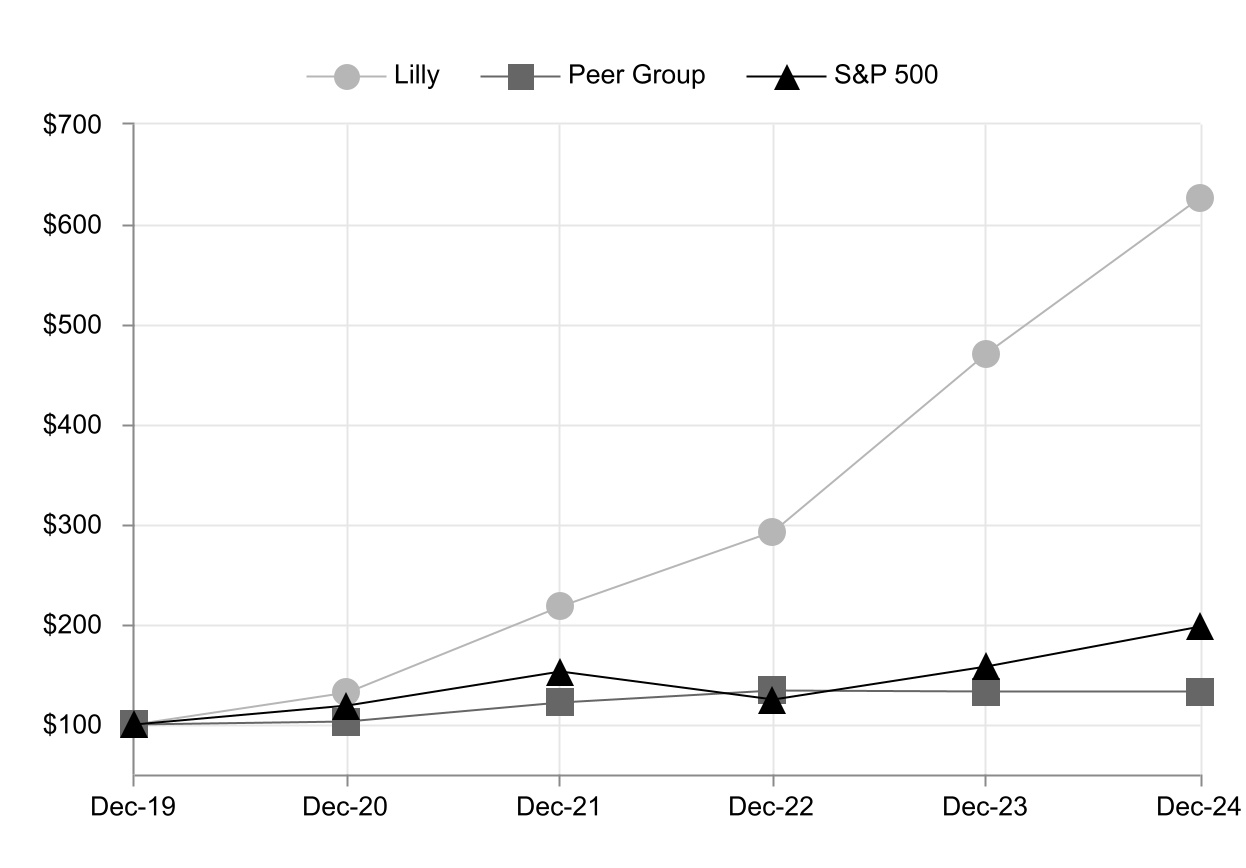
| Lilly | Peer Group | S&P 500 | ||||||||||||||||||
| Dec-19 | $ | 100.00 | $ | 100.00 | $ | 100.00 | ||||||||||||||
| Dec-20 | 131.06 | 102.07 | 118.40 | |||||||||||||||||
| Dec-21 | 217.66 | 121.90 | 152.39 | |||||||||||||||||
| Dec-22 | 292.18 | 133.61 | 124.79 | |||||||||||||||||
| Dec-23 | 470.13 | 132.57 | 157.59 | |||||||||||||||||
| Dec-24 | 626.69 | 132.19 | 197.02 | |||||||||||||||||
(1) We constructed the peer group as the industry index for this graph. It is comprised of the following companies in the pharmaceutical and biotechnology industries: AbbVie Inc.; Amgen Inc.; AstraZeneca PLC; Biogen Inc.; Bristol-Myers Squibb Company; Gilead Sciences Inc.; GlaxoSmithKline plc; Johnson & Johnson; Merck & Co., Inc.; Novartis AG; Novo Nordisk A/S; Pfizer Inc.; Roche Holding AG; Sanofi S.A.; and Takeda Pharmaceutical Company Limited. The peer group used for performance benchmarking aligns with the peer group used for executive compensation purposes for 2024.
40
Item 6. [Reserved]
Item 7.Management's Discussion and Analysis of Results of Operations and Financial Condition
(Tables present dollars in millions, except per-share data)
General
Management's discussion and analysis of results of operations and financial condition is intended to assist the reader in understanding and assessing significant changes and trends related to our results of operations and financial position. This discussion and analysis should be read in conjunction with Item 8, "Financial Statements and Supplementary Data." Certain statements in this Item 7 constitute forward-looking statements. Various risks and uncertainties, including those discussed in "Forward-Looking Statements" and Item 1A, "Risk Factors," may cause our actual results, financial position, and cash generated from operations to differ from these forward-looking statements.
EXECUTIVE OVERVIEW
This section provides an overview of our financial results, our clinical development pipeline, and other matters affecting our company and industry.
Financial Results
The following table summarizes certain financial information:
Year Ended December 31, | Percent Change | ||||||||||||||||
| 2024 | 2023 | ||||||||||||||||
| Revenue | $ | 45,042.7 | $ | 34,124.1 | 32 | ||||||||||||
| Net income | 10,590.0 | 5,240.4 | 102 | ||||||||||||||
| Earnings per share - diluted | 11.71 | 5.80 | 102 | ||||||||||||||
Revenue increased in 2024 driven by increased volume and, to a lesser extent, higher realized prices. The increase in revenue in 2024 was primarily driven by Mounjaro, Zepbound, and Verzenio, partially offset by Trulicity.
Net income and earnings per share increased in 2024, primarily due to higher gross margin, partially offset by increased research and development expenses, marketing, selling, and administrative expenses, and asset impairment, restructuring, and other special charges.
See "Results of Operations" for additional information.
41
Clinical Development Pipeline
Our long-term success depends on our ability to continually discover or acquire, develop, and commercialize innovative medicines. We currently have approximately 55 new medicine candidates in clinical development or under regulatory review, and a larger number of projects in the discovery phase.
The following select new molecular entities (NMEs) and new indication line extension (NILEX) products are currently in Phase 2 or Phase 3 clinical trials or have been submitted for regulatory review or have recently received regulatory approval in the United States (U.S.), European Union (EU), or Japan. The table reflects the status of these NMEs and NILEX products, including certain other developments, up to the time of the filing of this Annual Report on Form 10-K:
| Compound | Indication/Study | Status | Developments | ||||||||
Cardiometabolic Health | |||||||||||
Tirzepatide (Mounjaro, Zepbound) | Obesity | Approved | Approved in the U.S. and the EU in 2023 and in Japan in 2024. Phase 3 trials are ongoing. | ||||||||
Obstructive sleep apnea (OSA) | Approved | Approved in the U.S. and the EU in 2024. | |||||||||
| Heart failure with preserved ejection fraction | Submitted | Submitted in the U.S. and the EU in 2024. | |||||||||
Cardiovascular outcomes in type 2 diabetes | Phase 3 | Phase 3 trial is ongoing. | |||||||||
Morbidity and mortality in obesity | Phase 3 | Phase 3 trial is ongoing. | |||||||||
Higher doses | Phase 2 | Phase 2 trial is ongoing. | |||||||||
Metabolic dysfunction-associated steatohepatitis | Phase 2 | Announced in 2024 that a Phase 2 trial met the primary endpoint. | |||||||||
| Insulin Efsitora Alfa | Type 1 and type 2 diabetes | Phase 3 | Announced in 2024 that five Phase 3 trials met the primary endpoints. | ||||||||
| Lepodisiran | Atherosclerotic cardiovascular disease | Phase 3 | Phase 3 trial initiated in 2024. | ||||||||
| Orforglipron | Obesity | Phase 3 | Phase 3 trials are ongoing. | ||||||||
| OSA | Phase 3 | Phase 3 trials initiated in 2024. | |||||||||
| Type 2 diabetes | Phase 3 | Phase 3 trials are ongoing. | |||||||||
| Retatrutide | Cardiovascular / renal outcomes | Phase 3 | Phase 3 trials initiated in 2024. | ||||||||
Obesity, osteoarthritis, OSA | Phase 3 | Phase 3 trials are ongoing. | |||||||||
| Type 2 diabetes | Phase 3 | Phase 3 trials initiated in 2024. | |||||||||
| Bimagrumab | Obesity | Phase 2 | Phase 2 trial is ongoing. | ||||||||
| Eloralintide | Obesity | Phase 2 | Phase 2 trial initiated in 2024. | ||||||||
| GLP-1R NPA II | Obesity | Phase 2 | Phase 2 trial initiated in 2024. | ||||||||
| Mazdutide | Obesity | Phase 2 | Phase 2 trial is ongoing. | ||||||||
| Muvalaplin | Cardiovascular disease | Phase 2 | Announced in 2024 that a Phase 2 trial met the primary and secondary endpoints. | ||||||||
| Solbinsiran | Cardiovascular disease | Phase 2 | Phase 2 trial is ongoing. | ||||||||
| Volenrelaxin | Heart failure | Discontinued | In 2025, Phase 2 trial was discontinued based on clinical data readout. | ||||||||
42
| Compound | Indication/Study | Status | Developments | ||||||||
| Immunology | |||||||||||
| Mirikizumab (Omvoh) | Crohn's disease | Approved | Approved in the U.S. and the EU in 2025. Submitted in Japan in 2024. | ||||||||
Lebrikizumab(1) | AR (perennial allergens) | Phase 3 | Phase 3 trial initiated in 2024. | ||||||||
CRSwNP | Phase 3 | Phase 3 trial initiated in 2024. | |||||||||
CD19 Antibody | Multiple sclerosis | Phase 2 | Phase 2 trial initiated in 2024. | ||||||||
| Eltrekibart | Hidradenitis suppurativa | Phase 2 | Phase 2 trial is ongoing. | ||||||||
| Ulcerative colitis | Phase 2 | Phase 2 trial initiated in 2024. | |||||||||
KV1.3 Antagonist | Psoriasis | Phase 2 | Phase 2 trial initiated in 2024. | ||||||||
| MORF-057 | Crohn's disease | Phase 2 | Acquired in the acquisition of Morphic Holding, Inc. (Morphic) in 2024. Phase 2 trials are ongoing. | ||||||||
| Ulcerative colitis | Phase 2 | ||||||||||
| Ocadusertib | Rheumatoid arthritis | Phase 2 | Phase 2 trial is ongoing. | ||||||||
| Simepdekinra (DC-853) | Psoriasis | Phase 2 | Phase 2 trial initiated in 2024. | ||||||||
| Ucenprubart | Atopic dermatitis | Discontinued | In 2024, Phase 2 trial was discontinued based on clinical data readout. | ||||||||
| Neuroscience | |||||||||||
| Donanemab (Kisunla) | Early Alzheimer's disease | Approved | Approved in the U.S. and Japan in 2024. Submitted in the EU in 2023. Phase 3 trials are ongoing. | ||||||||
Pre-clinical Alzheimer's disease | Phase 3 | Phase 3 trial is ongoing. | |||||||||
| Remternetug | Early Alzheimer's disease | Phase 3 | Phase 3 trials are ongoing. | ||||||||
| Epiregulin Ab | Pain | Phase 2 | Phase 2 trial initiated in 2024. | ||||||||
| GBA1 Gene Therapy | Gaucher disease Type 1 | Phase 2 | Phase 2 trial is ongoing. | ||||||||
| Parkinson's disease | Phase 2 | Granted U.S. Food and Drug Administration (FDA) Fast Track designation(2). Phase 2 trial is ongoing. | |||||||||
| GRN Gene Therapy | Frontotemporal dementia | Phase 2 | Granted FDA Fast Track designation(2). Phase 2 trial is ongoing. | ||||||||
| Mazisotine | Pain | Phase 2 | Phase 2 trials are ongoing. | ||||||||
OTOF Gene Therapy | Hearing loss | Phase 2 | Phase 2 trial initiated in 2024. | ||||||||
| P2X7 Inhibitor | Pain | Phase 2 | Phase 2 trials were completed in 2023. | ||||||||
O-GlcNAcase Inh | Alzheimer's disease | Discontinued | In 2024, Phase 2 trial was discontinued based on clinical data readout. | ||||||||
43
| Compound | Indication/Study | Status | Developments | ||||||||
| Oncology | |||||||||||
Pirtobrutinib (Jaypirca) | Chronic lymphocytic leukemia | Approved(3) | FDA granted accelerated approval(3) in the U.S. in 2023. Submitted in the EU and Japan in 2024. Phase 3 trials are ongoing. | ||||||||
| Mantle cell lymphoma | Approved(3) | FDA granted accelerated approval(3) in the U.S. in 2023. Approved in the EU in 2023 and in Japan in 2024. Phase 3 trial is ongoing. | |||||||||
| Imlunestrant | ER+HER2- metastatic breast cancer | Submitted | Submitted in the U.S., the EU, and Japan in 2024. | ||||||||
| Adjuvant breast cancer | Phase 3 | Phase 3 trial is ongoing. | |||||||||
| Olomorasib | 1L KRAS G12C+ NSCLC | Phase 3 | Phase 3 trial initiated in 2024. | ||||||||
(1) In collaboration with Almirall, S.A. in Europe.
(2) Fast Track designation is designed to facilitate the development and expedite the review of medicines to treat serious conditions and fill an unmet medical need.
(3) Continued approval may be contingent on verification and description of clinical benefit in confirmatory Phase 3 trials.
There are many difficulties and uncertainties inherent in pharmaceutical research and development, the introduction of new products and indications, business development activities to enhance or refine our product pipeline, and commercialization of our products. There is a high rate of failure inherent in drug discovery and development. To bring a product from the discovery phase to market takes considerable time and entails significant cost. See Item 1A, "Risk Factors—Risks Related to Our Business and Industry—Pharmaceutical research and development is very costly and highly uncertain; we may not succeed in developing, licensing, or acquiring commercially successful products sufficient in number or value to replace revenues of products that have lost or will lose intellectual property protection or are displaced by competing products or therapies," for additional information.
We manage research and development spending across our portfolio of potential new medicines and indications. A delay in, or termination of, any one project will not necessarily cause a significant change in our total research and development spending. Due to the risks and uncertainties involved in the research and development process, we cannot reliably estimate the nature, timing, and costs of the efforts necessary to complete the development of our research and development projects, nor can we reliably estimate the future potential revenue that will be generated from any successful research and development project. Each project represents only a portion of the overall pipeline, and none is individually material to our consolidated research and development expense. While we do accumulate certain research and development costs on a project level for internal reporting purposes, we must make significant cost estimations and allocations, some of which rely on data that are neither reproducible nor validated through accepted control mechanisms. Therefore, we do not have sufficiently reliable data to report on total research and development costs by project, by pre-clinical versus clinical spend, or by therapeutic category.
Other Matters
Patent Matters
We depend on patents or other forms of intellectual property protection for most of our revenue, cash flows, and earnings.
See Note 16 to the consolidated financial statements for a description of legal proceedings currently pending regarding certain of our patents.
See Item 1, "Business—Patents, Trademarks, and Other Intellectual Property Rights," for a discussion of the impacts of trends involving intellectual property on our business and results.
44
Trends Affecting Pharmaceutical Pricing, Reimbursement, and Access and Certain Other Regulatory Developments
Reforms, including those that may stem from political initiatives, periods of uneven economic growth or downturns, or as a result of inflation or deflation, the emergence or escalation of, and responses to, international tension and conflicts, or government budgeting priorities, are expected to continue to result in added pressure on pricing and reimbursement for our products.
Global concern over access to, and affordability of, pharmaceutical products continues to drive regulatory and legislative debate and action, as well as cost containment efforts by governmental authorities. Such measures include the use of mandated discounts, price reporting requirements, mandated reference prices, restrictive formularies, changes to available intellectual property protections, as well as other efforts. In 2022, the U.S. government enacted the Inflation Reduction Act of 2022 (IRA). Among other measures, the IRA requires the U.S. Department of Health and Human Services (HHS) to effectively set prices for certain single-source drugs and biologics reimbursed under Medicare Part B and Part D. Generally, these government prices apply beginning at nine years (for medicines approved under a New Drug Application) or thirteen years (for medicines approved under a Biologics License Application) following FDA approval or licensure for the molecule and are set at a price that generally represents a significant discount from existing prices to wholesalers and direct purchasers. While the law specifies a maximum price that HHS can set, it does not set a minimum price. The Medicare price HHS determines may impact the product's best price determination under the Medicaid Drug Rebate Program and the 340B Drug Pricing Program, potentially leading to a negative impact on both Medicaid and 340B prices. In August 2023, HHS selected Jardiance, which is part of our collaboration with Boehringer Ingelheim, as one of the first ten medicines subject to government-set prices effective in 2026. In August 2024, HHS announced the government-set prices for these medicines with Jardiance subject to a 66% discount compared to the 2023 U.S. calendar year list price for a 30-day supply and discounts for the other nine medicines ranging from approximately 38% to 79% below list price. Given our product portfolio, we expect additional significant products will be selected in future years, which would have the effect of accelerating revenue erosion prior to expiry of exclusivities. The effect of reducing prices and reimbursement for certain of our products could significantly impact our business and consolidated results of operations.
Other IRA provisions require drug manufacturers to provide rebates for Medicare Part B and Part D medicines under certain circumstances. Also, on January 1, 2025, the Part D benefit redesign replaced the Part D Coverage Gap Discount Program with a new manufacturer discount program. Manufacturers that fail to comply with the IRA may be subject to various penalties, including civil monetary penalties, which could be significant.
The IRA has, and will continue to, meaningfully influence our business strategies and those of our competitors. In particular, the nine-year timeline to set prices for medicines approved under a New Drug Application reduces the attractiveness of investment in small molecule innovation. The IRA can cause changes to development approach and timing and investments at-risk. The full impact of the IRA on our business and the pharmaceutical industry, including the implications to us of a competitor's product being selected for price setting, remains uncertain.
Additional policies, regulations, legislation, or enforcement, including those proposed or pursued by lawmakers, regulators, and other authorities in the U.S. and worldwide, could adversely impact our business and consolidated results of operations. For example, the U.S. House of Representatives recently passed the BIOSECURE Act, which is under consideration in the U.S. Senate. This legislation, if passed, could affect elements of the pharmaceutical supply chain; although as currently drafted we do not anticipate the bill would have a material impact on our business.
45
Consolidation and integration of private payers and pharmacy benefit managers in the U.S. has also significantly impacted the market for pharmaceuticals by increasing payer leverage in negotiating manufacturer price or rebate concessions and pharmacy reimbursement rates. Furthermore, restrictive or unfavorable pricing, coverage, or reimbursement determinations for our medicines or product candidates by governments, regulatory agencies, courts, or private payers may adversely impact our business and consolidated results of operations. We expect that these actions may intensify and could particularly affect certain products, which could adversely affect our business. In addition, we are engaged in litigation and investigations related to the 340B program, access to insulin, pricing, product safety, and other matters that, if resolved adversely to us, could negatively impact our business and consolidated results of operations. It is not currently possible to predict the overall potential adverse impact to us or the general pharmaceutical industry of continued cost containment efforts worldwide.
In addition, regulatory issues concerning compliance with current Good Manufacturing Practices, quality assurance, safety signals, evolving standards, and increased scrutiny around excipients and potential impurities such as nitrosamines, and similar regulations and standards (and comparable foreign regulations and standards) for our products in some cases lead to regulatory and legal actions, product recalls and seizures, fines and penalties, interruption of production leading to product shortages, import bans or denials of import certifications, inability to realize the benefit of capital expenditures, or delays or denials in new product approvals, line extensions or supplemental approvals of current products pending resolution of the issues, or other negative impacts, any of which result in reputational harm or adversely affect our business.
See Item 1, "Business—Regulations and Private Payer Actions Affecting Pharmaceutical Pricing, Reimbursement, and Access," Item 1A, "Risk Factors," and Note 16 to the consolidated financial statements for additional information.
Incretin Medicines
At various times during 2024, demand for our incretin medicines exceeded production. Supply and channel dynamics have also contributed to variability in quarter-over-quarter revenue growth rates for tirzepatide. Tirzepatide supply currently exceeds demand in the U.S. Demand in launched markets remains dynamic, and increases or changes in demand, by dose or overall, as well as the complex supply chain, may result in periodic unavailability of certain presentations and dose levels at certain locations even when total tirzepatide supply can meet demand. Supply considerations will continue to influence the timing and approach (including available presentations) of tirzepatide launches in new markets. We continue to expand manufacturing capacity and progress efforts to bring tirzepatide to patients via different delivery presentations, such as single-use vials and multi-use pens. Production increases will continue, and additional capacity is expected to be operational over the next several years.
We have seen an increase in the production, marketing, and sale of counterfeit, misbranded, adulterated, and compounded incretins. These practices may impact patient safety and undermine regulatory drug approval processes. Lilly will continue to consider all options, including filing lawsuits where appropriate, to address unlawful practices and the patient safety risks of unapproved, untested, and manipulated drugs.
See Item 1, "Business—Government Regulation of Our Operations and Products” and Item 1A, "Risk —Risks Related to Our Business and Industry—We and our products face intense competition, including from multinational pharmaceutical companies, biotechnology companies, and lower-cost generic and biosimilar manufacturers, and such competition could have a material adverse effect on our business," for additional information.
46
Tax Matters
We are subject to income taxes and various other taxes in the U.S. and in many foreign jurisdictions; therefore, changes in both domestic and international tax laws or regulations have affected and may affect our effective tax rate, results of operations, and cash flows. The U.S. and countries around the world are actively proposing and enacting tax law changes. Further, actions taken with respect to tax-related matters by associations such as the Organisation for Economic Co-operation and Development (OECD) and the European Commission could influence tax laws in countries in which we operate. Tax authorities in the U.S. and other jurisdictions in which we do business routinely examine our tax returns and are expected to increase their scrutiny of cross-border tax issues. Changes to existing U.S. and foreign tax laws and increased scrutiny by tax authorities in the U.S. and other jurisdictions could have a material adverse impact our future consolidated results of operations and cash flows.
Effective January 1, 2024, several EU and non-EU countries enacted legislation (known as "Pillar Two") that provided for a minimum level of taxation of multinational companies. The increase to income tax expense as a result of the global minimum tax was not material in 2024 and is not expected to be material in current and future years. Our assessment of the impact for 2025 and subsequent years could be affected by legislative guidance and future enactment of additional provisions.
Acquisitions
We invest in external research and technologies and manufacturing capabilities that we believe complement and strengthen our own efforts. These investments can take many forms, including acquisitions, collaborations, investments, and licensing arrangements. We view our business development activity as a way to enhance or refine our pipeline and strengthen our business.
See Note 3 to the consolidated financial statements for further discussion regarding our recent acquisitions.
Continued regulatory focus on business combinations in our industry, including by the Federal Trade Commission and competition authorities in Europe and other jurisdictions, could continue to delay, jeopardize, or increase the costs of our business development activities and may negatively impact our consolidated financial position or results of operations. For discussion of risks related to business development activities, see Item 1A, "Risk Factors—Risks Related to Our Business and Industry—Pharmaceutical research and development is very costly and highly uncertain; we may not succeed in developing, licensing, or acquiring commercially successful products sufficient in number or value to replace revenues of products that have lost or will lose intellectual property protection or are displaced by competing products or therapies."
Foreign Currency Exchange Rates
As a global company, we face foreign currency risk exposure from fluctuating currency exchange rates, primarily the U.S. dollar against the euro, Japanese yen, and Chinese yuan. While we seek to manage a portion of these exposures through hedging and other risk management techniques, significant fluctuations in currency rates can have a material impact, either positive or negative, on our consolidated results of operations in any given period. There is uncertainty in the future movements in foreign currency exchange rates, and fluctuations in these rates have and could adversely impact our consolidated results of operations and cash flows.
Other Factors
Other factors have had, and may continue to have, an impact on our consolidated results of operations. These factors include cost and wage inflation, supply chain and labor market complexities, international tension and conflicts, uneven economic growth or downturns or uncertainty, and an increase in overall demand in our industry for certain products and materials.
See Item 1A, "Risk Factors," for additional information on risk factors that could impact our business and operations.
47
RESULTS OF OPERATIONS
Operating Results—2024
Revenue
The following table summarizes our revenue activity by region:
| Year Ended December 31, | |||||||||||||||||
| 2024 | 2023 | Percent Change | |||||||||||||||
| U.S. | $ | 30,375.2 | $ | 21,791.0 | 39 | ||||||||||||
| Outside U.S. | 14,667.5 | 12,333.1 | 19 | ||||||||||||||
| Revenue | $ | 45,042.7 | $ | 34,124.1 | 32 | ||||||||||||
Numbers may not add due to rounding.
The following are components of the change in revenue compared with the prior year:
2024 vs. 2023 | |||||||||||
| U.S. | Outside U.S. | Consolidated | |||||||||
| Volume | 31 | % | 20 | % | 27 | % | |||||
| Price | 8 | % | — | % | 5 | % | |||||
| Foreign exchange rates | — | % | (1) | % | — | % | |||||
| Percent change | 39 | % | 19 | % | 32 | % | |||||
Numbers may not add due to rounding.
In the U.S. the increase in volume in 2024 was primarily driven by Zepbound and Mounjaro, partially offset by Trulicity. In the U.S. the higher realized prices in 2024 were primarily driven by Humalog, Mounjaro, Verzenio, and Zepbound.
Outside the U.S. the increase in volume in 2024 was primarily driven by Mounjaro and, to a lesser extent, Verzenio, as well as a one-time payment received of $300.0 million related to Jardiance associated with an amendment to our collaboration with Boehringer Ingelheim. Outside the U.S. the increase in volume in 2024 was partially offset by the 2023 sale of rights for the olanzapine portfolio.
48
The following table summarizes our revenue, including net product revenue and collaboration and other revenue, by product in 2024 compared with 2023:
| Year Ended December 31, | |||||||||||||||||||||||||||||
| 2024 | 2023 | Percent Change | |||||||||||||||||||||||||||
| U.S. | Outside U.S. | Total | Total | ||||||||||||||||||||||||||
| Mounjaro | $ | 8,949.9 | $ | 2,590.2 | $ | 11,540.1 | $ | 5,163.1 | 124 | ||||||||||||||||||||
| Verzenio | 3,420.6 | 1,886.0 | 5,306.6 | 3,863.4 | 37 | ||||||||||||||||||||||||
| Trulicity | 3,693.8 | 1,559.7 | 5,253.5 | 7,132.6 | (26) | ||||||||||||||||||||||||
| Zepbound | 4,925.7 | — | 4,925.7 | 175.8 | NM | ||||||||||||||||||||||||
Jardiance(1) | 1,597.5 | 1,743.4 | 3,340.9 | 2,744.7 | 22 | ||||||||||||||||||||||||
| Taltz | 2,152.3 | 1,108.1 | 3,260.4 | 2,759.6 | 18 | ||||||||||||||||||||||||
Humalog(2) | 1,502.6 | 822.2 | 2,324.8 | 1,663.3 | 40 | ||||||||||||||||||||||||
| Cyramza | 442.2 | 531.0 | 973.3 | 974.7 | — | ||||||||||||||||||||||||
Olumiant | 228.7 | 728.7 | 957.4 | 922.6 | 4 | ||||||||||||||||||||||||
| Humulin | 643.4 | 273.7 | 917.1 | 852.1 | 8 | ||||||||||||||||||||||||
| Emgality | 559.7 | 310.7 | 870.4 | 678.3 | 28 | ||||||||||||||||||||||||
Basaglar(3) | 375.4 | 301.5 | 676.9 | 728.3 | (7) | ||||||||||||||||||||||||
| Erbitux | 562.1 | 65.3 | 627.4 | 596.5 | 5 | ||||||||||||||||||||||||
| Tyvyt | — | 526.0 | 526.0 | 393.4 | 34 | ||||||||||||||||||||||||
Zyprexa(4) | 2.0 | 114.3 | 116.3 | 1,694.8 | (93) | ||||||||||||||||||||||||
| Baqsimi | 2.5 | 26.7 | 29.1 | 677.6 | (96) | ||||||||||||||||||||||||
| Other products | 1,316.8 | 2,080.0 | 3,396.8 | 3,103.3 | 9 | ||||||||||||||||||||||||
| Revenue | $ | 30,375.2 | $ | 14,667.5 | $ | 45,042.7 | $ | 34,124.1 | 32 | ||||||||||||||||||||
Numbers may not add due to rounding.
NM - not meaningful
(1) Jardiance revenue includes Glyxambi, Synjardy, and Trijardy XR.
(2) Humalog revenue includes insulin lispro.
(3) Basaglar revenue includes Rezvoglar.
(4) Zyprexa revenue includes sale of the rights for the olanzapine portfolio in 2023.
Revenue of Mounjaro increased 85 percent in the U.S., primarily driven by strong demand and increased supply. Revenue outside of the U.S. was $2.59 billion in 2024 compared to $328.9 million in 2023, primarily driven by volume growth in launched markets.
Revenue of Verzenio increased 36 percent in the U.S., driven by increased demand, wholesaler buying patterns and, to a lesser extent, higher realized prices. Revenue outside the U.S. increased 39 percent, driven by increased demand.
Revenue of Trulicity decreased 32 percent in the U.S., driven by decreased volume primarily due to competitive dynamics and supply constraints during the first half of 2024. Revenue outside the U.S. decreased 8 percent, driven by decreased volume primarily due to competitive dynamics and actions we have taken to manage demand.
Revenue of Zepbound in the U.S. in 2024 was $4.93 billion, compared to $175.8 million in 2023. Zepbound launched in the U.S. for the treatment of adult patients with obesity or overweight with weight-related comorbidities in November 2023.
Revenue of Jardiance remained relatively flat in the U.S. as increased demand was offset by lower realized prices. Revenue outside the U.S. increased 52 percent, driven by increased volume and a one-time payment received of $300.0 million associated with an amendment to our collaboration with Boehringer Ingelheim. Pursuant to the amendment, we and Boehringer Ingelheim adjusted commercialization responsibilities for Jardiance within certain smaller markets. See Note 4 to the consolidated financial statements for information regarding our collaboration with Boehringer Ingelheim involving Jardiance.
Revenue of Taltz increased 18 percent in the U.S., driven by higher realized prices due to changes in estimates for rebates and discounts, as well as increased demand. Revenue outside the U.S. increased 19 percent, primarily driven by increased demand.
49
Gross Margin, Costs, and Expenses
The following table summarizes our gross margin, costs, and expenses:
Year Ended December 31, | Percent Change | ||||||||||||||||
| 2024 | 2023 | ||||||||||||||||
| Gross margin | $ | 36,624.4 | $ | 27,041.9 | 35 | ||||||||||||
| Gross margin as a percent of revenue | 81.3 | % | 79.2 | % | |||||||||||||
| Research and development | $ | 10,990.6 | $ | 9,313.4 | 18 | ||||||||||||
| Marketing, selling, and administrative | 8,593.8 | 7,403.1 | 16 | ||||||||||||||
Acquired in-process research and development | 3,280.4 | 3,799.8 | (14) | ||||||||||||||
| Asset impairment, restructuring, and other special charges | 860.6 | 67.7 | NM | ||||||||||||||
| Other—net, (income) expense | 218.6 | (96.7) | NM | ||||||||||||||
| Income taxes | 2,090.4 | 1,314.2 | 59 | ||||||||||||||
| Effective tax rate | 16.5 | % | 20.1 | % | |||||||||||||
NM - not meaningful
Gross margin as a percent of revenue in 2024 increased 2.1 percentage points compared with 2023, primarily driven by favorable product mix and higher realized prices.
Research and development expenses increased 18 percent in 2024, primarily driven by continued investments in our early and late-stage portfolio.
Marketing, selling, and administrative expenses increased 16 percent in 2024, primarily driven by promotional efforts supporting ongoing and future launches.
Acquired in-process research and development (IPR&D) charges recognized in 2024 primarily related to the acquisition of Morphic. Acquired IPR&D charges recognized in 2023 primarily related to acquisitions of DICE Therapeutics, Inc., Versanis Bio, Inc., Emergence Therapeutics AG, and Mablink Biosciences SAS and from a business development transaction with Beam Therapeutics Inc. See Note 3 to the consolidated financial statements for additional information.
Asset impairment, restructuring, and other special charges recognized in 2024 primarily related to a $435.0 million litigation charge and an intangible asset impairment for Vitrakvi, driven by expected commercial projections. See Notes 5 and 16 to the consolidated financial statements for additional information.
Our effective tax rate was 16.5 percent in 2024, compared with an effective tax rate of 20.1 percent in 2023. The effective tax rates for 2024 and 2023 were both unfavorably impacted by non-deductible acquired IPR&D charges, with a larger impact occurring in 2023. See Note 14 to the consolidated financial statements for additional information.
For additional information for other–net, (income) expense, see Note 18 to the consolidated financial statements.
Operating Results—2023
For a discussion of our results of operations pertaining to 2023 and 2022 see Item 7, "Management's Discussion and Analysis of Results of Operations and Financial Condition" in our Annual Report on Form 10-K for the year ended December 31, 2023.
50
FINANCIAL CONDITION AND LIQUIDITY
We believe our available cash and cash equivalents, together with our ability to generate operating cash flow and our access to short-term and long-term borrowings, are sufficient to fund our existing and planned capital requirements, which include:
•working capital requirements, including related to employee payroll and benefits, clinical trials, manufacturing materials, and taxes;
•capital expenditures;
•share repurchases and dividends;
•repayment of outstanding short-term and long-term borrowings;
•milestone and royalty payments;
•potential business development activities, including acquisitions, collaborations, investments, and licensing arrangements; and
•contributions to our defined benefit pension and retiree health benefit plans.
Our management continuously evaluates our liquidity and capital resources, including our access to external capital, to ensure we can adequately and efficiently finance our capital requirements. As of December 31, 2024, our material cash requirements primarily related to purchases of goods and services to produce our products and conduct our operations, income tax payments, capital expenditures, dividends, milestone and royalty payments, business development activities, share repurchases and repayment of outstanding borrowings (see Notes 14, 4, 3, 13, and 11 to the consolidated financial statements). We anticipate our cash requirements related to ordinary course purchases of goods and services will be consistent with our past levels relative to revenues.
Capital expenditures were $5.06 billion during 2024, compared to $3.45 billion in 2023. We are making investments in global facilities to manufacture existing and future products. These investments, and other capital investments that support our operations, have increased our capital expenditures and will result in meaningfully higher capital expenditures over the next several years.
As we expand our manufacturing capacity in order to meet existing and expected demand of our medicines, we have entered, and expect to continue to enter, into various agreements for contract manufacturing and for supply of materials. The executed agreements could, under certain circumstances, require us to pay up to approximately $14 billion if we do not purchase specified amounts of goods or services primarily related to our incretin medicines, including medicines in development, over the durations of the agreements, which are generally up to 8 years.
Cash and cash equivalents increased to $3.27 billion as of December 31, 2024, compared with $2.82 billion at December 31, 2023. Net cash provided by operating activities increased to $8.82 billion in 2024, compared with $4.24 billion in 2023. Refer to the consolidated statements of cash flows for additional information on the significant sources and uses of cash for the years ended December 31, 2024 and 2023.
In addition to our cash and cash equivalents, we held total investments of $3.37 billion and $3.16 billion as of December 31, 2024 and 2023, respectively. See Note 7 to the consolidated financial statements for additional information.
We paid $3.35 billion in 2024 for acquired IPR&D primarily related to the acquisition of Morphic. We paid $947.7 million in 2024 primarily related to the acquisition of a manufacturing site in Wisconsin. See Note 3 to the consolidated financial statements for additional information.
As of December 31, 2024, total debt was $33.64 billion, an increase of $8.42 billion compared with $25.23 billion at December 31, 2023. In February 2025, we issued $6.5 billion of fixed-rate notes. We expect to use the net cash proceeds from the offering to fund potential business development activities, as well as general business purposes, including the repayment of outstanding commercial paper. See Note 11 to the consolidated financial statements for additional information.
51
As of December 31, 2024, we had a total of $8.45 billion of unused committed bank credit facilities, $8.00 billion of which is available to support our commercial paper program. See Note 11 to the consolidated financial statements for additional information. We believe that amounts accessible through existing commercial paper markets should be adequate to fund short-term borrowing needs.
Dividends of $5.20 per share and $4.52 per share were paid in 2024 and 2023, respectively. The quarterly dividend was increased to $1.50 per share effective for the dividend to be paid in the first quarter of 2025, resulting in an indicated annual rate for 2025 of $6.00 per share.
In 2024, we repurchased $2.50 billion of shares, which completed our $5.00 billion share repurchase program that our board authorized in May 2021. Our board authorized a $15.00 billion share repurchase program in December 2024. No shares were repurchased under this new program as of December 31, 2024. See Note 13 to the consolidated financial statements for additional information.
See "—Executive Overview—Other Matters—Patent Matters" for information regarding losses of patent protection.
Both domestically and abroad, we monitor the potential impacts of the economic environment and international tension and conflicts; the creditworthiness of our wholesalers and other customers, including foreign government-backed agencies and suppliers; the uncertain impact of healthcare legislation; and various international government funding levels.
In the normal course of business, our operations are exposed to fluctuations in interest rates, currency values, and fair values of equity securities. These fluctuations impact the costs of financing, investing, and operating our business. We seek to address a portion of these risks through a controlled program of risk management that includes the use of derivative financial instruments. The objective of this risk management program is to limit the impact on earnings of fluctuations in interest and currency exchange rates. All derivative activities are for purposes other than trading.
Our primary interest rate risk exposure results from changes in short-term U.S. dollar interest rates. In an effort to manage interest rate exposures, we strive to achieve an acceptable balance between fixed and floating rate debt positions and in some cases we enter into interest rate derivatives to help maintain that balance. As of December 31, 2024, all of our total long-term debt is at a fixed rate. We have converted approximately 5 percent of our long-term fixed-rate notes to floating rates through the use of interest rate swaps. Based on our overall interest rate exposure at December 31, 2024 and 2023, including derivatives and other interest rate risk-sensitive instruments, a hypothetical 10 percent change in interest rates applied to the fair value of the instruments as of December 31, 2024 and 2023, respectively, would not have a material impact on earnings, cash flows, or fair values of interest rate risk-sensitive instruments over a one-year period.
Our foreign currency risk exposure results from fluctuating currency exchange rates, primarily the U.S. dollar against the euro, Japanese yen, and Chinese yuan. We face foreign currency exchange exposures when we enter into transactions arising from subsidiary trade and loan payables and receivables denominated in foreign currencies. We also face currency exposure that arises from translating the results of our global operations to the U.S. dollar at exchange rates that have fluctuated from the beginning of the period. We in some cases enter into foreign currency forward or option derivative contracts to reduce the effect of fluctuating currency exchange rates (primarily the euro, Chinese yuan, and Japanese yen). Our corporate risk-management policy outlines the minimum and maximum hedge coverage of such exposures. Gains and losses on these derivative contracts offset, in part, the impact of currency fluctuations on the existing assets and liabilities. We periodically analyze the fair values of the outstanding foreign currency derivative contracts to determine their sensitivity to changes in foreign exchange rates. A hypothetical 10 percent change in exchange rates (primarily against the U.S. dollar) applied to the fair values of our outstanding foreign currency derivative contracts as of December 31, 2024 and 2023, would not have a material impact on earnings, cash flows, or financial position over a one-year period. This sensitivity analysis does not consider the impact that hypothetical changes in exchange rates would have on the underlying foreign currency denominated transactions.
Our fair value risk exposure relates primarily to our public equity investments and to our equity investments that do not have readily determinable fair values. As of December 31, 2024 and 2023, our carrying values of these investments were $1.35 billion and $1.32 billion, respectively. A hypothetical 20 percent change in fair value of the equity instruments would have impacted other-net, (income) expense by $269.9 million and $263.9 million as of December 31, 2024 and 2023, respectively.
52
We have no off-balance sheet arrangements that have a material current effect or that are reasonably likely to have a material future effect on our financial condition, changes in financial condition, revenues or expenses, results of operations, liquidity, capital expenditures, or capital resources. We acquire and collaborate on potential products still in development and enter into research and development arrangements with third parties that often require milestone and royalty payments to the third-party contingent upon the occurrence of certain future events linked to the success of the asset in development. Milestone payments may be required contingent upon the successful achievement of an important point in the development life cycle of the pharmaceutical product (e.g., approval for marketing by the appropriate regulatory agency or upon the achievement of certain sales levels). If required by the arrangement, we may make royalty payments based upon a percentage of the sales of the product in the event that regulatory approval for marketing is obtained.
Individually, these arrangements are generally not material in any one annual reporting period. However, if milestones for multiple products covered by these arrangements were reached in the same reporting period, the aggregate expense or aggregate milestone payments made could be material to our results of operations or cash flows, respectively, in that period. See Note 4 to the consolidated financial statements for additional information. These arrangements often give us the discretion to unilaterally terminate development of the product, which would allow us to avoid making the contingent payments; however, we are unlikely to cease development if the compound successfully achieves milestone objectives. We view these payments as positive because they signify that the product is successfully moving through development and is now generating or is more likely to generate cash flows from sales of products.
APPLICATION OF CRITICAL ACCOUNTING ESTIMATES
In preparing our financial statements in accordance with accounting principles generally accepted in the U.S., we must often make estimates and assumptions that affect the reported amounts of assets, liabilities, revenues, expenses, and related disclosures. Some of those judgments can be subjective and complex, and consequently actual results could differ from those estimates. For any given individual estimate or assumption we make, it is possible that other people applying reasonable judgment to the same facts and circumstances could develop different estimates. We believe that, given current facts and circumstances, it is unlikely that applying any such other reasonable judgment would cause a material adverse effect on our consolidated results of operations, financial position, or liquidity for the periods presented in this Annual Report on Form 10-K. Our most critical accounting estimates have been discussed with our audit committee and are described below.
Revenue Recognition and Sales Return, Rebate, and Discount Accruals
Background and Uncertainties
We recognize revenue primarily from two different types of contracts, product sales to customers (net product revenue) and collaborations and other arrangements. For product sales to customers, provisions for returns, rebates and discounts are established in the same period the related product sales are recognized. To determine the appropriate transaction price for our product sales at the time we recognize a sale to a direct customer, we estimate any rebates or discounts that ultimately will be due to the direct customer and other customers in the distribution chain under the terms of our contracts. Significant judgments are required in making these estimates. The largest of our sales rebate and discount amounts include rebates associated with sales covered by managed care, Medicare, Medicaid, and chargeback programs, as well as reductions in revenue related to our patient assistance programs, in the U.S. In determining the appropriate accrual amount, we consider our historical rebate payments for these programs, as well as patient assistance program costs, by product as a percentage of our historical sales as well as any significant changes in sales trends (e.g., patent expiries and product launches), an evaluation of the current contracts for these programs, the percentage of our products that are sold via these programs, and our product pricing. Although we accrue a liability for revenue reductions related to these programs at the time we record the sale, the reduction related to that sale is typically paid up to six months later. Because of this time lag, in any particular period our net product revenue may incorporate revisions of accruals for several periods.
Refer to Note 2 to the consolidated financial statements for further information on revenue recognition and sales return, rebate, and discount accruals.
Revenue recognized from collaborations and other arrangements includes our share of profits from the collaborations, as well as royalties, upfront and milestone payments we receive under these types of contracts.
53
Financial Statement Impact
We believe that our accruals for sales returns, rebates, and discounts are reasonable and appropriate based on current facts and circumstances. Our rebate and discount liabilities are included in sales rebates and discounts on our consolidated balance sheet. Our sales return liability is included in other current liabilities and other noncurrent liabilities on our consolidated balance sheet. As of December 31, 2024, a 5 percent change in our consolidated sales return, rebate, and discount liability would result in a change in revenue of approximately $600 million.
The portion of our consolidated sales return, rebate, and discount liability resulting from sales of our products in the U.S. was approximately 90 percent as of December 31, 2024 and 2023.
The following represents a roll-forward of our most significant U.S. sales return, rebate, and discount liability balances, including managed care, Medicare, Medicaid, chargeback, and patient assistance programs:
| 2024 | 2023 | ||||||||||
| Sales return, rebate, and discount liabilities, beginning of year | $ | 10,667.5 | $ | 8,214.1 | |||||||
Reduction of net sales(1) | 41,452.3 | 37,866.8 | |||||||||
| Cash payments | (41,807.0) | (35,413.4) | |||||||||
| Sales return, rebate, and discount liabilities, end of year | $ | 10,312.8 | $ | 10,667.5 | |||||||
(1) Adjustments of the estimates for these returns, rebates, and discounts to actual results were less than 2 percent of consolidated revenue for each of the years presented.
Litigation Liabilities and Other Contingencies
Background and Uncertainties
Litigation liabilities and other contingencies are, by their nature, uncertain and based upon complex judgments and probabilities. The factors we consider in developing our litigation liability reserves and other contingent liability amounts include the merits and jurisdiction of the litigation, the nature and the number of other similar current and past matters, the nature of the product and the current assessment of the science subject to the litigation, as applicable, and the likelihood of settlement and current state of settlement discussions, if any. In addition, we accrue for certain product liability claims incurred but not filed to the extent we can formulate a reasonable estimate of their costs based primarily on historical claims experience and data regarding product usage.
We also consider the insurance coverage we have to diminish the exposure for periods covered by insurance. In assessing our insurance coverage, we consider the policy coverage limits and exclusions, the potential for denial of coverage by the insurance company, the financial condition of the insurers, and the possibility of and length of time for collection. Due to a very restrictive market for liability insurance, we are predominantly self-insured for liability losses for all our currently and previously marketed products, as well as for litigation or investigations related to our pricing practices or other similar matters. In addition to insurance coverage, we consider any third-party indemnification to which we are entitled or under which we are obligated. With respect to our third-party indemnification rights, these considerations include the nature of the indemnification, the financial condition of the indemnifying party, and the possibility of and length of time for collection.
The litigation accruals and environmental liabilities and the related estimated insurance recoverables are reflected on a gross basis as liabilities and assets, respectively, on our consolidated balance sheets.
54
Acquisitions
Background and Uncertainties
To determine whether acquisitions or licensing transactions should be accounted for as a business combination or as an asset acquisition, we make certain judgments, which include assessing whether the acquired set of activities and assets would meet the definition of a business under the relevant accounting rules.
If the acquired set of activities and assets meets the definition of a business, assets acquired and liabilities assumed are required to be recorded at their respective fair values on our consolidated balance sheet as of the acquisition date. The excess of the purchase price over the fair value of the acquired net assets, where applicable, is recorded as goodwill. If the acquired set of activities and assets does not meet the definition of a business, the transaction is recorded as an acquisition of assets and, therefore, any acquired IPR&D that does not have an alternative future use is charged to acquired IPR&D on our consolidated statement of operations at the acquisition date, and goodwill is not recorded. See Note 3 to the consolidated financial statements for additional information.
The judgments made in determining estimated fair values assigned to assets acquired and liabilities assumed in a business combination, as well as estimated asset lives, can materially affect our consolidated results of operations. The fair values of intangible assets, including acquired IPR&D, are determined using information available near the acquisition date based on estimates and assumptions that are deemed reasonable by management. Significant estimates and assumptions include, but are not limited to, probability of technical success, revenue projections, and discount rate. Depending on the facts and circumstances, we may deem it necessary to engage an independent valuation expert to assist in valuing significant assets and liabilities.
The fair values of identifiable intangible assets are primarily determined using the "income method," as described in Note 8 to the consolidated financial statements.
The fair value of any contingent consideration liability that results from a business combination is primarily determined using a discounted cash flow analysis, as described in Note 7 to the consolidated financial statements. Estimating the fair value of contingent consideration requires the use of significant estimates and judgments, including, but not limited to, probability of technical success, timing of the potential milestone event, and the discount rate.
Financial Statement Impact
As of December 31, 2024, a 5 percent change in the contingent consideration liabilities would result in a change in income before income taxes of $1.6 million.
55
Impairment of Indefinite-Lived and Long-Lived Assets
Background and Uncertainties
We review the carrying value of long-lived assets (both intangible and tangible) for potential impairment whenever events or changes in circumstances indicate the carrying value of an asset (or asset group) may not be recoverable. We identify impairment by comparing the projected undiscounted cash flows to be generated by the asset (or asset group) to its carrying value. If an impairment is identified, a loss is recorded equal to the excess of the asset's net book value over its fair value, and the cost basis is adjusted.
Goodwill and indefinite-lived intangible assets are reviewed for impairment at least annually, or more frequently if impairment indicators are present, by first assessing qualitative factors to determine whether it is more likely than not that the fair value of the asset is less than its carrying amount. If we conclude it is more likely than not that the fair value is less than the carrying amount, a quantitative test that compares the fair value of the intangible asset to its carrying value is performed to determine the amount of any impairment.
Several methods may be used to determine the estimated fair value of long-lived assets, all of which require multiple assumptions. When determining the fair value of indefinite-lived acquired IPR&D as well as the fair value of finite-lived intangible assets for impairment testing purposes, we utilize the "income method," as described in Note 8 to the consolidated financial statements.
For acquired IPR&D assets, the risk of failure has been factored into the fair value measure and there can be no certainty that these assets ultimately will yield a successful product, as discussed previously in "—Executive Overview—Clinical Development Pipeline." The nature of the pharmaceutical business is high-risk and requires that we invest in a large number of projects to maintain a successful portfolio of approved products. As such, it is likely that some acquired IPR&D assets will become impaired in the future.
Estimates of future cash flows, based on what we believe to be reasonable and supportable assumptions and projections, require management's judgment. Actual results could vary materially from these estimates.
Income Taxes
Background and Uncertainties
We file tax returns based upon our interpretation of tax laws and regulations, and we record estimates in our financial statements based upon these interpretations at the applicable tax rates in the jurisdictions in which we operate. Our tax returns are routinely subject to examination by taxing authorities, which could result in future tax, interest, and penalty assessments. Inherent uncertainties also exist in estimates of many tax positions due to the complexity of tax laws. We recognize the tax benefit from an uncertain tax position only if it is more likely than not that the tax position will be sustained upon examination by the taxing authorities, based on the technical merits of the position. The tax benefits recognized in the financial statements from such a position are measured based on the largest benefit that has a greater than 50 percent likelihood of being realized upon ultimate resolution. The amount of unrecognized tax benefits is adjusted for changes in facts and circumstances such as changes to existing tax law, the issuance of regulations by taxing authorities, new information obtained during a tax examination, or resolution of a tax examination. We believe our estimates for uncertain tax positions are both appropriate and sufficient to pay assessments that may result from examinations of our tax returns; however, given the uncertainty of positions that could be taken by taxing authorities during the examinations of our tax returns, the ultimate outcome of any tax matters may result in liabilities that are greater than amounts accrued. We recognize both accrued interest and penalties related to unrecognized tax benefits in income tax expense.
We have recorded valuation allowances against certain of our deferred tax assets, primarily those that have been generated from net operating losses, tax credits, and other tax carryforwards in certain taxing jurisdictions, when the amount of future taxable income is unlikely to support their utilization.
Financial Statement Impact
As of December 31, 2024, a 5 percent change in the amount of uncertain tax positions and the valuation allowance would result in a change in net income of $131.3 million and $48.2 million, respectively.
56
Retirement Benefits Assumptions
Background and Uncertainties
Defined benefit pension plan and retiree health benefit plan costs include assumptions for the discount rate, expected return on plan assets, and retirement age. These assumptions have a significant effect on the amounts reported. In addition to the analysis below, see Note 15 to the consolidated financial statements for additional information regarding our retirement benefits.
Annually, we evaluate the discount rate and the expected return on plan assets in our defined benefit pension and retiree health benefit plans. We use an actuarially determined, plan-specific yield curve of high quality, fixed income debt instruments to determine the discount rates. In evaluating the expected return on plan assets, we consider many factors, with a primary analysis of current and projected market conditions, asset returns and asset allocations (approximately 75 percent of which are growth investments), and the views of leading financial advisers and economists. We may also review our historical assumptions compared with actual results, as well as the discount rates and expected return on plan assets of other companies, where applicable. In evaluating our expected retirement age assumption, we consider the retirement ages of our past employees eligible for pension and medical benefits together with our expectations of future retirement ages.
Financial Statement Impact
If the 2024 discount rate for the U.S. defined benefit pension and retiree health benefit plans (U.S. plans) were to change by a quarter percentage point, income before income taxes would change by $15.0 million. If the 2024 expected return on plan assets for U.S. plans were to change by a quarter percentage point, income before income taxes would change by $33.2 million. If our assumption regarding the 2024 expected age of future retirees for U.S. plans were adjusted by one year, our income before income taxes would be affected by $35.9 million. The U.S. plans, including Puerto Rico, represent approximately 80 percent for total projected benefit obligation and 85 percent for total plan assets at December 31, 2024.
LEGAL AND REGULATORY MATTERS
Information relating to certain legal proceedings can be found in Note 16 to the consolidated financial statements and is incorporated here by reference.
Item 7A.Quantitative and Qualitative Disclosures About Market Risk
You can find quantitative and qualitative disclosures about market risk (e.g., interest rate risk) at Item 7, "Management's Discussion and Analysis - Financial Condition and Liquidity." That information is incorporated by reference herein.
57
Item 8.Financial Statements and Supplementary Data
Consolidated Statements of Operations
ELI LILLY AND COMPANY AND SUBSIDIARIES
(Dollars in millions, except per-share data, and shares in thousands)
| Year Ended December 31, | ||||||||||||||||||||||||||
| 2024 | 2023 | 2022 | ||||||||||||||||||||||||
| Revenue (Note 2) | $ | $ | $ | |||||||||||||||||||||||
| Costs, expenses, and other: | ||||||||||||||||||||||||||
| Cost of sales | ||||||||||||||||||||||||||
| Research and development | ||||||||||||||||||||||||||
| Marketing, selling, and administrative | ||||||||||||||||||||||||||
| Acquired in-process research and development (Note 3) | ||||||||||||||||||||||||||
| Asset impairment, restructuring, and other special charges (Note 5) | ||||||||||||||||||||||||||
| Other—net, (income) expense (Note 18) | ( | |||||||||||||||||||||||||
| Income before income taxes | ||||||||||||||||||||||||||
| Income taxes (Note 14) | ||||||||||||||||||||||||||
| Net income | $ | $ | $ | |||||||||||||||||||||||
| Earnings per share: | ||||||||||||||||||||||||||
| Basic | $ | $ | $ | |||||||||||||||||||||||
| Diluted | $ | $ | $ | |||||||||||||||||||||||
| Shares used in calculation of earnings per share: | ||||||||||||||||||||||||||
| Basic | ||||||||||||||||||||||||||
| Diluted | ||||||||||||||||||||||||||
See notes to consolidated financial statements.
58
Consolidated Statements of Comprehensive Income
ELI LILLY AND COMPANY AND SUBSIDIARIES
(Dollars in millions)
| Year Ended December 31, | ||||||||||||||||||||||||||
| 2024 | 2023 | 2022 | ||||||||||||||||||||||||
| Net income | $ | $ | $ | |||||||||||||||||||||||
| Other comprehensive income (loss): | ||||||||||||||||||||||||||
| Change in foreign currency translation gains (losses) | ( | ( | ( | |||||||||||||||||||||||
| Change in net unrealized gains (losses) on available-for-sale securities | ( | ( | ||||||||||||||||||||||||
Change in retirement benefit plans (Note 15) | ( | |||||||||||||||||||||||||
| Change in net unrealized gains (losses) on cash flow hedges | ||||||||||||||||||||||||||
| Other comprehensive income (loss) before income taxes | ( | |||||||||||||||||||||||||
| Benefit (expense) for income taxes related to other comprehensive income (loss) | ( | ( | ||||||||||||||||||||||||
Other comprehensive income (loss), net of tax (Note 17) | ( | |||||||||||||||||||||||||
| Comprehensive income | $ | $ | $ | |||||||||||||||||||||||
See notes to consolidated financial statements.
59
Consolidated Balance Sheets
ELI LILLY AND COMPANY AND SUBSIDIARIES
(Dollars in millions, shares in thousands)
| December 31, | ||||||||||||||||||||
| 2024 | 2023 | |||||||||||||||||||
| Assets | ||||||||||||||||||||
| Current Assets | ||||||||||||||||||||
| Cash and cash equivalents (Note 7) | $ | $ | ||||||||||||||||||
| Short-term investments (Note 7) | ||||||||||||||||||||
Accounts receivable, net of allowances of $ | ||||||||||||||||||||
| Other receivables | ||||||||||||||||||||
| Inventories (Note 6) | ||||||||||||||||||||
| Prepaid expenses | ||||||||||||||||||||
| Other current assets | ||||||||||||||||||||
| Total current assets | ||||||||||||||||||||
| Investments (Note 7) | ||||||||||||||||||||
| Goodwill (Note 8) | ||||||||||||||||||||
| Other intangibles, net (Note 8) | ||||||||||||||||||||
| Deferred tax assets (Note 14) | ||||||||||||||||||||
| Property and equipment, net (Note 9) | ||||||||||||||||||||
| Other noncurrent assets | ||||||||||||||||||||
| Total assets | $ | $ | ||||||||||||||||||
| Liabilities and Equity | ||||||||||||||||||||
| Current Liabilities | ||||||||||||||||||||
| Short-term borrowings and current maturities of long-term debt (Note 11) | $ | $ | ||||||||||||||||||
| Accounts payable | ||||||||||||||||||||
| Employee compensation | ||||||||||||||||||||
| Sales rebates and discounts | ||||||||||||||||||||
| Dividends payable | ||||||||||||||||||||
| Other current liabilities | ||||||||||||||||||||
| Total current liabilities | ||||||||||||||||||||
| Noncurrent Liabilities | ||||||||||||||||||||
| Long-term debt (Note 11) | ||||||||||||||||||||
| Accrued retirement benefits (Note 15) | ||||||||||||||||||||
| Long-term income taxes payable (Note 14) | ||||||||||||||||||||
| Other noncurrent liabilities | ||||||||||||||||||||
| Total noncurrent liabilities | ||||||||||||||||||||
| Commitments and Contingencies (Note 16) | ||||||||||||||||||||
| Eli Lilly and Company Shareholders' Equity (Notes 12 and 13) | ||||||||||||||||||||
Common stock—no par value Authorized shares: Issued shares: | ||||||||||||||||||||
| Additional paid-in capital | ||||||||||||||||||||
| Retained earnings | ||||||||||||||||||||
| Employee benefit trust | ( | ( | ||||||||||||||||||
| Accumulated other comprehensive loss (Note 17) | ( | ( | ||||||||||||||||||
Cost of common stock in treasury | ( | ( | ||||||||||||||||||
| Total Eli Lilly and Company shareholders' equity | ||||||||||||||||||||
| Noncontrolling interests | ||||||||||||||||||||
| Total equity | ||||||||||||||||||||
| Total liabilities and equity | $ | $ | ||||||||||||||||||
See notes to consolidated financial statements.
60
Consolidated Statements of Shareholders' Equity
ELI LILLY AND COMPANY AND SUBSIDIARIES
| Equity of Eli Lilly and Company Shareholders | |||||||||||||||||||||||||||||||||||||||||||||||||||||
| (Dollars in millions, except per-share data, and shares in thousands) | Common Stock | Additional Paid-in Capital | Retained Earnings | Employee Benefit Trust | Accumulated Other Comprehensive Loss | Common Stock in Treasury | Noncontrolling Interest | ||||||||||||||||||||||||||||||||||||||||||||||
| Shares | Amount | Shares | Amount | ||||||||||||||||||||||||||||||||||||||||||||||||||
Balance at January 1, 2022 | $ | $ | $ | $ | ( | $ | ( | $ | ( | $ | |||||||||||||||||||||||||||||||||||||||||||
| Net income (loss) | ( | ||||||||||||||||||||||||||||||||||||||||||||||||||||
| Other comprehensive income, net of tax | |||||||||||||||||||||||||||||||||||||||||||||||||||||
Cash dividends declared per share: $ | ( | ||||||||||||||||||||||||||||||||||||||||||||||||||||
| Retirement of treasury shares | ( | ( | ( | ( | |||||||||||||||||||||||||||||||||||||||||||||||||
| Purchase of treasury shares | ( | ||||||||||||||||||||||||||||||||||||||||||||||||||||
| Issuance of stock under employee stock plans, net | ( | ( | |||||||||||||||||||||||||||||||||||||||||||||||||||
| Stock-based compensation | |||||||||||||||||||||||||||||||||||||||||||||||||||||
| Other | ( | ||||||||||||||||||||||||||||||||||||||||||||||||||||
Balance at December 31, 2022 | ( | ( | ( | ||||||||||||||||||||||||||||||||||||||||||||||||||
| Net income | |||||||||||||||||||||||||||||||||||||||||||||||||||||
| Other comprehensive loss, net of tax | ( | ||||||||||||||||||||||||||||||||||||||||||||||||||||
Cash dividends declared per share: $ | ( | ||||||||||||||||||||||||||||||||||||||||||||||||||||
| Retirement of treasury shares | ( | ( | ( | ( | |||||||||||||||||||||||||||||||||||||||||||||||||
| Purchase of treasury shares | ( | ||||||||||||||||||||||||||||||||||||||||||||||||||||
| Issuance of stock under employee stock plans, net | ( | ( | |||||||||||||||||||||||||||||||||||||||||||||||||||
| Stock-based compensation | |||||||||||||||||||||||||||||||||||||||||||||||||||||
| Other | ( | ( | ( | ||||||||||||||||||||||||||||||||||||||||||||||||||
Balance at December 31, 2023 | ( | ( | ( | ||||||||||||||||||||||||||||||||||||||||||||||||||
| Net income (loss) | ( | ||||||||||||||||||||||||||||||||||||||||||||||||||||
| Other comprehensive income, net of tax | |||||||||||||||||||||||||||||||||||||||||||||||||||||
Cash dividends declared per share: $ | ( | ||||||||||||||||||||||||||||||||||||||||||||||||||||
| Retirement of treasury shares | ( | ( | ( | ( | |||||||||||||||||||||||||||||||||||||||||||||||||
| Purchase of treasury shares | ( | ||||||||||||||||||||||||||||||||||||||||||||||||||||
| Issuance of stock under employee stock plans, net | ( | ( | |||||||||||||||||||||||||||||||||||||||||||||||||||
| Stock-based compensation | |||||||||||||||||||||||||||||||||||||||||||||||||||||
| Other | ( | ( | ( | ||||||||||||||||||||||||||||||||||||||||||||||||||
Balance at December 31, 2024 | $ | $ | $ | $ | ( | $ | ( | $ | ( | $ | |||||||||||||||||||||||||||||||||||||||||||
See notes to consolidated financial statements.
61
Consolidated Statements of Cash Flows
ELI LILLY AND COMPANY AND SUBSIDIARIES
(Dollars in millions)
| Year Ended December 31, | ||||||||||||||||||||||||||
| 2024 | 2023 | 2022 | ||||||||||||||||||||||||
| Cash Flows from Operating Activities | ||||||||||||||||||||||||||
| Net income | $ | $ | $ | |||||||||||||||||||||||
| Adjustments to Reconcile Net Income to Cash Flows from Operating Activities: | ||||||||||||||||||||||||||
| Depreciation and amortization | ||||||||||||||||||||||||||
| Change in deferred income taxes | ( | ( | ( | |||||||||||||||||||||||
| Stock-based compensation expense | ||||||||||||||||||||||||||
Investment (gains) losses, net | ||||||||||||||||||||||||||
| Gains on sale of product rights | ( | ( | ( | |||||||||||||||||||||||
| Acquired in-process research and development | ||||||||||||||||||||||||||
| Other operating activities, net | ||||||||||||||||||||||||||
| Other changes in operating assets and liabilities, net of acquisitions and divestitures: | ||||||||||||||||||||||||||
| Receivables—(increase) decrease | ( | ( | ( | |||||||||||||||||||||||
| Inventories—(increase) decrease | ( | ( | ( | |||||||||||||||||||||||
Prepaid expenses and other assets—(increase) decrease | ( | ( | ( | |||||||||||||||||||||||
| Accounts payable and other liabilities—increase (decrease) | ||||||||||||||||||||||||||
| Net Cash Provided by Operating Activities | ||||||||||||||||||||||||||
| Cash Flows from Investing Activities | ||||||||||||||||||||||||||
| Purchases of property and equipment | ( | ( | ( | |||||||||||||||||||||||
| Proceeds from sales and maturities of short-term investments | ||||||||||||||||||||||||||
| Purchases of short-term investments | ( | ( | ( | |||||||||||||||||||||||
| Proceeds from sales of and distributions from noncurrent investments | ||||||||||||||||||||||||||
| Purchases of noncurrent investments | ( | ( | ( | |||||||||||||||||||||||
| Proceeds from sale of product rights | ||||||||||||||||||||||||||
| Purchases of in-process research and development | ( | ( | ( | |||||||||||||||||||||||
| Cash paid for acquisitions, net of cash acquired | ( | ( | ( | |||||||||||||||||||||||
| Other investing activities, net | ( | ( | ( | |||||||||||||||||||||||
| Net Cash Used for Investing Activities | ( | ( | ( | |||||||||||||||||||||||
| Cash Flows from Financing Activities | ||||||||||||||||||||||||||
| Dividends paid | ( | ( | ( | |||||||||||||||||||||||
| Net change in short-term borrowings | ( | |||||||||||||||||||||||||
| Proceeds from issuance of long-term debt | ||||||||||||||||||||||||||
| Repayments of long-term debt | ( | ( | ||||||||||||||||||||||||
| Purchases of common stock | ( | ( | ( | |||||||||||||||||||||||
| Other financing activities, net | ( | ( | ( | |||||||||||||||||||||||
Net Cash Provided by (Used for) Financing Activities | ( | |||||||||||||||||||||||||
| Effect of exchange rate changes on cash and cash equivalents | ( | ( | ||||||||||||||||||||||||
| Net increase (decrease) in cash and cash equivalents | ( | |||||||||||||||||||||||||
| Cash and cash equivalents at beginning of year | ||||||||||||||||||||||||||
| Cash and Cash Equivalents at End of Year | $ | $ | $ | |||||||||||||||||||||||
See notes to consolidated financial statements.
62
Notes to Consolidated Financial Statements
ELI LILLY AND COMPANY AND SUBSIDIARIES
(Tables present dollars in millions)
Note 1: Summary of Significant Accounting Policies and Implementation of New Financial Accounting Standards
Basis of Presentation
The accompanying consolidated financial statements include Eli Lilly and Company and all subsidiaries and have been prepared in accordance with accounting principles generally accepted in the United States (GAAP). We consider majority voting interests, as well as effective economic or other control over an entity when deciding whether or not to consolidate an entity. We generally do not have control by means other than voting interests. Where our ownership of consolidated subsidiaries is less than 100 percent, the noncontrolling shareholders' interests are reflected as a separate component of equity. All intercompany balances and transactions have been eliminated.
The preparation of financial statements in conformity with GAAP requires management to make estimates and assumptions that affect the reported amounts of assets, liabilities, revenues, expenses, and related disclosures at the date of the financial statements and during the reporting period. Actual results could differ from those estimates. We issued our financial statements by filing with the Securities and Exchange Commission (SEC) and have evaluated subsequent events up to the time of the filing of this Annual Report on Form 10-K.
We operate as a single operating segment engaged in the discovery, development, manufacturing, marketing, and sales of pharmaceutical products worldwide. A global research and development organization and a supply chain organization are responsible for the discovery, development, manufacturing, and supply of our products. Our commercial organizations market, distribute, and sell the products. The business is also supported by global corporate staff functions. See Note 19 for additional information.
Research and Development Expenses and Acquired In-Process Research and Development (IPR&D)
Research and development costs are expensed as incurred. Research and development costs consist of expenses incurred in performing research and development activities, including but not limited to, compensation and benefits, facilities and overhead expense, clinical trial expense and fees paid to contract research organizations.
Acquired IPR&D includes the initial costs and development milestones incurred related to externally developed IPR&D projects, acquired directly in a transaction other than a business combination, that do not have an alternative future use. Development milestones are milestone payment obligations that are incurred prior to regulatory approval of the compound and are expensed when the event triggering an obligation to pay the milestone occurs.
Earnings Per Share (EPS)
Foreign Currency Translation
Operations in our subsidiaries outside the United States (U.S.) are recorded in the functional currency of each subsidiary which is determined by a review of the environment where each subsidiary primarily generates and expends cash. The results of operations for our subsidiaries outside the U.S. are translated from functional currencies into U.S. dollars using the weighted-average currency rate for the period. Assets and liabilities are translated using the period end exchange rates. The U.S. dollar effects that arise from translating the net assets of these subsidiaries are recorded in other comprehensive income (loss).
63
Advertising Expenses
Other Significant Accounting Policies
Our other significant accounting policies are described in the remaining appropriate notes to the consolidated financial statements.
Reclassifications
Implementation of New Financial Accounting Standards
Effective January 1, 2024, we adopted Accounting Standards Update (ASU) 2023-07, Segment Reporting (Topic 280): Improvements to Reportable Segment Disclosures, which requires disclosures about significant segment expenses and additional interim disclosure requirements. This standard also requires a single reportable segment company to provide all disclosures required by Topic 280. See Note 19 for the segment disclosures as required by Topic 280, as amended by ASU 2023-07.
ASU 2023-09, Income Taxes (Topic 740): Improvements to Income Tax Disclosures, establishes incremental disaggregation of income tax disclosures pertaining to the effective tax rate reconciliation and income taxes paid. This standard is effective for fiscal years beginning after December 15, 2024, and requires prospective application with the option to apply it retrospectively. We intend to adopt this standard in our Annual Report on Form 10-K for the year ending December 31, 2025. We are currently evaluating the potential impact of adopting this standard on our disclosures.
ASU 2024-03, Income Statement—Reporting Comprehensive Income—Expense Disaggregation Disclosures (Subtopic 220-40): Disaggregation of Income Statement Expenses, requires disaggregation of specific expense categories in the notes to the financial statements and a qualitative description of the remaining expense amounts not separately disaggregated. This standard is effective for annual reporting periods beginning after December 15, 2026, and requires prospective application with the option to apply it retrospectively. We intend to adopt this standard in our Annual Report on Form 10-K for the year ending December 31, 2027. We are currently evaluating the potential impact of adopting this standard on our disclosures.
Note 2: Revenue
The following table summarizes our revenue recognized in our consolidated statements of operations:
| 2024 | 2023 | 2022 | |||||||||||||||
| Net product revenue | $ | $ | $ | ||||||||||||||
| Collaboration and other revenue | |||||||||||||||||
| Revenue | $ | $ | $ | ||||||||||||||
We recognize revenue primarily from two different types of contracts, product sales to customers (net product revenue) and collaborations and other arrangements. Revenue recognized from collaborations and other arrangements includes our share of profits from the collaborations, as well as royalties, upfront and milestone payments we receive under these types of contracts. See Note 4 for additional information related to our collaborations and other arrangements. Collaboration and other revenue disclosed above includes the revenue resulting from our collaboration with Boehringer Ingelheim, as well as from the 2023 sales of rights for the olanzapine portfolio, including Zyprexa, and for Baqsimi, all of which are discussed in Note 4. Substantially all of the remainder of collaboration and other revenue is related to contracts accounted for as contracts with customers. Collaboration and other revenue associated with intellectual property licensed in prior periods was not material for the years ended December 31, 2024, 2023, and 2022.
64
Net Product Revenue
Revenue from sales of products is recognized at the point where the customer obtains control of the goods and we satisfy our performance obligation, which generally is at the time we ship the product to the customer. Payment terms differ by jurisdiction and customer, but payment terms in most of our major jurisdictions typically range from 30 to 70 days from date of shipment. Revenue for our product sales has not been adjusted for the effects of a financing component as we expect, at contract inception, that the period between when we transfer control of the product and when we receive payment will be one year or less. Any exceptions are either not material or we collect interest for payments made after the due date. Provisions for rebates, discounts, and returns are established in the same period the related product sales are recognized. We generally ship product shortly after orders are received; therefore, we generally only have a few days of orders received but not yet shipped at the end of any reporting period. Shipping and handling activities are considered to be fulfillment activities and are not considered to be a separate performance obligation. We exclude from the measurement of the transaction price all taxes assessed by a governmental authority that are imposed on our sales of product and collected from a customer.
Most of our products are sold to wholesalers that serve pharmacies, physicians and other healthcare professionals, and hospitals. For the years ended December 31, 2024, 2023, and 2022, our three largest wholesalers each accounted for between 16 24 21 29
Significant judgments must be made in determining the transaction price for our sales of products related to anticipated rebates, discounts, and returns. The following describe the most significant of these judgments:
Sales Rebates and Discounts - Background and Uncertainties
•We initially invoice our customers at contractual list prices. Contracts with direct and indirect customers may provide for various rebates and discounts that may differ in each contract. As a consequence, to determine the appropriate transaction price for our product sales at the time we recognize a sale to a direct customer, we estimate any rebates or discounts that ultimately will be due to the direct customer and other customers in the distribution chain under the terms of our contracts. Significant judgments are required in making these estimates.
•The rebate and discount amounts are recorded as a deduction to arrive at our net product revenue. Sales rebates and discounts that require the use of judgment in the establishment of the accrual include managed care, Medicare, Medicaid, chargebacks, long-term care, hospital, patient assistance programs, and various other programs. We estimate these accruals using an expected value approach.
•The largest of our sales rebate and discount amounts include rebates associated with sales covered by managed care, Medicare, Medicaid, and chargeback programs, as well as reductions in revenue related to our patient assistance programs, in the U.S. In determining the appropriate accrual amount, we consider our historical rebate payments for these programs, as well as patient assistance program costs, by product as a percentage of our historical sales as well as any significant changes in sales trends (e.g., patent expiries and product launches), an evaluation of the current contracts for these programs, the percentage of our products that are sold via these programs, and our product pricing. Although we accrue a liability for revenue reductions related to these programs at the time we record the sale, the reduction related to that sale is typically paid up to six months later. Because of this time lag, in any particular period our net product revenue may incorporate revisions of accruals for several periods.
•Most of our rebates outside the U.S. are contractual or legislatively mandated and are estimated and recognized in the same period as the related sales. In some large European countries, government rebates are based on the anticipated budget for pharmaceutical payments in the country. An estimate of these rebates, updated as governmental authorities revise budgeted deficits, is recognized in the same period as the related sale.
65
Sales Returns - Background and Uncertainties
•When product sales occur, to determine the appropriate transaction price for our sales, we estimate a reserve for future product returns related to those sales using an expected value approach. This estimate is based on several factors, including: historical return rates, expiration date by product (on average, approximately 24 months after the initial sale of a product to our customer), and estimated levels of inventory in the wholesale and retail channels, as well as any other specifically identified anticipated returns due to known factors such as the loss of patent exclusivity, product recalls and discontinuations, or a changing competitive environment. We maintain a returns policy that allows most U.S. customers to return most of our products for dating issues within a specified period prior to and subsequent to the product's expiration date. Following the loss of exclusivity for a patent-dependent product, we expect to experience an elevated level of product returns as product inventory remaining in the wholesale and retail channels expires. Adjustments to the returns reserve have been and may in the future be required based on revised estimates to our assumptions. We record the return amounts as a deduction to arrive at our net product revenue. Once the product is returned, it is destroyed; we do not record a right of return asset. Our returns policies outside the U.S. are generally more restrictive than in the U.S. as returns are not allowed for reasons other than failure to meet product specifications in many countries. Our reserve for future product returns for product sales outside the U.S. is not material.
•As a part of our process to estimate a reserve for product returns, we regularly review the supply levels of our significant products at the major wholesalers in the U.S. and in major markets outside the U.S., primarily by reviewing periodic inventory reports supplied by our major wholesalers and available prescription volume information for our products, or alternative approaches. We attempt to maintain U.S. wholesaler inventory levels at an average of approximately one month or less. Causes of unusual wholesaler buying patterns include actual or anticipated product-supply issues, weather patterns, anticipated changes in the transportation network, redundant holiday stocking, and changes in wholesaler business operations. In the U.S., the current structure of our arrangements provides us with data on inventory levels at our wholesalers; however, our data on inventory levels in the retail channel is more limited. Wholesaler stocking and destocking activity historically has not caused any material changes in the rate of actual product returns.
•Actual U.S. product returns have been less than 1
Adjustments to Revenue
Adjustments to revenue recognized as a result of changes in estimates for our most significant U.S. sales returns, rebates, and discounts liability balances for products shipped in previous periods were less than 3 percent of U.S. revenue during the year ended December 31, 2024, and less than 1
Collaboration and Other Arrangements
We recognize several types of revenue from our collaborations and other arrangements, which we discuss in general terms immediately below and more specifically in Note 4 for each of our significant collaborations and other arrangements. Our collaborations and other arrangements are evaluated to determine if the arrangements in their entirety, or contain aspects that, are contracts with customers.
•Revenue related to products we sell pursuant to these arrangements is included in net product revenue at the earlier of when control of the asset transfers to the other party or when the product has no alternative use to us and we have right to payment.
•Profit-sharing due from our collaboration partners, which is based upon gross margins reported to us by our partners, is recognized as collaboration and other revenue as earned.
•Royalty revenue from licensees and certain of our collaboration partners, which is based on sales to third parties of licensed products and technology, is recorded when the third-party sale occurs and the performance obligation to which some or all of the royalty has been allocated has been satisfied (or partially satisfied). This royalty revenue is included in collaboration and other revenue.
66
•The net gain or loss related to the sale of rights of a product is included in collaboration and other revenue when control of the asset transfers to the other party.
•For arrangements that involve variable consideration where we have sold intellectual property, we recognize revenue based on estimates of the amount of consideration we believe we will be entitled to receive from the other party, but only to the extent a significant reversal in the amount of revenue recognized is not probable of occurring when the uncertainties associated with the variable consideration are subsequently resolved. These estimates are adjusted to reflect the actual amounts to be collected when those facts and circumstances become known. Significant judgments must be made in determining the transaction price for our sales of intellectual property. Because of the risk that products in development will not receive regulatory approval, we generally do not recognize any contingent payments that would be due to us upon or after regulatory approval.
•For arrangements involving multiple goods or services (e.g., research and development, marketing and selling, manufacturing, and distribution), each required good or service is evaluated to determine whether it is distinct. If a good or service does not qualify as distinct, it is combined with the other non-distinct goods or services within the arrangement and these combined goods or services are treated as a single performance obligation for accounting purposes. The arrangement's transaction price is then allocated to each performance obligation based on the relative standalone selling price of each performance obligation.
Contract Liabilities
Our contract liabilities result from arrangements where we have received payment in advance of performance under the contract and do not include sales returns, rebates, and discounts. Changes in contract liabilities are generally due to either receipt of additional advance payments or our performance under the contract.
The following table summarizes contract liability balances at December 31:
| 2024 | 2023 | ||||||||||
| Contract liabilities | $ | $ | |||||||||
The contract liabilities balances disclosed above as of December 31, 2024 and 2023 were primarily related to the remaining license period of symbolic intellectual property and obligations to supply product for a defined period of time.
During the years ended December 31, 2024, 2023, and 2022, revenue recognized from contract liabilities as of the beginning of the respective year was not material. Revenue expected to be recognized in the future from contract liabilities as the related performance obligations are satisfied is not expected to be material in any one year.
67
Disaggregation of Revenue
The following table summarizes revenue, including net product revenue and collaboration and other revenue, by product:
| U.S. | Outside U.S. | ||||||||||||||||||||||||||||||||||||||||
| 2024 | 2023 | 2022 | 2024 | 2023 | 2022 | ||||||||||||||||||||||||||||||||||||
| Cardiometabolic Health: | |||||||||||||||||||||||||||||||||||||||||
| Mounjaro | $ | $ | $ | $ | $ | $ | |||||||||||||||||||||||||||||||||||
| Trulicity | |||||||||||||||||||||||||||||||||||||||||
| Zepbound | |||||||||||||||||||||||||||||||||||||||||
Jardiance(1) | |||||||||||||||||||||||||||||||||||||||||
Humalog(2) | |||||||||||||||||||||||||||||||||||||||||
| Humulin | |||||||||||||||||||||||||||||||||||||||||
Basaglar(3) | |||||||||||||||||||||||||||||||||||||||||
Baqsimi | |||||||||||||||||||||||||||||||||||||||||
| Other cardiometabolic health | |||||||||||||||||||||||||||||||||||||||||
| Total cardiometabolic health | |||||||||||||||||||||||||||||||||||||||||
| Oncology: | |||||||||||||||||||||||||||||||||||||||||
| Verzenio | |||||||||||||||||||||||||||||||||||||||||
| Cyramza | |||||||||||||||||||||||||||||||||||||||||
| Erbitux | |||||||||||||||||||||||||||||||||||||||||
| Tyvyt | |||||||||||||||||||||||||||||||||||||||||
| Other oncology | |||||||||||||||||||||||||||||||||||||||||
| Total oncology | |||||||||||||||||||||||||||||||||||||||||
| Immunology: | |||||||||||||||||||||||||||||||||||||||||
| Taltz | |||||||||||||||||||||||||||||||||||||||||
Olumiant(4) | |||||||||||||||||||||||||||||||||||||||||
| Other immunology | |||||||||||||||||||||||||||||||||||||||||
| Total immunology | |||||||||||||||||||||||||||||||||||||||||
| Neuroscience: | |||||||||||||||||||||||||||||||||||||||||
| Emgality | |||||||||||||||||||||||||||||||||||||||||
Zyprexa(5) | |||||||||||||||||||||||||||||||||||||||||
| Other neuroscience | |||||||||||||||||||||||||||||||||||||||||
| Total neuroscience | |||||||||||||||||||||||||||||||||||||||||
| Other: | |||||||||||||||||||||||||||||||||||||||||
COVID-19 antibodies(6) | |||||||||||||||||||||||||||||||||||||||||
| Other | |||||||||||||||||||||||||||||||||||||||||
| Total other | |||||||||||||||||||||||||||||||||||||||||
| Revenue | $ | $ | $ | $ | $ | $ | |||||||||||||||||||||||||||||||||||
Numbers may not add due to rounding.
(1) Jardiance revenue includes Glyxambi, Synjardy, and Trijardy XR.
(2) Humalog revenue includes insulin lispro.
(3) Basaglar revenue includes Rezvoglar.
(4) Olumiant revenue includes sales for baricitinib that were made pursuant to Emergency Use Authorization (EUA) or similar regulatory authorizations.
(5) Zyprexa revenue includes sale of rights for the olanzapine portfolio in July 2023.
(6) COVID-19 antibodies include sales for bamlanivimab administered alone, for bamlanivimab and etesevimab administered together, and for bebtelovimab and were made pursuant to EUAs or similar regulatory authorizations.
68
The following table summarizes revenue by geographical area:
| 2024 | 2023 | 2022 | ||||||||||||||||||||||||
Revenue(1): | ||||||||||||||||||||||||||
| U.S. | $ | $ | $ | |||||||||||||||||||||||
| Europe | ||||||||||||||||||||||||||
| Japan | ||||||||||||||||||||||||||
| China | ||||||||||||||||||||||||||
| Rest of world | ||||||||||||||||||||||||||
| Revenue | $ | $ | $ | |||||||||||||||||||||||
Numbers may not add due to rounding.
Note 3: Acquisitions
We engage in various forms of business development activities to enhance or refine our product pipeline, including acquisitions, collaborations, investments, and licensing arrangements. In connection with these arrangements, our partners may be entitled to future royalties and/or commercial milestones based on sales should products be approved for commercialization and/or milestones based on the successful progress of compounds through the development process. We account for each arrangement as either a business combination or an asset acquisition in accordance with GAAP.
Business Combinations
When an acquisition met the definition of a business under GAAP, the assets acquired and liabilities assumed were recorded at their respective fair values as of the acquisition date in our consolidated financial statements. The determination of estimated fair value required management to make significant estimates and assumptions. The excess of the purchase price over the fair value of the acquired net assets was recorded as goodwill. The results of operations of the acquisition are included in our consolidated financial statements from the date of acquisition.
Manufacturing Facility Acquisition
Overview of Transaction
In May 2024, we acquired all outstanding membership interests of NexPharm Parent HoldCo, LLC and Isopro Holdings, LLC, which together own the assets of a manufacturing site in Wisconsin, for a purchase price of $924.7 million, net of cash acquired. The facility is intended to further expand our global parenteral (injectable) product manufacturing network.
69
Assets Acquired and Liabilities Assumed
The following table summarizes the amounts recognized for assets acquired and liabilities assumed as of the acquisition date:
Estimated Fair Value at May 23, 2024 | |||||
| Cash | $ | ||||
Goodwill(1) | |||||
| Property and equipment | |||||
| Other assets and liabilities, net | ( | ||||
| Acquisition date fair value of consideration transferred | |||||
| Less: | |||||
| Cash acquired | ( | ||||
| Cash paid, net of cash acquired | $ | ||||
(1) The goodwill recognized from this acquisition is primarily attributable to the synergies between the manufacturing capabilities of the site and our products as well as the assembled workforce of the site, which is deductible for tax purposes.
The results of operations attributable to this acquisition for the year ended December 31, 2024 were not material.
Pro forma information has not been included as this acquisition did not have a material impact on our consolidated statements of operations for the year ended December 31, 2024.
POINT Acquisition
Overview of Transaction
In December 2023, we acquired all shares of POINT Biopharma Global Inc. (POINT) for a purchase price of $12.50 per share in cash (or an aggregate of $1.04 billion, net of cash acquired). POINT has capabilities in radiopharmaceutical discovery, development, and manufacturing efforts, as well as clinical and pre-clinical radioligand therapies in development for the treatment of cancer.
Assets Acquired and Liabilities Assumed
The following table summarizes the amounts recognized for assets acquired and liabilities assumed as of the acquisition date:
| Estimated Fair Value at December 27, 2023 | |||||
| Cash | $ | ||||
| Acquired IPR&D | |||||
Goodwill(1) | |||||
| Other assets and liabilities, net | ( | ||||
| Acquisition date fair value of consideration transferred | |||||
| Less: | |||||
| Cash acquired | ( | ||||
| Cash paid, net of cash acquired | $ | ||||
(1) The goodwill recognized from this acquisition is primarily attributable to the radiopharmaceutical discovery, development, and manufacturing capabilities and the assembled workforce for POINT, which is not deductible for tax purposes.
The results of operations attributable to POINT for the years ended December 31, 2024 and 2023 were not material.
Pro forma information has not been included as this acquisition did not have a material impact on our consolidated statements of operations for the year ended December 31, 2023.
70
Akouos Acquisition
Overview of Transaction
In December 2022, we acquired all shares of Akouos, Inc. (Akouos) for a purchase price that included $12.50 per share in cash (or an aggregate of $327.2 million, net of cash acquired) plus one non-tradable contingent value right (CVR) per share. The CVR entitles the Akouos shareholders up to an additional $3.00 per share in cash (or an aggregate of approximately $122 million) payable, subject to certain terms and conditions, upon the achievement of certain specified milestones prior to December 2028.
Under the terms of the agreement, we acquired potential gene therapy treatments for hearing loss and other inner ear conditions. The lead gene therapies in clinical development that we acquired included GJB2 (which encodes connexin 26) for a common form of monogenic deafness and hearing loss; AK-OTOF for hearing loss due to mutations in the otoferlin gene; AK-CLRN1 for Usher Type 3A, an autosomal recessive disorder characterized by progressive loss of both hearing and vision; and AK-antiVEGF for vestibular schwannoma.
Assets Acquired and Liabilities Assumed
The following table summarizes the amounts recognized for assets acquired and liabilities assumed as of the acquisition date:
| Estimated Fair Value at December 1, 2022 | |||||
| Cash | $ | ||||
Acquired IPR&D(1) | |||||
Goodwill(2) | |||||
| Other assets and liabilities, net | |||||
| Acquisition date fair value of consideration transferred | |||||
| Less: | |||||
| Cash acquired | ( | ||||
Fair value of CVR liability(3) | ( | ||||
| Cash paid, net of cash acquired | $ | ||||
(1) Acquired IPR&D intangibles primarily relate to GJB2.
(2) The goodwill recognized from this acquisition is primarily attributable to future unidentified projects and products and the assembled workforce for Akouos and is not deductible for tax purposes.
The results of operations attributable to Akouos for the years ended December 31, 2024, 2023 and 2022 were not material.
Pro forma information has not been included as this acquisition did not have a material impact on our consolidated statements of operations for the year ended December 31, 2022.
71
Asset Acquisitions
Upon each asset acquisition, the cost allocated to acquired IPR&D was immediately expensed as acquired IPR&D if the compound has no alternative future use. Milestone payment obligations incurred prior to regulatory approval of the compound were expensed when the event triggering an obligation to pay the milestone occurred. We recognized acquired IPR&D charges of $3.28 billion, $3.80 billion, and $908.5 million for the years ended December 31, 2024, 2023, and 2022, respectively. The following table summarizes our significant asset acquisitions during 2024, 2023, and 2022.
| Counterparty | Compound, Therapy, or Asset | Acquisition Month | Phase of Development(1) | Acquired IPR&D Charge | ||||||||||||||||
Morphic Holding, Inc. (Morphic) | MORF-057, inhibitor of α4β7 integrin for the treatment of inflammatory bowel disease | August 2024 | Phase 2 | $ | ||||||||||||||||
| Mablink Biosciences SAS | MBK-103, a folate receptor alpha antibody drug conjugate for the treatment of ovarian cancer | December 2023 | Pre-clinical | |||||||||||||||||
| Beam Therapeutics Inc. | Opt-in right for programs targeting PCSK9, ANGPTL3 and an undisclosed liver-mediated, cardiovascular target | October 2023 | Phase 1 | |||||||||||||||||
| DICE Therapeutics, Inc. (DICE) | DC-806, an oral IL-17 inhibitor for the treatment of chronic diseases in immunology(2) | August 2023 | Phase 2 | |||||||||||||||||
| Versanis Bio, Inc. (Versanis) | Bimagrumab, a monoclonal antibody for the treatment of people living with obesity and obesity-related complications | August 2023 | Phase 2 | |||||||||||||||||
Emergence Therapeutics AG (Emergence) | ETx-22, a Nectin-4 antibody-drug conjugate for the treatment of urothelial cancer | August 2023 | Pre-clinical | |||||||||||||||||
| BioMarin Pharmaceutical Inc. | Priority Review Voucher | February 2022 | Not applicable | |||||||||||||||||
(1) The phase of development presented is as of the date of the arrangement and represents the phase of development of the most advanced asset acquired, where applicable.
(2) In 2024, we discontinued development of this molecule in favor of another molecule in development.
In connection with our acquisition of Petra Pharma Corporation (Petra) in 2020, we were required to make milestone payments to Petra shareholders contingent upon the occurrence of certain future events linked to the success of the mutant-selective PI3Kα inhibitor. In 2022, we entered into agreements with substantially all Petra shareholders to acquire their rights to receive any future milestone payments in exchange for a one-time payment. As a result of these agreements, we recognized a charge of $333.8 million as acquired IPR&D in 2022. Any remaining contingent milestones payments linked to the success of the mutant-selective PI3Kα inhibitor are not expected to be material.
72
Note 4: Collaborations and Other Arrangements
We often enter into collaborative and other arrangements to develop and commercialize drug candidates or to sell the rights of a product. See Note 2 for a discussion of our recognition of revenue from our collaborations and other arrangements.
Collaborative activities may include research and development, marketing and selling, manufacturing, and distribution for which we may receive from or pay to the collaboration partner expense reimbursements. Operating expenses for costs incurred pursuant to these arrangements are reported in their respective expense line item, net of any payments due to or reimbursements due from our collaboration partners, with such reimbursements being recognized at the time the party becomes obligated to pay. Each arrangement is unique in nature, and our more significant arrangements are discussed below.
Boehringer Ingelheim Collaboration
We and Boehringer Ingelheim have a global agreement to jointly develop and commercialize a portfolio of compounds. Significant product families included in the collaboration are Boehringer Ingelheim's Jardiance product family and our Basaglar product family. Glyxambi, Synjardy, and Trijardy XR are included in the Jardiance product family. Rezvoglar is included in the Basaglar product family.
For the Jardiance product family, we and Boehringer Ingelheim generally share equally the ongoing development and commercialization costs in the most significant markets, and we record our portion of the development and commercialization costs as research and development expense and marketing, selling, and administrative expense, respectively. We receive a royalty on net sales of the Jardiance product family in the most significant markets and recognize the royalty as collaboration and other revenue. Boehringer Ingelheim is entitled to potential performance payments depending on the net sales of the Jardiance product family; therefore, our reported revenue for Jardiance may be reduced by any potential performance payments we make related to this product family. The royalty received by us related to the Jardiance product family may also be increased or decreased depending on whether net sales for this product family exceed or fall below certain thresholds. We pay to Boehringer Ingelheim a royalty on net sales for the Basaglar product family in the U.S. We record our sales of the Basaglar product family to third parties as net product revenue with the royalty payments made to Boehringer Ingelheim recorded as cost of sales. The following table summarizes our revenue recognized:
| 2024 | 2023 | 2022 | |||||||||||||||
| Jardiance | $ | $ | $ | ||||||||||||||
| Basaglar | |||||||||||||||||
2024 revenue from Jardiance included a one-time payment received of $300.0 million associated with an amendment to our collaboration with Boehringer Ingelheim. Pursuant to the amendment, we and Boehringer Ingelheim adjusted commercialization responsibilities for Jardiance within certain smaller markets.
Olumiant
We have a worldwide license and collaboration agreement with Incyte Corporation (Incyte), which provides us the development and commercialization rights to baricitinib, which is branded and trademarked as Olumiant, and certain follow-on compounds, for the treatment of inflammatory and autoimmune diseases and COVID-19. Incyte has the right to receive tiered, double digit royalty payments on worldwide net sales with rates ranging up to 20 percent. Incyte has the right to receive an additional royalty ranging up to the low teens on worldwide net sales for the treatment of COVID-19 that exceed a specified aggregate worldwide net sales threshold.
We record our sales of Olumiant, including sales of baricitinib that were made pursuant to EUA or similar regulatory authorizations, to third parties as net product revenue with the royalty payments made to Incyte recorded as cost of sales. The following table summarizes our net product revenue recognized:
| 2024 | 2023 | 2022 | |||||||||||||||
| Olumiant | $ | $ | $ | ||||||||||||||
73
Tyvyt
We have a collaboration agreement with Innovent Biologics, Inc. (Innovent) to jointly develop and commercialize sintilimab injection in China, where it is branded and trademarked as Tyvyt. We record our sales of Tyvyt to third parties as net product revenue, with payments made to Innovent for its portion of the gross margin reported as cost of sales. We report as collaboration and other revenue our portion of the gross margin for Tyvyt sales made by Innovent to third parties. The following table summarizes our revenue recognized:
| 2024 | 2023 | 2022 | |||||||||||||||
| Tyvyt | $ | $ | $ | ||||||||||||||
Ebglyss
We have a license agreement with F. Hoffmann-La Roche Ltd and Genentech, Inc. (collectively, Roche), which provides us the worldwide development and commercialization rights to lebrikizumab, which is branded and trademarked as Ebglyss. Roche receives tiered royalty payments on worldwide net sales ranging in percentages from high single digits to high teens, which we recognize as cost of sales. As of December 31, 2024, Roche is eligible to receive additional payments from us, including up to $1.03 billion in potential sales-based milestones. During the years ended December 31, 2024, 2023, and 2022, milestone payments to Roche were not material.
We have a license agreement with Almirall, S.A. (Almirall), under which Almirall licensed the rights to develop and commercialize Ebglyss for the treatment or prevention of dermatology indications, including, but not limited to, atopic dermatitis in Europe. We receive tiered royalty payments on net sales in Europe ranging in percentages from low double digits to low twenties, which we recognize as collaboration and other revenue. During the years ended December 31, 2024, 2023, and 2022, collaboration and other revenue recognized under this license agreement was not material. As of December 31, 2024, we are eligible to receive additional payments up to $1.25 billion in a series of sales-based milestones.
Orforglipron
We have a license agreement with Chugai Pharmaceutical Co., Ltd (Chugai), which provides us with the worldwide development and commercialization rights to orforglipron. Chugai has the right to receive tiered royalty payments on future worldwide net sales from mid single digits to low teens if the product is successfully commercialized. As of December 31, 2024, Chugai is eligible to receive up to $140.0 million contingent upon the achievement of success-based regulatory milestones and up to $250.0 million in a series of sales-based milestones, contingent upon the commercial success of orforglipron. During the years ended December 31, 2024, 2023, and 2022, milestone payments to Chugai were not material.
COVID-19 Antibodies
We have a worldwide license and collaboration agreement with AbCellera Biologics Inc. (AbCellera) to co-develop therapeutic antibodies for the potential prevention and treatment of COVID-19, including bamlanivimab and bebtelovimab, for which we hold development and commercialization rights. AbCellera received royalty payments, recorded as cost of sales, in the mid-teens to mid-twenties on worldwide net sales of bamlanivimab and bebtelovimab.
Pursuant to EUAs or similar regulatory authorizations, we recognized net product revenue associated with our sales of our COVID-19 antibodies of $2.02 billion during 2022. We had no
Divestitures
Olanzapine Portfolio (including Zyprexa)
In July 2023, we sold the rights for the olanzapine portfolio, including Zyprexa, to Cheplapharm Arzneimittel GmbH (Cheplapharm), a European company. Under the terms of the agreement, we received $1.05 billion in cash in 2023 and an additional $305.0 million in cash in 2024. We included both in the transaction price in 2023.
We entered into a supply agreement with Cheplapharm that obligates Cheplapharm to purchase Zyprexa product we are manufacturing at an amount which represents a standalone selling price. As the product we are manufacturing under this supply agreement has no alternative use to us and we have right to payment, we recognize net product revenue over time as we manufacture the product.
74
During the year ended December 31, 2023, we recognized $1.45 billion in revenue primarily related to the net gain on the sale of rights for the olanzapine portfolio.
Baqsimi
In June 2023, we sold the rights for Baqsimi to Amphastar Pharmaceuticals, Inc. (Amphastar). Under the terms of the agreement, we received $500.0 million in cash in 2023 and an additional $125.0 million in cash in 2024. We included both in the transaction price in 2023. We are eligible to receive payments of up to $450.0 million in a series of sales-based milestones, that have not been included in the transaction price as of December 31, 2024.
We entered into a supply agreement with Amphastar that obligates Amphastar to purchase Baqsimi product we are manufacturing at an amount which represents a standalone selling price. As the product we are manufacturing under this supply agreement has no alternative use to us and we have right to payment, we recognize net product revenue over time as we manufacture the product.
Note 5: Asset Impairment, Restructuring, and Other Special Charges
Asset impairment, restructuring, and other special charges were $860.6 million, $67.7 million, and $244.6 million for the years ended December 31, 2024, 2023, and 2022, respectively.
recognized during the year ended December 31, 2024 were primarily related to a $435.0 million litigation charge and an intangible asset impairment for Vitrakvi, driven by expected commercial projections. See Note 16 for additional information related to the litigation charge.
Asset impairment, restructuring, and other special charges recognized during the year ended December 31, 2022 were primarily related to an intangible asset impairment driven by delays in estimated launch timing.
Note 6: Inventories
Inventories at December 31 consisted of the following:
| 2024 | 2023 | ||||||||||
| Finished products | $ | $ | |||||||||
| Work in process | |||||||||||
| Raw materials and supplies | |||||||||||
| Total (approximates replacement cost) | |||||||||||
| Increase to LIFO cost | |||||||||||
| Inventories | $ | $ | |||||||||
Inventories valued under the LIFO method comprised $2.70 billion and $1.77 billion of total inventories at December 31, 2024 and 2023, respectively.
When we believe that future commercialization is probable and the future economic benefit is expected to be realized, we capitalize pre-launch inventory prior to regulatory approval. A number of factors are considered, including the current status in the regulatory approval process, potential impediments to the approval process such as safety or efficacy, viability of commercialization, and marketplace trends. Pre-launch inventory capitalized as of December 31, 2024 was $548.1 million, primarily related to orforglipron.
75
Note 7: Financial Instruments
Investments in Equity and Debt Securities
Our equity investments are accounted for using three different methods depending on the type of equity investment:
•Investments in companies over which we have significant influence but not a controlling interest are accounted for using the equity method, with our share of earnings or losses reported in other-net, (income) expense.
•For equity investments that do not have readily determinable fair values, we measure these investments at cost, less any impairment, plus or minus changes resulting from observable price changes in orderly transactions for the identical or similar investment of the same issuer. Any change in recorded value is recorded in other-net, (income) expense.
•Our public equity investments are measured and carried at fair value. Any change in fair value is recognized in other-net, (income) expense.
The net losses recognized in our consolidated statements of operations for equity securities were $49.5 million, $20.2 million, and $410.7 million for the years ended December 31, 2024, 2023, and 2022, respectively. The net gains (losses) recognized for the years ended December 31, 2024, 2023, and 2022 on equity securities sold during the respective periods were not material.
As of December 31, 2024, we had approximately $899 million of unfunded commitments to invest in venture capital funds, which we anticipate will be paid over a period of up to 10 years.
The table below summarizes the contractual maturities of our investments in debt securities measured at fair value as of December 31, 2024:
| Maturities by Period | |||||||||||||||||||||||||||||
| Total | Less Than 1 Year | 1-5 Years | 6-10 Years | More Than 10 Years | |||||||||||||||||||||||||
| Fair value of debt securities | $ | $ | $ | $ | $ | ||||||||||||||||||||||||
A summary of the amount of unrealized gains and losses in accumulated other comprehensive loss and the fair value of available-for-sale securities in an unrealized gain or loss position follows:
| 2024 | 2023 | ||||||||||
| Unrealized gross gains | $ | $ | |||||||||
| Unrealized gross losses | |||||||||||
| Fair value of securities in an unrealized gain position | |||||||||||
| Fair value of securities in an unrealized loss position | |||||||||||
76
As of December 31, 2024, the available-for-sale securities in an unrealized loss position include primarily fixed-rate debt securities of varying maturities, which are sensitive to changes in the yield curve and other market conditions. Substantially all of the fixed-rate debt securities in a loss position are investment-grade debt securities. As of December 31, 2024, we do not intend to sell, and it is not more likely than not that we will be required to sell, the securities in a loss position before the market values recover or the underlying cash flows have been received, and there is no indication of a material default on interest or principal payments for our debt securities.
Realized gains and losses on sales of available-for-sale investments are computed based upon specific identification of the initial cost adjusted for any other-than-temporary declines in fair value that were recorded in earnings and were not material for the years ended December 31, 2024, 2023, and 2022. Proceeds from sales of available-for-sale investments were $98.0 million, $145.6 million, and $132.9 million for the years ended December 31, 2024, 2023, and 2022, respectively.
77
Fair Value of Investments
The following table summarizes certain fair value information at December 31, 2024 and 2023 for investment assets measured at fair value on a recurring basis, as well as the carrying amount and amortized cost of certain other investments:
| Fair Value Measurements Using | |||||||||||||||||||||||||||||||||||
| Carrying Amount | Cost(1) | Quoted Prices in Active Markets for Identical Assets (Level 1) | Significant Other Observable Inputs (Level 2) | Significant Unobservable Inputs (Level 3) | Fair Value | ||||||||||||||||||||||||||||||
| December 31, 2024 | |||||||||||||||||||||||||||||||||||
Cash equivalents(2) | $ | $ | $ | $ | $ | $ | |||||||||||||||||||||||||||||
| Short-term investments: | |||||||||||||||||||||||||||||||||||
| U.S. government and agency securities | $ | $ | $ | $ | $ | $ | |||||||||||||||||||||||||||||
| Corporate debt securities | |||||||||||||||||||||||||||||||||||
| Asset-backed securities | |||||||||||||||||||||||||||||||||||
| Other securities | |||||||||||||||||||||||||||||||||||
| Short-term investments | $ | ||||||||||||||||||||||||||||||||||
| Noncurrent investments: | |||||||||||||||||||||||||||||||||||
| U.S. government and agency securities | $ | $ | $ | $ | $ | $ | |||||||||||||||||||||||||||||
| Corporate debt securities | |||||||||||||||||||||||||||||||||||
| Mortgage-backed securities | |||||||||||||||||||||||||||||||||||
| Asset-backed securities | |||||||||||||||||||||||||||||||||||
| Other securities | |||||||||||||||||||||||||||||||||||
| Marketable equity securities | |||||||||||||||||||||||||||||||||||
Equity investments without readily determinable fair values(3) | |||||||||||||||||||||||||||||||||||
Equity method investments(3) | |||||||||||||||||||||||||||||||||||
| Noncurrent investments | $ | ||||||||||||||||||||||||||||||||||
| December 31, 2023 | |||||||||||||||||||||||||||||||||||
Cash equivalents(2) | $ | $ | $ | $ | $ | $ | |||||||||||||||||||||||||||||
| Short-term investments: | |||||||||||||||||||||||||||||||||||
| U.S. government and agency securities | $ | $ | $ | $ | $ | $ | |||||||||||||||||||||||||||||
| Corporate debt securities | |||||||||||||||||||||||||||||||||||
| Other securities | |||||||||||||||||||||||||||||||||||
| Short-term investments | $ | ||||||||||||||||||||||||||||||||||
| Noncurrent investments: | |||||||||||||||||||||||||||||||||||
| U.S. government and agency securities | $ | $ | $ | $ | $ | $ | |||||||||||||||||||||||||||||
| Corporate debt securities | |||||||||||||||||||||||||||||||||||
| Mortgage-backed securities | |||||||||||||||||||||||||||||||||||
| Asset-backed securities | |||||||||||||||||||||||||||||||||||
| Other securities | |||||||||||||||||||||||||||||||||||
| Marketable equity securities | |||||||||||||||||||||||||||||||||||
Equity investments without readily determinable fair values(3) | |||||||||||||||||||||||||||||||||||
Equity method investments(3) | |||||||||||||||||||||||||||||||||||
| Noncurrent investments | $ | ||||||||||||||||||||||||||||||||||
(1) For available-for-sale debt securities, amounts disclosed represent the securities' amortized cost.
(2) We consider all highly liquid investments with a maturity of three months or less from the date of purchase to be cash equivalents. The cost of these investments approximates fair value.
(3) Fair value disclosures are not applicable for equity method investments and investments accounted for under the measurement alternative for equity investments.
78
We determine our Level 1 and Level 2 fair value measurements based on a market approach using quoted market values, significant other observable inputs for identical or comparable assets or liabilities, or discounted cash flow analyses. Level 3 fair value measurements for other investment securities are determined using unobservable inputs, including the investments' cost adjusted for impairments and price changes from orderly transactions. Fair values are not readily available for certain equity investments measured under the measurement alternative.
Debt
Fair Value of Debt
The following table summarizes certain fair value information for our short-term and long-term debt:
| Fair Value Measurements Using | |||||||||||||||||||||||||||||
| Carrying Amount | Quoted Prices in Active Markets for Identical Assets (Level 1) | Significant Other Observable Inputs (Level 2) | Significant Unobservable Inputs (Level 3) | Fair Value | |||||||||||||||||||||||||
| Short-term commercial paper borrowings | |||||||||||||||||||||||||||||
| December 31, 2024 | $ | $ | $ | $ | $ | ||||||||||||||||||||||||
| December 31, 2023 | |||||||||||||||||||||||||||||
| Long-term debt, including current portion | |||||||||||||||||||||||||||||
| December 31, 2024 | |||||||||||||||||||||||||||||
| December 31, 2023 | |||||||||||||||||||||||||||||
Risk Management and Related Financial Instruments
Financial instruments that potentially subject us to credit risk consist principally of trade receivables and interest-bearing investments. Wholesale distributors of our products account for a substantial portion of our trade receivables; collateral is generally not required. We seek to mitigate the risk associated with this concentration through our ongoing credit-review procedures and insurance. The majority of our cash is held by a few major financial institutions that have been identified as Global Systemically Important Banks (G-SIBs) by the Financial Stability Board. G-SIBs are subject to rigorous regulatory testing and oversight and must meet certain capital requirements. We monitor our exposures with these institutions and do not expect any of these institutions to fail to meet their obligations. In accordance with documented corporate risk-management policies, we monitor the amount of credit exposure to any one financial institution or corporate issuer based on credit rating of our counterparty. We are exposed to credit-related losses in the event of nonperformance by counterparties to risk-management instruments but do not expect significant counterparties to fail to meet their obligations given their investment grade credit ratings.
We have entered into accounts receivable factoring agreements with financial institutions to sell certain of our non-U.S. accounts receivable. These transactions are accounted for as sales and result in a reduction in accounts receivable because the agreements transfer effective control over, and risk related to, the receivables to the buyers. We derecognized $421.6 million and $431.9 million of accounts receivable as of December 31, 2024 and 2023, respectively, under these factoring arrangements. The costs of factoring such accounts receivable as well as estimated credit losses were not material for the years ended December 31, 2024, 2023, and 2022.
Our derivative activities are initiated within the guidelines of documented corporate risk-management policies and are intended to offset losses and gains on the assets, liabilities, and transactions being hedged. Management reviews the correlation and effectiveness of our derivatives on a quarterly basis.
79
For derivative instruments that are designated and qualify as fair value hedges, the derivative instrument is marked to market, with gains and losses recognized currently in income to offset the respective losses and gains recognized on the underlying exposure. For derivative instruments that are designated and qualify as cash flow hedges, gains and losses are reported as a component of accumulated other comprehensive income (loss) (see Note 17) and reclassified into earnings in the same period the hedged transaction affects earnings. For derivative and non-derivative instruments that are designated and qualify as net investment hedges, the foreign currency translation gains or losses due to spot rate fluctuations are reported as a component of accumulated other comprehensive income (loss) (see Note 17). Derivative contracts that are not designated as hedging instruments are recorded at fair value with the gain or loss recognized in earnings during the period of change.
Foreign currency exchange risk is managed through the use of foreign currency debt, cross-currency interest rate swaps, and foreign currency forward contracts. Our foreign currency-denominated notes had carrying amounts of $6.03 billion and $7.14 billion as of December 31, 2024 and 2023, respectively, of which $5.34 billion and $5.67 billion have been designated as, and are effective as, hedges of net investments in certain of our foreign operations as of December 31, 2024 and 2023, respectively. At December 31, 2024, we had outstanding cross-currency interest rate swaps with notional amounts of $218.0 million swapping U.S. dollars to euro and 402.0 million Swiss francs swapping to U.S. dollars, with settlement dates ranging through 2028. Our cross-currency interest rate swaps have been designated as, and are effective as, net investment and cash flow hedges, respectively. At December 31, 2024, we had outstanding foreign currency forward contracts to sell 7.59 billion euro and to sell 4.20 billion Chinese yuan, with settlement dates ranging through 2025, which have been designated as, and are effective as, hedges of net investments.
| December 31, 2024 | ||||||||||||||
| Purchase | Sell | |||||||||||||
| Currency | Amount (in millions) | Currency | Amount (in millions) | |||||||||||
| Euro | U.S. dollars | |||||||||||||
| U.S. dollars | Euro | |||||||||||||
| U.S. dollars | Japanese yen | |||||||||||||
| Japanese yen | U.S. dollars | |||||||||||||
In the normal course of business, our operations are exposed to fluctuations in interest rates which can vary the costs of financing, investing, and operating. We seek to address a portion of these risks through a controlled program of risk management that includes the use of derivative financial instruments. The objective of controlling these risks is to limit the impact of fluctuations in interest rates on earnings. Our primary interest-rate risk exposure results from changes in short-term U.S. dollar interest rates. In an effort to manage interest-rate exposures, we strive to achieve an acceptable balance between fixed- and floating-rate debt and investment positions and may enter into interest rate swaps or collars to help maintain that balance.
80
The Effect of Risk Management Instruments on the Consolidated Statements of Operations
The following effects of risk-management instruments were recognized in other–net, (income) expense:
| 2024 | 2023 | 2022 | |||||||||||||||
| Fair value hedges: | |||||||||||||||||
| Effect from hedged fixed-rate debt | $ | ( | $ | $ | ( | ||||||||||||
| Effect from interest rate contracts | ( | ||||||||||||||||
| Cash flow hedges: | |||||||||||||||||
| Effective portion of losses on interest rate contracts reclassified from accumulated other comprehensive loss | |||||||||||||||||
| Cross-currency interest rate swaps | ( | ||||||||||||||||
| Net losses on foreign currency exchange contracts not designated as hedging instruments | |||||||||||||||||
Total | $ | $ | ( | $ | |||||||||||||
During the years ended December 31, 2024, 2023, and 2022, the amortization of losses related to the portion of our risk management hedging instruments, fair value hedges, and cash flow hedges that was excluded from the assessment of effectiveness was not material.
The Effect of Risk-Management Instruments on Other Comprehensive Income (Loss)
The effective portion of risk-management instruments that was recognized in other comprehensive income (loss) is as follows:
| 2024 | 2023 | 2022 | |||||||||||||||
| Net investment hedges: | |||||||||||||||||
| Foreign currency-denominated notes | $ | $ | ( | $ | |||||||||||||
| Cross-currency interest rate swaps | ( | ||||||||||||||||
| Foreign currency forward contracts | ( | ( | |||||||||||||||
| Cash flow hedges: | |||||||||||||||||
| Forward-starting interest rate swaps | |||||||||||||||||
| Cross-currency interest rate swaps | |||||||||||||||||
During the years ended December 31, 2024, 2023, and 2022, the amounts excluded from the assessment of hedge effectiveness recognized in other comprehensive income (loss) were not material. As of December 31, 2024, the amount of pre-tax gains or losses on cash flow hedges expected to be reclassified from accumulated other comprehensive income (loss) to other–net, (income) expense over the next 12 months is not material.
81
Fair Value of Risk-Management Instruments
The following table summarizes certain fair value information at December 31, 2024 and 2023 for risk-management assets and liabilities measured at fair value on a recurring basis:
| Fair Value Measurements Using | |||||||||||||||||||||||||||||
| Carrying Amount | Quoted Prices in Active Markets for Identical Assets (Level 1) | Significant Other Observable Inputs (Level 2) | Significant Unobservable Inputs (Level 3) | Fair Value | |||||||||||||||||||||||||
| December 31, 2024 | |||||||||||||||||||||||||||||
| Risk-management instruments | |||||||||||||||||||||||||||||
| Interest rate contracts designated as fair value hedges: | |||||||||||||||||||||||||||||
| $ | ( | $ | $ | ( | $ | $ | ( | ||||||||||||||||||||||
| Other noncurrent liabilities | ( | ( | ( | ||||||||||||||||||||||||||
| Cross-currency interest rate contracts designated as net investment hedges: | |||||||||||||||||||||||||||||
| Other receivables | |||||||||||||||||||||||||||||
| Cross-currency interest rate contracts designated as cash flow hedges: | |||||||||||||||||||||||||||||
| Other noncurrent assets | |||||||||||||||||||||||||||||
| Foreign exchange contracts designated as net investment hedges: | |||||||||||||||||||||||||||||
| Other receivables | |||||||||||||||||||||||||||||
| Foreign exchange contracts not designated as hedging instruments: | |||||||||||||||||||||||||||||
| Other receivables | |||||||||||||||||||||||||||||
| Other current liabilities | ( | ( | ( | ||||||||||||||||||||||||||
| Contingent consideration liabilities: | |||||||||||||||||||||||||||||
| Other noncurrent liabilities | ( | ( | ( | ||||||||||||||||||||||||||
82
| Fair Value Measurements Using | |||||||||||||||||||||||||||||
| Carrying Amount | Quoted Prices in Active Markets for Identical Assets (Level 1) | Significant Other Observable Inputs (Level 2) | Significant Unobservable Inputs (Level 3) | Fair Value | |||||||||||||||||||||||||
| December 31, 2023 | |||||||||||||||||||||||||||||
| Risk-management instruments | |||||||||||||||||||||||||||||
| Interest rate contracts designated as fair value hedges: | |||||||||||||||||||||||||||||
| Other current liabilities | $ | ( | $ | $ | ( | $ | $ | ( | |||||||||||||||||||||
| Other noncurrent liabilities | ( | ( | ( | ||||||||||||||||||||||||||
| Interest rate contracts designated as cash flow hedges: | |||||||||||||||||||||||||||||
Other noncurrent assets | |||||||||||||||||||||||||||||
| Cross-currency interest rate contracts designated as net investment hedges: | |||||||||||||||||||||||||||||
| Other current liabilities | ( | ( | ( | ||||||||||||||||||||||||||
| Other noncurrent liabilities | ( | ( | ( | ||||||||||||||||||||||||||
| Cross-currency interest rate contracts designated as cash flow hedges: | |||||||||||||||||||||||||||||
| Other receivables | |||||||||||||||||||||||||||||
| Other noncurrent assets | |||||||||||||||||||||||||||||
Foreign exchanges contracts designated as hedging instruments: | |||||||||||||||||||||||||||||
| Other current liabilities | ( | ( | ( | ||||||||||||||||||||||||||
| Foreign exchange contracts not designated as hedging instruments: | |||||||||||||||||||||||||||||
| Other receivables | |||||||||||||||||||||||||||||
| Other current liabilities | ( | ( | ( | ||||||||||||||||||||||||||
| Contingent consideration liabilities: | |||||||||||||||||||||||||||||
| Other current liabilities | ( | ( | ( | ||||||||||||||||||||||||||
| Other noncurrent liabilities | ( | ( | ( | ||||||||||||||||||||||||||
Risk-management instruments above are disclosed on a gross basis. There are various rights of setoff associated with certain of the risk-management instruments above that are subject to enforceable master netting arrangements or similar agreements. Although various rights of setoff and master netting arrangements or similar agreements may exist with the individual counterparties to the risk-management instruments above, individually, these financial rights are not material.
83
Note 8: Goodwill and Other Intangibles
Goodwill
Other Intangibles
The components of intangible assets other than goodwill at December 31 were as follows:
| 2024 | 2023 | ||||||||||||||||||||||||||||||||||
| Carrying Amount, Gross | Accumulated Amortization | Carrying Amount, Net | Carrying Amount, Gross | Accumulated Amortization | Carrying Amount, Net | ||||||||||||||||||||||||||||||
| Finite-lived intangible assets: | |||||||||||||||||||||||||||||||||||
| Marketed products | $ | $ | ( | $ | $ | $ | ( | $ | |||||||||||||||||||||||||||
| Indefinite-lived intangible assets: | |||||||||||||||||||||||||||||||||||
| Acquired IPR&D | — | — | |||||||||||||||||||||||||||||||||
| Other intangibles | $ | $ | ( | $ | $ | $ | ( | $ | |||||||||||||||||||||||||||
Marketed products consist primarily of the amortized cost of the rights to assets acquired in business combinations and approved for marketing in a significant global jurisdiction (U.S., Europe, and Japan) and capitalized milestone payments. For transactions other than a business combination, we capitalize milestone payments incurred at or after the product has obtained regulatory approval for marketing.
Acquired IPR&D consists of the fair values of acquired IPR&D projects acquired in business combinations, adjusted for subsequent impairments, if any. The costs of acquired IPR&D projects acquired directly in a transaction other than a business combination are capitalized as other intangible assets if the projects have an alternative future use; otherwise, they are expensed immediately. See Note 3 for significant acquired IPR&D projects that had no alternative future use.
84
Intangible assets with finite lives are capitalized and are amortized primarily to cost of sales over their estimated useful lives, ranging from to 20 years. As of December 31, 2024, the remaining weighted-average amortization period for finite-lived intangible assets was approximately 12 years.
Amortization expense related to finite-lived intangible assets was as follows:
| 2024 | 2023 | 2022 | |||||||||||||||
| Amortization expense | $ | $ | $ | ||||||||||||||
The estimated amortization expense for each of the next five years associated with our finite-lived intangible assets as of December 31, 2024 is as follows:
| 2025 | 2026 | 2027 | 2028 | 2029 | |||||||||||||||||||||||||
| Estimated amortization expense | $ | $ | $ | $ | $ | ||||||||||||||||||||||||
Note 9: Property and Equipment
Property and equipment is stated on the basis of cost. Provisions for depreciation of buildings and equipment are computed generally by the straight-line method at rates based on their estimated useful lives (12 to 50 years for buildings and to 25 years for equipment). We review the carrying value of long-lived assets for potential impairment on a periodic basis and whenever events or changes in circumstances indicate the carrying value of an asset may not be recoverable. Impairment is determined by comparing projected undiscounted cash flows to be generated by the asset to its carrying value. If an impairment is identified, a loss is recorded equal to the excess of the asset's net book value over its fair value, and the cost basis is adjusted.
At December 31, property and equipment consisted of the following:
| 2024 | 2023 | ||||||||||
| Land | $ | $ | |||||||||
| Buildings | |||||||||||
| Equipment | |||||||||||
| Construction in progress | |||||||||||
| Less accumulated depreciation | ( | ( | |||||||||
| Property and equipment, net | $ | $ | |||||||||
Depreciation expense related to property and equipment was as follows:
| 2024 | 2023 | 2022 | |||||||||||||||
| Depreciation expense | $ | $ | $ | ||||||||||||||
Capitalized interest costs were not material for the years ended December 31, 2024, 2023, and 2022.
The following table summarizes long-lived assets by geographical area:
| 2024 | 2023 | |||||||||||||||||||
Long-lived assets(1): | ||||||||||||||||||||
| U.S. and Puerto Rico | $ | $ | ||||||||||||||||||
| Ireland | ||||||||||||||||||||
| Rest of world | ||||||||||||||||||||
| Long-lived assets | $ | $ | ||||||||||||||||||
85
Note 10: Leases
We determine if an arrangement is a lease at inception. We have leases with terms up to 15 years primarily for corporate offices, research and development facilities, vehicles, and equipment, including some of which have options to extend and/or early-terminate the leases. We determine the lease term by assuming the exercise of any renewal and/or early-termination options that are reasonably assured.
Operating lease right-of-use assets are presented as other noncurrent assets in our consolidated balance sheets, and the current and long-term portions of operating lease liabilities are included in other current liabilities and other noncurrent liabilities, respectively, in our consolidated balance sheets. Short-term leases, which are deemed at inception to have a lease term of 12 months or less, are not recorded on the consolidated balance sheets.
Operating lease assets represent our right to use an underlying asset for the lease term, and operating lease liabilities represent our obligation to make lease payments arising from the lease. Operating lease assets and liabilities are recognized at commencement date based on the present value of lease payments over the lease term. As most of our leases do not provide an implicit rate, we use our incremental borrowing rate based on the information available at commencement date in determining the present value of lease payments.
Lease expense for operating lease assets, which is recognized on a straight-line basis over the lease term, was $209.6 million, $171.2 million, and $148.8 million during the years ended December 31, 2024, 2023, and 2022, respectively. Variable lease payments, which represent non-lease components such as maintenance, insurance and taxes, and which vary due to changes in facts or circumstances occurring after the commencement date other than the passage of time, are expensed in the period in which the payment obligation is incurred and were not material during the years ended December 31, 2024, 2023, and 2022. Short-term lease expense was not material during the years ended December 31, 2024, 2023, and 2022.
Supplemental balance sheet information related to operating leases as of December 31 was as follows:
| 2024 | 2023 | |||||||
| $ | $ | |||||||
| Weighted-average remaining lease term | ||||||||
| Weighted-average discount rate | % | % | ||||||
Supplemental cash flow information related to operating leases was as follows:
| 2024 | 2023 | 2022 | |||||||||||||||
| Operating cash flows from operating leases | $ | $ | $ | ||||||||||||||
| Right-of-use assets obtained in exchange for new operating lease liabilities | |||||||||||||||||
The annual minimum lease payments of our operating lease liabilities as of December 31, 2024 were as follows:
2025 | $ | ||||
2026 | |||||
2027 | |||||
2028 | |||||
2029 | |||||
After 2029 | |||||
| Total lease payments | |||||
| Less imputed interest | |||||
| $ | |||||
86
Finance leases are included in property and equipment, short-term borrowings and current maturities of long-term debt, and long-term debt in our consolidated balance sheets. Finance leases are not material to our consolidated financial statements.
Note 11: Borrowings
Debt at December 31 consisted of the following:
| 2024 | 2023 | ||||||||||
| Short-term commercial paper borrowings | $ | $ | |||||||||
| Long-term notes | |||||||||||
| Other long-term debt | |||||||||||
| Unamortized debt issuance costs | ( | ( | |||||||||
| Fair value adjustment on hedged long-term notes | ( | ||||||||||
| Total debt | |||||||||||
| Less current portion | ( | ( | |||||||||
| Long-term debt | $ | $ | |||||||||
The weighted-average effective borrowing rates on short-term commercial paper borrowings were 4.61 percent and 5.39 percent at December 31, 2024 and 2023, respectively.
87
The following table summarizes long-term notes at December 31:
| 2024 | 2023 | |||||||
| $ | $ | |||||||
| Unamortized note discounts | ( | ( | ||||||
| Total long-term notes | $ | $ | ||||||
88
The weighted-average effective borrowing rate for each issuance of the long term-notes approximates the stated interest rate.
At December 31, 2024, we had a total of $8.45 billion of unused committed bank credit facilities, which consisted primarily of a $3.00 billion credit facility that expires in December 2028 and a $5.00 billion 364 -day facility that expires in September 2025, both of which are available to support our commercial paper program. We have not drawn against the $3.00 billion and $5.00 billion facilities as of December 31, 2024. Of the remaining committed bank credit facilities, the outstanding balances as of December 31, 2024 and 2023 were not material. Compensating balances and commitment fees are not material, and there are no conditions that are probable of occurring under which the lines may be withdrawn.
In February 2025, we issued $1.00 billion of 4.550 percent fixed-rate notes due in 2028, $1.25 billion of 4.750 percent fixed-rate notes due in 2030, $1.00 billion of 4.900 percent fixed-rate notes due in 2032, $1.25 billion of 5.100 percent fixed-rate notes due in 2035, $1.25 billion of 5.500 percent fixed-rate notes due in 2055, and $750.0 million of 5.600 percent fixed-rate notes due in 2065, all with interest to be paid semi-annually. We expect to use the net cash proceeds from the offering to fund potential business development activities, as well as general business purposes, including the repayment of outstanding commercial paper.
In August 2024, we issued $750.0 million of 4.150 percent fixed-rate notes due in 2027, $1.00 billion of 4.200 percent fixed-rate notes due in 2029, $1.25 billion of 4.600 percent fixed-rate notes due in 2034, $1.25 billion of 5.050 percent fixed-rate notes due in 2054, and $750.0 million of 5.200 percent fixed-rate notes due in 2064, all with interest to be paid semi-annually. We used a portion of the net cash proceeds from the offering of $4.96 billion to fund the acquisition of Morphic and related fees and expenses, with any remaining funds used for general business purposes, including the repayment of outstanding commercial paper.
In February 2024, we issued $1.00 billion of 4.500 percent fixed-rate notes due in 2027, $1.00 billion of 4.500 percent fixed-rate notes due in 2029, $1.50 billion of 4.700 percent fixed-rate notes due in 2034, $1.50 billion of 5.000 percent fixed-rate notes due in 2054, and $1.50 billion of 5.100 percent fixed-rate notes due in 2064, all with interest to be paid semi-annually. We used, or may be using, the net cash proceeds from the offering of $6.45 billion for general business purposes, including the repayment of outstanding commercial paper, repayment of current maturities of long-term debt, and repayment of the $750.0 million of 5.000 percent fixed-rate notes due in 2026.
In February 2023, we issued $750.0 million of 5.000 percent fixed-rate notes due in 2026, $1.00 billion of 4.700 percent fixed-rate notes due in 2033, $1.25 billion of 4.875 percent fixed-rate notes due in 2053, and $1.00 billion of 4.950 percent fixed-rate notes due in 2063, all with interest to be paid semi-annually. We used the net cash proceeds from the offering of $3.96 billion for general business purposes, including the repayment of outstanding commercial paper.
The aggregate amounts of maturities on long-term debt for the next five years are as follows:
| 2025 | 2026 | 2027 | 2028 | 2029 | |||||||||||||||||||||||||
| Maturities on long-term debt | $ | $ | $ | $ | $ | ||||||||||||||||||||||||
We have converted approximately 5 percent of our long-term fixed-rate notes to floating rates through the use of interest rate swaps. The weighted-average effective borrowing rates based on long-term debt obligations and interest rates at December 31, 2024 and 2023, including the effects of interest rate swaps for hedged debt obligations, were 3.95 percent and 3.37 percent, respectively.
The aggregate amount of cash payments for interest on borrowings, net of capitalized interest, are as follows:
| 2024 | 2023 | 2022 | |||||||||||||||
| Cash payments for interest on borrowings | $ | $ | $ | ||||||||||||||
In accordance with the requirements of derivatives and hedging guidance, the portion of our fixed-rate debt obligations that is hedged as a fair value hedge is reflected in the consolidated balance sheets as an amount equal to the sum of the debt's carrying value plus the fair value adjustment representing changes in fair value of the hedged debt attributable to movements in market interest rates subsequent to the inception of the hedge.
89
Note 12: Stock-Based Compensation
Our stock-based compensation expense consists of restricted stock units (RSUs), shareholder value awards (SVAs), performance awards (PAs), and relative value awards (RVAs). We recognize the fair value of stock-based compensation as expense over the requisite service period of the individual grantees, which generally equals the vesting period. We provide newly issued shares of our common stock and treasury stock to satisfy the issuance of RSU, SVA, PA, and RVA shares.
Stock-based compensation expense and the related tax benefits were as follows:
| 2024 | 2023 | 2022 | |||||||||||||||
| Stock-based compensation expense | $ | $ | $ | ||||||||||||||
| Tax benefit | |||||||||||||||||
At December 31, 2024, stock-based compensation awards may be granted under the 2002 Lilly Stock Plan for not more than 48.8 million additional shares.
Restricted Stock Units
RSUs are granted to certain employees and are payable in shares of our common stock. RSU shares are accounted for at fair value based upon the closing stock price on the date of grant. The corresponding expense is amortized over the vesting period, typically three years . The weighted-average fair values of RSU awards granted during the years ended December 31, 2024, 2023, and 2022 were $749.74 , $339.30 , and $239.88 , respectively. The number of shares ultimately issued for the RSU program remains constant with the number of shares originally granted less forfeitures. Pursuant to this program, 0.9 million, 1.0 million, and 1.0 million shares were granted and approximately 0.3 million, 0.5 million, and 0.8 million shares were issued during the years ended December 31, 2024, 2023, and 2022, respectively. We expect to issue approximately 0.5 million shares in 2025. As of December 31, 2024, the total estimated remaining unrecognized compensation cost related to nonvested RSUs was $485.1 million, which will be amortized over the weighted-average remaining requisite service period of 23 months.
Shareholder Value Award Program
SVAs are granted to officers and management and are payable in shares of our common stock. The number of shares actually issued, if any, varies depending on our stock price at the end of the three-year vesting period compared to pre-established target stock prices. We measure the fair value of the SVA unit on the grant date using a Monte Carlo simulation model. The model utilizes multiple input variables that determine the probability of satisfying the market condition stipulated in the award grant and calculates the fair value of the award. Expected volatilities utilized in the model are based on implied volatilities from traded options on our stock, historical volatility of our stock price, and other factors. Similarly, the dividend yield is based on historical experience and our estimate of future dividend yields. The risk-free interest rate is derived from the U.S. Treasury yield curve in effect at the time of grant. The weighted-average fair values of the SVA units granted during the years ended December 31, 2024, 2023, and 2022 were $1,030.87 , $349.63 , and $203.88 , respectively, determined using the following assumptions:
| 2024 | 2023 | 2022 | |||||||||||||||
| Expected dividend yield | % | % | % | ||||||||||||||
| Risk-free interest rate | |||||||||||||||||
| Volatility | |||||||||||||||||
Pursuant to this program, approximately 0.2 million, 0.3 million, and 0.5 million shares were issued during the years ended December 31, 2024, 2023, and 2022, respectively. We expect to issue approximately 0.3 million shares in 2025. As of December 31, 2024, the total estimated remaining unrecognized compensation cost related to nonvested SVAs was $61.4 million, which will be amortized over the weighted-average remaining requisite service period of 21 months.
90
Performance Award Program
PAs were granted to officers and management prior to 2024 and are payable in shares of our common stock. The number of PA shares actually issued, if any, varied depending on the achievement of certain pre-established earnings-per-share targets over a two-year period. PA shares were accounted for at fair value based upon the closing stock price on the date of grant and fully vest at the end of the measurement period. The fair values of PAs granted for the years ended December 31, 2023 and 2022 were, $335.86 and $234.93 , respectively. Pursuant to this program, approximately 0.4 million, 0.5 million, and 0.7 million shares were issued during the years ended December 31, 2024, 2023, and 2022, respectively. We expect to issue approximately 0.6 million shares in 2025. As of December 31, 2024, there was no remaining unrecognized compensation cost related to PAs, as we discontinued the program.
Relative Value Award Program
RVAs are granted to officers and management and are payable in shares of our common stock. The number of shares actually issued, if any, varies depending on the growth of our stock price at the end of the three-year vesting period compared to our peers. We measure the fair value of the RVA unit on the grant date using a Monte Carlo simulation model. The model utilizes multiple input variables that determine the probability of satisfying the market condition stipulated in the award grant and calculates the fair value of the award. Expected volatilities utilized in the model are based on implied volatilities from traded options on our stock, historical volatility of our stock price and our peers' stock price, and other factors. Similarly, the dividend yield is based on historical experience and our estimate of future dividend yields. The risk-free interest rate is derived from the U.S. Treasury yield curve in effect at the time of grant. The weighted-average fair value of the RVA units granted during the years ended December 31, 2024, 2023 and 2022 were $1,106.40 , $397.95 , and $230.00 , respectively, determined using the following assumptions:
| 2024 | 2023 | 2022 | |||||||||||||||
| Expected dividend yield | % | % | % | ||||||||||||||
| Risk-free interest rate | |||||||||||||||||
| Volatility | |||||||||||||||||
Pursuant to this program, approximately 0.1 0.1 million shares in 2025. As of December 31, 2024, the total estimated remaining unrecognized compensation cost related to nonvested RVAs was $27.5 million, which will be amortized over the weighted-average remaining requisite service period of 22 months.
Note 13: Shareholders' Equity
In 2024, 2023, and 2022, we repurchased $2.50 billion, $750.0 million, and $1.50 billion, respectively, of shares associated with our share repurchase programs.
In 2024, we repurchased $2.50 billion of shares, which completed our $5.00 billion share repurchase program that our board authorized in May 2021. Our board authorized a $15.00 billion share repurchase program in December 2024. No shares were repurchased under this new program as of December 31, 2024.
We have 5.0 million authorized shares of preferred stock. As of December 31, 2024 and 2023, no
We have an employee benefit trust that held 50.0 3.01
91
Note 14: Income Taxes
Deferred taxes are recognized for the future tax effects of temporary differences between financial and income tax reporting based on enacted tax laws and rates. Deferred taxes related to global intangible low-taxed income (GILTI) are also recognized for the future tax effects of temporary differences.
We recognize the tax benefit from an uncertain tax position only if it is more likely than not that the tax position, based on its technical merits, will be sustained upon examination by the taxing authority. The tax benefits recognized in the financial statements from such a position are measured based on the largest benefit that has a greater than 50 percent likelihood of being realized upon ultimate resolution.
Following is the composition of income tax expense:
| 2024 | 2023 | 2022 | |||||||||||||||
| Current: | |||||||||||||||||
Federal(1) | $ | $ | $ | ||||||||||||||
| Foreign | |||||||||||||||||
| State | |||||||||||||||||
| Total current tax expense | |||||||||||||||||
| Deferred: | |||||||||||||||||
| Federal | ( | ( | ( | ||||||||||||||
| Foreign | ( | ( | |||||||||||||||
| State | ( | ( | ( | ||||||||||||||
| Total deferred tax benefit | ( | ( | ( | ||||||||||||||
| Income taxes | $ | $ | $ | ||||||||||||||
92
Significant components of our deferred tax assets and liabilities as of December 31 were as follows:
| 2024 | 2023 | ||||||||||
| Deferred tax assets: | |||||||||||
| Capitalized research and development | $ | $ | |||||||||
| Purchases of intangible assets | |||||||||||
| Sales rebates and discounts | |||||||||||
| Correlative tax adjustments | |||||||||||
Tax loss and other tax carryforwards | |||||||||||
| Tax credit carryforwards | |||||||||||
| Compensation and benefits | |||||||||||
| Foreign tax redeterminations | |||||||||||
| Operating lease liabilities | |||||||||||
| Other | |||||||||||
| Total gross deferred tax assets | |||||||||||
| Valuation allowances | ( | ( | |||||||||
| Total deferred tax assets | |||||||||||
| Deferred tax liabilities: | |||||||||||
| Intangibles | ( | ( | |||||||||
| Earnings of foreign subsidiaries | ( | ( | |||||||||
| Prepaid employee benefits | ( | ( | |||||||||
| Property and equipment | ( | ( | |||||||||
| Operating lease assets | ( | ( | |||||||||
| Financial instruments | ( | ( | |||||||||
| Inventories | ( | ( | |||||||||
| Total deferred tax liabilities | ( | ( | |||||||||
| Deferred tax assets - net | $ | $ | |||||||||
The deferred tax asset and related valuation allowance amounts for U.S. federal, international, and state net operating losses and tax credits shown above have been reduced for differences between financial reporting and tax return filings.
At December 31, 2024, based on filed tax returns we have tax credit carryforwards and carrybacks of $1.13 billion available to reduce future income taxes; $148.8 million, if unused, will expire in 2026, and $53.6 million, if unused, will expire between 2030 and 2044. The remaining portion of the tax credit carryforwards is related to federal tax credits of $68.0 million, international tax credits of $109.4 million, and state tax credits of $754.8 million, all of which are fully reserved.
At December 31, 2024, based on filed tax returns we have net operating losses and other carryforwards for U.S. federal and international tax purposes of $1.74 billion available to reduce future income taxes: $5.8 million will expire by 2029, $355.7 million will expire between 2030 and 2044, and $861.5 million of the carryforwards will never expire. The remaining net operating losses and other carryforwards for U.S. federal and international tax purposes of $481.0 million and $32.4 million, respectively, are fully reserved. Deferred tax assets related to state net operating losses and other carryforwards of $282.6 million are fully reserved as of December 31, 2024.
At December 31, 2024 and 2023, prepaid expenses included prepaid taxes of $7.13 billion and $4.26 billion, respectively.
Domestic and Puerto Rican companies contributed approximately 20 percent, 14 percent, and 33 percent for the years ended December 31, 2024, 2023, and 2022, respectively, to consolidated income before income taxes.
93
Substantially all of the unremitted earnings of our foreign subsidiaries are considered not to be indefinitely reinvested for continued use in our foreign operations. At December 31, 2024 and 2023, we accrued an immaterial amount of foreign withholding taxes and state income taxes that would be owed upon future distributions of unremitted earnings of our foreign subsidiaries that are not indefinitely reinvested. For the amount considered to be indefinitely reinvested, it is not practicable to determine the amount of the related deferred income tax liability due to the complexities in the tax laws and assumptions we would have to make.
Cash payments of U.S. federal, state, and foreign income taxes, net of refunds, were as follows:
| 2024 | 2023 | 2022 | |||||||||||||||
| Cash payments of income taxes | $ | $ | $ | ||||||||||||||
As of December 31, 2024, we have noncurrent income tax payables of $490.7 million that we expect to pay in 2026 and $3.57 billion that we cannot reasonably estimate the timing of future cash outflows.
Following is a reconciliation of the consolidated income tax expense applying the U.S. federal statutory rate to income before income taxes to reported consolidated income tax expense:
| 2024 | 2023 | 2022 | |||||||||||||||
| Income tax at the U.S. federal statutory tax rate | $ | $ | $ | ||||||||||||||
| Add (deduct): | |||||||||||||||||
Non-deductible acquired IPR&D(1) | |||||||||||||||||
| Foreign-derived intangible income deduction | ( | ( | ( | ||||||||||||||
International operations, including Puerto Rico(2) | ( | ( | ( | ||||||||||||||
| General business credits | ( | ( | ( | ||||||||||||||
Stock-based compensation(3) | ( | ( | ( | ||||||||||||||
| Valuation allowance release | ( | ( | ( | ||||||||||||||
| Other | ( | ( | |||||||||||||||
| Income taxes | $ | $ | $ | ||||||||||||||
(1) Non-deductible acquired IPR&D was primarily related to the acquisitions of Morphic in 2024, and DICE, Versanis, and Emergence in 2023. See Note 3 for additional information related to acquisitions.
(2) Includes the impact of GILTI tax, Puerto Rico Excise Tax (for 2022), and other U.S. taxation of foreign income.
(3) Includes excess tax benefits from stock-based compensation and non-deductible stock-based compensation.
A reconciliation of the beginning and ending amount of gross unrecognized tax benefits is as follows:
| 2024 | 2023 | 2022 | |||||||||||||||
| Beginning balance at January 1 | $ | $ | $ | ||||||||||||||
| Additions based on tax positions related to the current year | |||||||||||||||||
| Additions for tax positions of prior years | |||||||||||||||||
| Reductions for tax positions of prior years | ( | ( | ( | ||||||||||||||
| Settlements | ( | ( | ( | ||||||||||||||
| Lapses of statutes of limitation | ( | ( | ( | ||||||||||||||
| Changes related to the impact of foreign currency translation | ( | ( | |||||||||||||||
| Ending balance at December 31 | $ | $ | $ | ||||||||||||||
The total amount of unrecognized tax benefits that, if recognized, would affect our effective tax rate was $2.62 billion at December 31, 2024.
We file U.S. federal, foreign, and various state and local income tax returns. We are no longer subject to U.S. federal income tax examination for years before 2016. In most major foreign and state jurisdictions, we are no longer subject to income tax examination for years before 2014.
The U.S. examination of tax years 2019-2021 began in 2023 and remains ongoing. For tax years 2016-2018, we are pursuing competent authority assistance through the Mutual Agreement Procedure (MAP) process for the pricing of certain intercompany transactions. The resolution of both audit periods will likely extend beyond the next 12 months.
94
Interest and penalties related to unrecognized tax benefits are recognized in income tax expense and were not material for the years ended December 31, 2024, 2023, and 2022. Our accrued interest and penalties related to unrecognized tax benefits were $594.2 million and $414.9 million at December 31, 2024 and 2023, respectively.
Note 15: Retirement Benefits
We use a measurement date of December 31 to determine the change in benefit obligation, change in plan assets, funded status, and amounts recognized in the consolidated balance sheets at December 31 for our defined benefit pension and retiree health benefit plans, which were as follows:
| Defined Benefit Pension Plans | Retiree Health Benefit Plans | ||||||||||||||||||||||
| 2024 | 2023 | 2024 | 2023 | ||||||||||||||||||||
| Change in benefit obligation: | |||||||||||||||||||||||
| Benefit obligation at beginning of year | $ | $ | $ | $ | |||||||||||||||||||
| Service cost | |||||||||||||||||||||||
| Interest cost | |||||||||||||||||||||||
| Actuarial (gain) loss | ( | ( | |||||||||||||||||||||
| Benefits paid | ( | ( | ( | ( | |||||||||||||||||||
| Foreign currency exchange rate changes and other adjustments | ( | ( | |||||||||||||||||||||
| Benefit obligation at end of year | |||||||||||||||||||||||
| Change in plan assets: | |||||||||||||||||||||||
| Fair value of plan assets at beginning of year | |||||||||||||||||||||||
| Actual return on plan assets | |||||||||||||||||||||||
| Employer contribution | |||||||||||||||||||||||
| Benefits paid | ( | ( | ( | ( | |||||||||||||||||||
| Foreign currency exchange rate changes and other adjustments | ( | ( | |||||||||||||||||||||
| Fair value of plan assets at end of year | |||||||||||||||||||||||
| Funded status | ( | ||||||||||||||||||||||
| Unrecognized net actuarial loss | |||||||||||||||||||||||
| Unrecognized prior service (benefit) cost | ( | ( | |||||||||||||||||||||
| Net amount recognized | $ | $ | $ | $ | |||||||||||||||||||
Amounts recognized in the consolidated balance sheets consisted of: | |||||||||||||||||||||||
| Other noncurrent assets | $ | $ | $ | $ | |||||||||||||||||||
| Other current liabilities | ( | ( | ( | ( | |||||||||||||||||||
| Accrued retirement benefits | ( | ( | ( | ( | |||||||||||||||||||
Accumulated other comprehensive loss | |||||||||||||||||||||||
| Net amount recognized | $ | $ | $ | $ | |||||||||||||||||||
The unrecognized net actuarial (gain) loss and unrecognized prior service (benefit) cost have not yet been recognized in net periodic pension costs and were included in accumulated other comprehensive loss at December 31, 2024 and 2023. Unrecognized net actuarial (gain) loss for the U.S. and Puerto Rico defined benefit pension and retiree health benefit plans are amortized over the average remaining service period of active employees in the plan. The amortization of actuarial (gains) losses for U.S. and Puerto Rico defined benefit pension plans are determined by using a 10% corridor of the greater of the market related value of assets or the projected benefit obligations.
The $930.1 million decrease in benefit obligation in 2024 was primarily driven by increases in the discount rates. The $1.09 billion increase in benefit obligation in 2023 was primarily driven by decreases in the discount rates.
95
The following represents our weighted-average assumptions:
| Defined Benefit Pension Plans | Retiree Health Benefit Plans | ||||||||||||||||||||||
| 2024 | 2023 | 2022 | 2024 | 2023 | 2022 | ||||||||||||||||||
Weighted-average assumptions used to determine net periodic benefit costs: | |||||||||||||||||||||||
Discount rate | % | % | % | % | % | % | |||||||||||||||||
Rate of compensation increase | |||||||||||||||||||||||
Expected return on plan assets | |||||||||||||||||||||||
Weighted-average assumptions used to determine benefit obligation as of December 31: | |||||||||||||||||||||||
Discount rate | % | % | % | % | % | % | |||||||||||||||||
Rate of compensation increase | |||||||||||||||||||||||
We annually evaluate the expected return on plan assets in our defined benefit pension and retiree health benefit plans. In evaluating the expected return on plan assets, we consider many factors, with a primary analysis of current and projected market conditions; asset returns and asset allocations; and the views of leading financial advisers and economists. In U.S. and Puerto Rico, the expected return on plan assets uses a market-related value of assets. For U.S. dollar denominated investment grade debt securities and derivatives, the market-related value of assets is the actual fair value. For all other asset categories, the market-related value of assets uses a method that recognizes investment gains and losses arising from the difference between expected and actual returns on plan assets over a five-year period.
We may also review our historical assumptions compared with actual results, as well as the assumptions and trend rates utilized by similar plans, where applicable.
Given the design of our retiree health benefit plans, healthcare-cost trend rates do not have a material impact on our financial condition or results of operations.
Expected benefit payments, which reflect expected future service, are as follows:
| 2025 | 2026 | 2027 | 2028 | 2029 | 2030 - 2034 | ||||||||||||||||||||||||||||||
| Defined benefit pension plans | $ | $ | $ | $ | $ | $ | |||||||||||||||||||||||||||||
| Retiree health benefit plans | |||||||||||||||||||||||||||||||||||
Amounts relating to defined benefit pension plans with projected benefit obligations in excess of plan assets were as follows at December 31:
| 2024 | 2023 | ||||||||||
| Projected benefit obligation | $ | $ | |||||||||
| Fair value of plan assets | |||||||||||
Amounts relating to defined benefit pension plans and retiree health benefit plans with accumulated benefit obligations in excess of plan assets were as follows at December 31:
| Defined Benefit Pension Plans | Retiree Health Benefit Plans | ||||||||||||||||||||||
| 2024 | 2023 | 2024 | 2023 | ||||||||||||||||||||
| Accumulated benefit obligation | $ | $ | $ | $ | |||||||||||||||||||
| Fair value of plan assets | |||||||||||||||||||||||
The total accumulated benefit obligation for our defined benefit pension plans was $12.18 billion and $12.74 billion at December 31, 2024 and 2023, respectively.
96
Net periodic (benefit) cost included the following components:
| Defined Benefit Pension Plans | Retiree Health Benefit Plans | ||||||||||||||||||||||||||||||||||
| 2024 | 2023 | 2022 | 2024 | 2023 | 2022 | ||||||||||||||||||||||||||||||
| Components of net periodic (benefit) cost: | |||||||||||||||||||||||||||||||||||
| Service cost | $ | $ | $ | $ | $ | $ | |||||||||||||||||||||||||||||
| Interest cost | |||||||||||||||||||||||||||||||||||
| Expected return on plan assets | ( | ( | ( | ( | ( | ( | |||||||||||||||||||||||||||||
| Amortization of prior service (benefit) cost | ( | ( | ( | ||||||||||||||||||||||||||||||||
| Recognized actuarial (gain) loss | ( | ( | |||||||||||||||||||||||||||||||||
| Net periodic (benefit) cost | $ | $ | $ | $ | ( | $ | ( | $ | ( | ||||||||||||||||||||||||||
The following represents the amounts recognized in other comprehensive income (loss) for the years ended December 31:
| Defined Benefit Pension Plans | Retiree Health Benefit Plans | ||||||||||||||||||||||||||||||||||
| 2024 | 2023 | 2022 | 2024 | 2023 | 2022 | ||||||||||||||||||||||||||||||
| Actuarial gain (loss) arising during period | $ | $ | ( | $ | $ | ( | $ | ( | $ | ( | |||||||||||||||||||||||||
| Amortization of prior service (benefit) cost included in net income | ( | ( | ( | ||||||||||||||||||||||||||||||||
| Amortization of net actuarial (gain) loss included in net income | ( | ( | |||||||||||||||||||||||||||||||||
| Foreign currency exchange rate changes and other | ( | ( | ( | ||||||||||||||||||||||||||||||||
| Total other comprehensive income (loss) during period | $ | $ | ( | $ | $ | ( | $ | ( | $ | ( | |||||||||||||||||||||||||
We have defined contribution savings plans that cover our eligible employees worldwide. The purpose of these plans is generally to provide additional financial security during retirement by providing employees with an incentive to save. Our contributions to the plans are based on employee contributions and the level of our match. Expenses under the plans totaled $249.7 million, $222.6 million, and $170.6 million for the years ended December 31, 2024, 2023, and 2022, respectively.
Benefit Plan Investments
Our benefit plan investment policies are set with specific consideration of return and risk requirements in relationship to the respective liabilities. U.S. and Puerto Rico plans represent approximately 85 percent of our global investments. Given the long-term nature of our liabilities, these plans have the flexibility to manage an above-average degree of risk in the asset portfolios. At the investment-policy level, there are no specifically prohibited investments. However, within individual investment manager mandates, restrictions and limitations are contractually set to align with our investment objectives, ensure risk control, and limit concentrations.
We manage our portfolio to minimize concentration of risk by allocating funds within asset categories. In addition, within a category we use different managers with various management objectives to eliminate any significant concentration of risk.
Our global benefit plans may enter into contractual arrangements (derivatives) to implement the local investment policy or manage particular portfolio risks. Derivatives are principally used to increase or decrease exposure to a particular public equity, fixed income, commodity, or currency market more rapidly or less expensively than could be accomplished through the use of the cash markets. The plans utilize both exchange-traded and over-the-counter instruments. The maximum exposure to either a market or counterparty credit loss is limited to the carrying value of the receivable, and is managed within contractual limits. We expect all of our counterparties to meet their obligations. The gross values of these derivative receivables and payables are not material to the global asset portfolio, and their values are reflected within the tables below.
97
The defined benefit pension and retiree health benefit plan allocation for the U.S. and Puerto Rico currently comprises approximately 80 percent growth investments and 20 percent fixed-income investments. The growth investment allocation encompasses U.S. and international public equity securities, hedge funds, private equity-like investments, and real estate. These portfolio allocations are intended to reduce overall risk by providing diversification, while seeking moderate to high returns over the long term.
Public equity securities are well diversified and invested in U.S. and international small-to-large companies across various asset managers and styles. The remaining portion of the growth portfolio is invested in private alternative investments.
Fixed-income investments primarily consist of fixed-income securities in U.S. treasuries and agencies, emerging market debt obligations, corporate bonds, bank loans, mortgage-backed securities, commercial mortgage-backed obligations, and any related repurchase agreements.
Hedge funds are privately owned institutional investment funds that generally have moderate liquidity. Hedge funds seek specified levels of absolute return regardless of overall market conditions, and generally have low correlations to public equity and debt markets. Hedge funds often invest substantially in financial market instruments (stocks, bonds, commodities, currencies, derivatives, etc.) using a very broad range of trading activities to manage portfolio risks. Hedge fund strategies focus primarily on security selection and seek to be neutral with respect to market moves. Common groupings of hedge fund strategies include relative value, tactical, and event driven. Relative value strategies include arbitrage, when the same asset can simultaneously be bought and sold at different prices, achieving an immediate profit. Tactical strategies often take long and short positions to reduce or eliminate overall market risks while seeking a particular investment opportunity. Event strategy opportunities can evolve from specific company announcements such as mergers and acquisitions, and typically have little correlation to overall market directional movements. Our hedge fund investments are made through limited partnership interests in fund-of-funds structures and directly into hedge funds. Plan holdings in hedge funds are valued based on net asset values (NAVs) calculated by each fund or general partner, as applicable, and we have the ability to redeem these investments at NAV.
Private equity-like investment funds typically have low liquidity and are made through long-term partnerships or joint ventures that invest in pools of capital invested in primarily non-publicly traded entities. Underlying investments include venture capital (early stage investing), buyout, special situations, private debt, and private real estate investments. Private equity management firms typically acquire and then reorganize private companies to create increased long term value. Private equity-like funds usually have a limited life of approximately 10-15 years, and require a minimum investment commitment from their limited partners. Our private equity-like investments are made both directly into funds and through fund-of-funds structures to ensure broad diversification of management styles and assets across the portfolio. Plan holdings in private equity-like investments are valued using the value reported by the partnership, adjusted for known cash flows and significant events through our reporting date. Values provided by the partnerships are primarily based on analysis of and judgments about the underlying investments. Inputs to these valuations include underlying NAVs, discounted cash flow valuations, comparable market valuations, and may also include adjustments for currency, credit, liquidity and other risks as applicable. The vast majority of these private partnerships provide us with annual audited financial statements including their compliance with fair valuation procedures consistent with applicable accounting standards.
Real estate is composed of public holdings. Real estate investments in registered investment companies that trade on an exchange are classified as Level 1 on the fair value hierarchy. Real estate investments in funds measured at fair value on the basis of NAV provided by the fund manager are classified as such. These NAVs are developed with inputs including discounted cash flow, independent appraisal, and market comparable analyses.
Other assets include cash and cash equivalents and mark-to-market value of derivatives.
The cash value of the trust-owned insurance contract is primarily invested in investment-grade publicly traded equity and fixed-income securities.
Other than hedge funds, private equity-like investments, and a portion of the real estate holdings, which are discussed above, we determine fair values based on a market approach using quoted market values, significant other observable inputs for identical or comparable assets or liabilities, or discounted cash flow analyses.
98
The fair values of our defined benefit pension plan and retiree health plan assets as of December 31, 2024 by asset category were as follows:
| Fair Value Measurements Using | |||||||||||||||||||||||||||||
| Asset Class | Total | Quoted Prices in Active Markets for Identical Assets (Level 1) | Significant Observable Inputs (Level 2) | Significant Unobservable Inputs (Level 3) | Investments Valued at Net Asset Value(1) | ||||||||||||||||||||||||
| Defined Benefit Pension Plans | |||||||||||||||||||||||||||||
| Public equity securities: | |||||||||||||||||||||||||||||
| U.S. | $ | $ | $ | $ | $ | ||||||||||||||||||||||||
| International | |||||||||||||||||||||||||||||
| Fixed income: | |||||||||||||||||||||||||||||
| Developed markets | |||||||||||||||||||||||||||||
| Developed markets - repurchase agreements | ( | ( | |||||||||||||||||||||||||||
| Emerging markets | |||||||||||||||||||||||||||||
| Private alternative investments: | |||||||||||||||||||||||||||||
| Hedge funds | |||||||||||||||||||||||||||||
| Equity-like funds | |||||||||||||||||||||||||||||
| Real estate | |||||||||||||||||||||||||||||
| Other | |||||||||||||||||||||||||||||
| Total | $ | $ | $ | $ | $ | ||||||||||||||||||||||||
| Retiree Health Benefit Plans | |||||||||||||||||||||||||||||
| Public equity securities: | |||||||||||||||||||||||||||||
| U.S. | $ | $ | $ | $ | $ | ||||||||||||||||||||||||
| International | |||||||||||||||||||||||||||||
| Fixed income: | |||||||||||||||||||||||||||||
| Developed markets | |||||||||||||||||||||||||||||
| Emerging markets | |||||||||||||||||||||||||||||
| Private alternative investments: | |||||||||||||||||||||||||||||
| Hedge funds | |||||||||||||||||||||||||||||
| Equity-like funds | |||||||||||||||||||||||||||||
| Cash value of trust owned insurance contract | |||||||||||||||||||||||||||||
| Real estate | |||||||||||||||||||||||||||||
| Other | ( | ||||||||||||||||||||||||||||
| Total | $ | $ | $ | $ | $ | ||||||||||||||||||||||||
(1) Certain investments that are measured at fair value using the NAV per share (or its equivalent) as a practical expedient have not been classified in the fair value hierarchy.
No material transfers between Level 1, Level 2, or Level 3 occurred during the year ended December 31, 2024. The activity in the Level 3 investments during the year ended December 31, 2024 was not material.
99
The fair values of our defined benefit pension plan and retiree health plan assets as of December 31, 2023 by asset category were as follows:
| Fair Value Measurements Using | |||||||||||||||||||||||||||||
| Asset Class | Total | Quoted Prices in Active Markets for Identical Assets (Level 1) | Significant Observable Inputs (Level 2) | Significant Unobservable Inputs (Level 3) | Investments Valued at Net Asset Value(1) | ||||||||||||||||||||||||
| Defined Benefit Pension Plans | |||||||||||||||||||||||||||||
| Public equity securities: | |||||||||||||||||||||||||||||
| U.S. | $ | $ | $ | $ | $ | ||||||||||||||||||||||||
| International | |||||||||||||||||||||||||||||
| Fixed income: | |||||||||||||||||||||||||||||
| Developed markets | |||||||||||||||||||||||||||||
| Developed markets - repurchase agreements | ( | ( | |||||||||||||||||||||||||||
| Emerging markets | |||||||||||||||||||||||||||||
| Private alternative investments: | |||||||||||||||||||||||||||||
| Hedge funds | |||||||||||||||||||||||||||||
| Equity-like funds | |||||||||||||||||||||||||||||
| Real estate | |||||||||||||||||||||||||||||
| Other | |||||||||||||||||||||||||||||
| Total | $ | $ | $ | $ | $ | ||||||||||||||||||||||||
| Retiree Health Benefit Plans | |||||||||||||||||||||||||||||
| Public equity securities: | |||||||||||||||||||||||||||||
| U.S. | $ | $ | $ | $ | $ | ||||||||||||||||||||||||
| International | |||||||||||||||||||||||||||||
| Fixed income: | |||||||||||||||||||||||||||||
| Developed markets | |||||||||||||||||||||||||||||
| Emerging markets | |||||||||||||||||||||||||||||
| Private alternative investments: | |||||||||||||||||||||||||||||
| Hedge funds | |||||||||||||||||||||||||||||
| Equity-like funds | |||||||||||||||||||||||||||||
| Cash value of trust owned insurance contract | |||||||||||||||||||||||||||||
| Real estate | |||||||||||||||||||||||||||||
| Other | |||||||||||||||||||||||||||||
| Total | $ | $ | $ | $ | $ | ||||||||||||||||||||||||
(1) Certain investments that are measured at fair value using the NAV per share (or its equivalent) as a practical expedient have not been classified in the fair value hierarchy.
No material transfers between Level 1, Level 2, or Level 3 occurred during the year ended December 31, 2023. The activity in the Level 3 investments during the year ended December 31, 2023 was not material.
In 2025, we expect to contribute approximately $30 million to our defined benefit pension plans to satisfy minimum funding requirements for the year. We do not currently expect to make material discretionary contributions in 2025.
100
Note 16: Contingencies
We are involved in various lawsuits, claims, government investigations and other legal proceedings that arise in the ordinary course of business. These claims or proceedings can involve various types of parties, including governments, regulatory agencies, competitors, customers, suppliers, service providers, licensees, employees, or shareholders, among others. These matters may involve patent infringement, antitrust, securities, pricing, access, sales and marketing practices, environmental, commercial, contractual rights, licensing obligations, health and safety matters, consumer fraud, employment matters, product liability, insurance coverage, and regulatory compliance, among others. The resolution of these matters often develops over a long period of time and expectations can change as a result of new findings, rulings, appeals or settlement arrangements. Legal proceedings that are significant or that we believe could become significant or material are described below.
We are defending against the legal proceedings in which we are named as defendants vigorously. It is not possible to determine the final outcome of these matters, and, unless otherwise noted, we cannot reasonably estimate the maximum potential exposure or the range of possible loss in excess of amounts accrued for any of these matters; however, we believe that the resolution of all such matters will not have a material adverse effect on our consolidated financial position or liquidity, but could possibly be material to our consolidated results of operations in any one accounting period.
Litigation accruals and environmental liabilities and the related estimated insurance recoverables are reflected on a gross basis as liabilities and assets, respectively, on our consolidated balance sheets. With respect to the product liability claims currently asserted against us, we have accrued for our estimated exposures to the extent they are both probable and reasonably estimable based on the information available to us. We accrue for certain product liability claims incurred but not filed to the extent we can formulate a reasonable estimate of their costs. We estimate these expenses based primarily on historical claims experience and data regarding product usage. Legal defense costs expected to be incurred in connection with significant product liability loss contingencies are accrued when both probable and reasonably estimable.
Patent Matters
Emgality Patent Litigation
In September 2018, Teva Pharmaceuticals International GmbH and Teva Pharmaceuticals USA, Inc. (collectively, Teva) filed a complaint in the U.S. District Court for the District of Massachusetts alleging that Lilly's launch and continued sales of Emgality infringed various claims in three Teva patents. In November 2022, following a trial, a jury returned a verdict in favor of Teva. In September 2023, the trial court overruled the jury verdict, found all asserted claims invalid, and entered judgment in Lilly's favor. In October 2023, Teva appealed to the U.S. Court of Appeals for the Federal Circuit. The appeal is pending.
Environmental Matters
Superfund Matters
Under the Comprehensive Environmental Response, Compensation, and Liability Act, commonly known as "Superfund," we have been designated as one of several potentially responsible parties with respect to the cleanup of fewer than 10 sites. Under Superfund, each responsible party may be jointly and severally liable for the entire amount of the cleanup.
Brazil Litigation – Cosmopolis Facility
Labor Attorney Litigation
101
In March 2008, the state Labor Public Attorney (LPA) filed a public civil action against Eli Lilly do Brasil Limitada (Lilly Brasil) in the Labor Court of Paulinia, State of Sao Paulo, alleging harm to employees and former employees from alleged exposure to soil and groundwater contaminants at a former manufacturing facility in Cosmopolis, operated by the company between 1977 and 2003. In May 2014, the trial court ruled against Lilly Brasil, ordering it to undertake several remedial and compensatory actions, including health coverage for a class of individuals and certain of their children. The trial court's ruling included a liquidated award of 300 million Brazilian reais, which, when adjusted for inflation, is approximately 1.4 billion Brazilian reais (approximately $226 million as of December 31, 2024). In July 2018, the appeals court generally affirmed the trial court's ruling. Lilly Brasil has appealed to the superior labor court (TST).
In July 2019, at the LPA's request, the trial court ordered a freeze of Lilly Brasil's immovable property in the amount of 500 million Brazilian reais, which was reduced on Lilly Brasil's appeal and, when adjusted for inflation, is approximately 145 million Brazilian reais (approximately $23 million as of December 31, 2024). Both parties have appealed this order to the TST.
The trial court is currently assessing the status of Lilly Brasil's compliance with the obligations as to the land, and an inspection in the industrial plant occurred in October 2023.
Former Employee Litigation
Various former employees have filed related claims against Lilly Brasil in the trial court. These lawsuits are at various stages in the litigation process.
Pricing Matters
340B Litigation and Investigations
In January 2021, we filed a lawsuit in the U.S. District Court for the Southern District of Indiana against the U.S. Department of Health and Human Services (HHS), the Secretary of HHS, the Health Resources and Services Administration (HRSA), and the Administrator of HRSA. The lawsuit challenges HHS's December 2020 advisory opinion that the 340B program requires drug manufacturers to deliver discounts to all contract pharmacies, as well as HHS's December 2020 administrative dispute resolution (ADR) regulations. It seeks a declaratory judgment that the defendants violated the Administrative Procedure Act (APA) and the U.S. Constitution, a preliminary injunction enjoining implementation of the ADR process and application of the advisory opinion, and other related relief. In March 2021, the court preliminarily enjoined the government's use of the ADR process as to us. In May 2021, we amended the complaint to add claims related to a May 2021 letter from HRSA asserting that Lilly's contract pharmacy policy violated the 340B statute. In October 2021, the court granted in part and denied in part the parties' cross-motions for summary judgment. Both parties appealed to the U.S. Court of Appeals for the Seventh Circuit. The appeal remains pending.
We received a civil investigative subpoena in February 2021 from the Office of the Attorney General for the State of Vermont relating to the sale of pharmaceutical products to Vermont covered entities under the 340B program. We are cooperating with the subpoena.
We have been named in various ADR petitions, filed in 2021, 2023, and 2024, seeking declaratory, injunctive, and/or monetary relief related to the 340B program. In light of the preliminary injunction order described above, these petitions are being held in abeyance as to us.
In July 2021, Mosaic Health, Inc. filed a putative class action lawsuit in the U.S. District Court for the Western District of New York against us, Sanofi-Aventis U.S., LLC (Sanofi), Novo Nordisk Inc. (Novo Nordisk), and AstraZeneca Pharmaceuticals LP (AstraZeneca), alleging antitrust and unjust enrichment claims related to the defendants' 340B programs. In October 2021, an amended complaint added Central Virginia Health Services, Inc. as a plaintiff. In September 2022, the court dismissed the amended complaint for failure to state a claim but allowed the plaintiffs to move for leave to file a second amended complaint. In January 2024, the court denied the plaintiffs' motion for leave to amend and dismissed the case. In February 2024, the plaintiffs appealed to the U.S. Court of Appeals for the Second Circuit. The appeal remains pending.
We have multiple other challenges against HHS and related parties related to interpretations and actions under the 340B program.
102
Insulin Pricing Litigation
Since 2017, various plaintiffs, including consumers, states and state attorneys general, counties, municipalities, Native American tribes, school districts, wholesalers, third-party payers, and others, have filed lawsuits, including putative class actions, against us, other manufacturers, pharmacy benefit managers, and others, relating to the pricing of insulin medications, and in some cases other diabetes medications, and rebates paid by manufacturers to pharmacy benefit managers. The complaints in the various lawsuits assert a variety of claims, including among others consumer protection, unfair or deceptive trade practices, fraud, false advertising, unjust enrichment, civil conspiracy, racketeering, antitrust, and unfair competition claims. Most cases have been coordinated or consolidated for pretrial proceedings in a multidistrict litigation (MDL) pending in the U.S. District Court for the District of New Jersey. The lawsuits are at various stages in the litigation process.
In the first-filed case, a putative consumer class action, we and the plaintiffs reached a proposed settlement in May 2023. In January 2024, the court denied the plaintiffs' motion for class certification. We and the plaintiffs subsequently terminated our proposed settlement and stipulated that the court's ruling denying class certification applied to Lilly. The MDL court has issued various case management orders, including but not limited to orders establishing separate tracks for state attorney general claims (State AG Track), putative class actions (Class Action Track), and non-class suits by self-funded payers (Self-Funded Payer Track).
In January 2022, the Michigan attorney general filed a petition in Michigan state court seeking authorization to investigate Lilly for potential violations of the Michigan Consumer Protection Act (MCPA), along with a complaint seeking a declaratory judgment that the state has authority to investigate Lilly's sale of insulin under the MCPA. The court authorized the proposed investigation and the issuance of civil investigative subpoenas. In April 2022, however, the parties entered into a stipulation providing that the state will not issue any civil investigative subpoena to us under the MCPA until the declaratory judgment action is resolved, and in July 2022, the court dismissed the case in its entirety. In June 2023, the Michigan Court of Appeals affirmed the judgment in our favor. In August 2023, the state filed an application for leave to appeal to the Michigan Supreme Court, and oral argument was held in October 2024. The state's request for leave to appeal remains pending.
Lilly has entered into settlement agreements with two states to resolve allegations relating to insulin pricing. In particular, in February 2024, after discovery, Lilly entered into a non-monetary settlement with the Minnesota attorney general's office that resolved a lawsuit filed by Minnesota in 2018; and Lilly entered into a similar non-monetary settlement with the New York attorney general’s office in May 2023. These agreements involved no monetary payments and no admission of wrongdoing or liability.
Insulin and Other Pricing Investigations
We have been subject to various investigations and received subpoenas, civil investigative demands, information requests, interrogatories, and other inquiries from various governmental entities related to pricing issues, including the pricing and sale of insulin medications, and in some instances certain other diabetes medications, and/or calculations of average manufacturer price and best price. These include subpoenas from the Vermont attorney general office, civil investigative demands from the U.S. Department of Justice, the U.S. Federal Trade Commission, and the Colorado, Indiana, Louisiana, Oregon, Texas, and Washington attorney general offices, as well as information requests from the California, Florida, Hawaii, Mississippi, New Mexico, Nevada, and Washington D.C. attorney general offices.
To the extent the foregoing governmental entities have not filed lawsuits, we are cooperating with the various investigations, subpoenas, and inquiries.
Average Manufacturer Price Litigation
In November 2014, a relator filed a qui tam action in the U.S. District Court for the Northern District of Illinois against us and Takeda Pharmaceuticals America, Inc. The relator's complaint alleges that the defendants should have treated certain credits from distributors as retroactive price increases and included such increases in calculating average manufacturer prices. In August 2022, following a trial, the jury returned a verdict in favor of the relator. Lilly has appealed to the U.S. Court of Appeals for the Seventh Circuit, and the appeal remains pending.
103
Other Matters
Actos Litigation
We, along with Takeda Chemical Industries, Ltd. and Takeda affiliates (collectively, Takeda), are named in a third party payer class action in the U.S. District Court for the Central District of California. The plaintiffs allege that bladder cancer risk was concealed from them and claim that as a result they and a proposed class of third-party payers are entitled to recover money paid for Actos prescriptions. Our agreement with Takeda calls for Takeda to defend and indemnify us against losses and expenses with respect to U.S. litigation arising out of the manufacture, use, or sale of Actos and other related expenses in accordance with the terms of the agreement. In May 2023, the district court granted class certification. In August 2023, the U.S. Court of Appeals for the Ninth Circuit granted our and Takeda's petition for permission to appeal the class certification order. That appeal remains pending.
Mounjaro and Trulicity Product Liability Litigation
Since August 2023, various plaintiffs have filed lawsuits against us, Novo Nordisk A/S (Novo), and other related Novo entities, alleging injuries following purported use of incretin medicines, including Mounjaro and Trulicity. The complaints assert a variety of claims and generally seek damages, medical monitoring, or other relief. Most of these lawsuits have been coordinated or consolidated for pretrial proceedings in a federal MDL pending in the U.S. District Court for the Eastern District of Pennsylvania; cases outside the MDL include one case pending in Georgia state court, as well as a class action petition in Israel. In November 2024, the MDL plaintiffs filed a master complaint.
Branchburg Manufacturing Facility
In May 2021, we received a subpoena from the U.S. Department of Justice requesting the production of certain documents relating to our manufacturing site in Branchburg, New Jersey. We are cooperating with the subpoena.
Puerto Rico Tax Matter
In May 2013, the Municipality of Carolina in Puerto Rico (Municipality) filed a lawsuit against us alleging noncompliance with respect to a contract with the Municipality and seeking a declaratory judgment. In June 2019, the Court of First Instance (CFI) granted summary judgment in our favor, dismissing the Municipality's complaint in its entirety. In December 2020, the Puerto Rico Appellate Court (AP) reversed and remanded the case to the CFI for trial on the merits. After trial began in May 2022, the Municipality filed a motion requesting the CFI to execute an alleged judgment. The CFI denied the request, and the Municipality filed for revision at the AP, which we opposed, staying the case. The AP denied the Municipality's motion for revision. Trial resumed in October 2024.
Health Choice Alliance
In October 2019, a relator filed a qui tam lawsuit against us in Texas state court asserting claims under the Texas Medicaid Fraud Prevention Act based on allegations about certain patient support programs related to our products Humalog, Humulin, and Forteo. The lawsuit seeks to recover the value of payments by the Texas Medicaid Program for these products, as well as civil penalties and other relief. The action has been stayed since 2020.
Research Corporation Technologies, Inc.
In April 2016, Research Corporation Technologies, Inc. (RCT) filed a lawsuit against us in the U.S. District Court for the District of Arizona asserting damages claims for breach of contract, unjust enrichment, and conversion related to processes used to manufacture certain products, including Humalog and Humulin. In October 2021, the court issued a summary judgment decision in favor of RCT on certain issues, including with respect to a disputed royalty. In July 2024, we reached a confidential agreement with RCT that requires different payments based on various litigation outcomes as determined on appeal. The settlement agreement is not an admission of liability or fault, and is subject to conditions. Pursuant to the agreement, the court entered final judgment, Lilly filed a notice of appeal to the U.S. Court of Appeals for the Ninth Circuit, and Lilly made an initial payment under the agreement. Lilly's appeal remains pending. The remaining amount payable under the agreement, if any, should not have a material impact on our financial position, liquidity or results of operations.
104
Note 17: Other Comprehensive Income (Loss)
The following table summarizes the activity related to each component of other comprehensive income (loss):
| (Amounts presented net of taxes) | Foreign Currency Translation Gains (Losses) | Net Unrealized Gains (Losses) on Available-For-Sale Securities | Retirement Benefit Plans | Net Unrealized Gains (Losses) on Cash Flow Hedges | Accumulated Other Comprehensive Loss | ||||||||||||||||||||||||
Beginning balance at January 1, 2022 | $ | ( | $ | $ | ( | $ | ( | $ | ( | ||||||||||||||||||||
| Other comprehensive income (loss) before reclassifications | ( | ( | |||||||||||||||||||||||||||
| Net amount reclassified from accumulated other comprehensive loss | |||||||||||||||||||||||||||||
| Net other comprehensive income (loss) | ( | ( | |||||||||||||||||||||||||||
Balance at December 31, 2022 | ( | ( | ( | ( | |||||||||||||||||||||||||
| Other comprehensive income (loss) before reclassifications | ( | ( | |||||||||||||||||||||||||||
| Net amount reclassified from accumulated other comprehensive loss | ( | ||||||||||||||||||||||||||||
| Net other comprehensive income (loss) | ( | ( | |||||||||||||||||||||||||||
Balance at December 31, 2023 | ( | ( | ( | ( | |||||||||||||||||||||||||
| Other comprehensive income (loss) before reclassifications | ( | ( | ( | ||||||||||||||||||||||||||
| Net amount reclassified from accumulated other comprehensive loss | ( | ||||||||||||||||||||||||||||
| Net other comprehensive income (loss) | ( | ( | |||||||||||||||||||||||||||
Ending balance at December 31, 2024 | $ | ( | $ | ( | $ | ( | $ | $ | ( | ||||||||||||||||||||
The tax effects on the net activity related to each component of other comprehensive income (loss) for the years ended December 31, were as follows:
| Tax benefit (expense) | 2024 | 2023 | 2022 | ||||||||||||||
| Foreign currency translation gains/losses | $ | ( | $ | $ | ( | ||||||||||||
| Net unrealized gains/losses on available-for-sale securities | ( | ||||||||||||||||
| Retirement benefit plans | ( | ( | |||||||||||||||
| Net unrealized gains/losses on cash flow hedges | ( | ( | ( | ||||||||||||||
| Benefit (expense) for income taxes related to other comprehensive income (loss) | $ | ( | $ | $ | ( | ||||||||||||
Except for the tax effects of foreign currency translation gains and losses related to our foreign currency-denominated notes, cross-currency interest rate swaps, and other foreign currency exchange contracts designated as net investment hedges (see Note 7), income taxes were not provided for foreign currency translation. Generally, the assets and liabilities of foreign operations are translated into U.S. dollars using the current exchange rate. For those operations, changes in exchange rates generally do not affect cash flows; therefore, resulting translation adjustments are made in shareholders' equity rather than in the consolidated statements of operations.
105
Reclassifications out of accumulated other comprehensive loss were as follows:
| Affected Line Item in the Consolidated Statements of Operations | ||||||||||||||||||||
| 2024 | 2023 | 2022 | ||||||||||||||||||
| Amortization of retirement benefit items: | ||||||||||||||||||||
| Prior service benefits, net | $ | ( | $ | ( | $ | ( | Other—net, (income) expense | |||||||||||||
| Actuarial losses | Other—net, (income) expense | |||||||||||||||||||
| Total before tax | ||||||||||||||||||||
| Tax benefit | ( | ( | ( | Income taxes | ||||||||||||||||
| Net of tax | ||||||||||||||||||||
| Other, net of tax | ( | Other—net, (income) expense | ||||||||||||||||||
| Total reclassifications for the period, net of tax | $ | $ | $ | |||||||||||||||||
Note 18: Other–Net, (Income) Expense
Other–net, (income) expense consisted of the following:
| 2024 | 2023 | 2022 | |||||||||||||||
| Interest expense | $ | $ | $ | ||||||||||||||
| Interest income | ( | ( | ( | ||||||||||||||
| Net investment losses on equity securities (Note 7) | |||||||||||||||||
| Retirement benefit plans | ( | ( | ( | ||||||||||||||
| Other (income) expense | |||||||||||||||||
| Other–net, (income) expense | $ | $ | ( | $ | |||||||||||||
Note 19: Segment Information
We operate as a single reportable segment engaged in the discovery, development, manufacturing, marketing, and sales of pharmaceutical products worldwide. A global research and development organization and a supply chain organization are responsible for the discovery, development, manufacturing, and supply of our products. Our commercial organizations market, distribute, and sell the products. The business is also supported by global corporate staff functions. Our determination that we operate as a single segment is consistent with the nature of our operations and the financial information regularly reviewed by the chief executive officer, in his capacity as the chief operating decision maker (CODM), for the purposes of evaluating performance, allocating resources, setting incentive compensation targets, and planning and forecasting for future periods.
Our purpose is to unite caring with discovery to create medicines that make life better for people around the world. Our long-term success is significantly dependent on our ability to research and develop innovative medicines. The CODM uses consolidated net income to assess performance of our company, ensuring that we are investing in future research and development while efficiently delivering products to patients. The CODM allocates research and development resources based upon several factors, including the likelihood of technical success, unmet medical needs, and the viability of commercial success. A significant component of the CODM’s decision-making process is to ensure a balanced investment in our research and development portfolio to drive near-term success and sustain for the long-term.
106
The following table summarizes our segment revenue, significant segment expenses, and segment profit:
| 2024 | 2023 | 2022 | |||||||||||||||
| Revenue | $ | $ | $ | ||||||||||||||
Less: | |||||||||||||||||
| Cost of sales | |||||||||||||||||
Early-stage research and development(1) | |||||||||||||||||
Late-stage research and development(1) | |||||||||||||||||
| Marketing, selling, and administrative | |||||||||||||||||
| Acquired in-process research and development | |||||||||||||||||
Other segment items(2) | |||||||||||||||||
| Net income | $ | $ | $ | ||||||||||||||
(1) Early-stage research and development primarily includes costs incurred from discovery through Phase 2 clinical trials. Late-stage research and development primarily includes costs incurred from Phase 3 clinical trials.
(2) Other segment items primarily include income taxes and asset impairment, restructuring, and other special charges.
The following tables summarize additional segment information:
| 2024 | 2023 | 2022 | |||||||||||||||
| Interest income | $ | $ | $ | ||||||||||||||
| Interest expense | |||||||||||||||||
| Depreciation and amortization | |||||||||||||||||
| Asset impairment, restructuring, and other special charges | |||||||||||||||||
Earnings (loss) in equity method investments | ( | ( | |||||||||||||||
| Income taxes | |||||||||||||||||
Expenditures for long-lived assets(1) | |||||||||||||||||
| 2024 | 2023 | ||||||||||
| Total assets | $ | $ | |||||||||
Equity method investments | |||||||||||
107
Management's Reports
Management's Report for Financial Statements—Eli Lilly and Company and Subsidiaries
Management of Eli Lilly and Company and subsidiaries is responsible for the accuracy, integrity, and fair presentation of the financial statements. The statements have been prepared in accordance with generally accepted accounting principles in the United States and include amounts based on judgments and estimates by management. In management's opinion, the consolidated financial statements present fairly our financial position, results of operations, and cash flows.
In addition to the system of internal accounting controls, we maintain a code of conduct (known as "The Red Book") that applies to all employees worldwide, requiring proper overall business conduct, avoidance of conflicts of interest, compliance with laws, and confidentiality of proprietary information. All employees must take training annually on The Red Book and are required to report suspected violations. A hotline number is available on our lilly.com website and on the internal LillyNow website to enable reporting of suspected violations anonymously. Employees who report suspected violations are protected from discrimination or retaliation by the company. In addition to The Red Book, the chief executive officer and all financial management must sign a financial code of ethics, which further reinforces their ethical and fiduciary responsibilities.
The consolidated financial statements have been audited by Ernst & Young LLP, an independent registered public accounting firm (PCAOB ID: 42 ). Their responsibility is to examine our consolidated financial statements in accordance with generally accepted auditing standards of the Public Company Accounting Oversight Board (United States). Ernst & Young's opinion with respect to the fairness of the presentation of the statements is included in Item 8 of our Annual Report on Form 10-K. Ernst & Young reports directly to the audit committee of the board of directors.
Our audit committee includes four nonemployee members of the board of directors, all of whom are independent from our company. The committee charter, which is available on our website, outlines the members' roles and responsibilities. It is the audit committee's responsibility to appoint an independent registered public accounting firm subject to shareholder ratification, pre-approve both audit and non-audit services performed by the independent registered public accounting firm, and review the reports submitted by the firm. The audit committee meets several times during the year with management, the internal auditors, and the independent public accounting firm to discuss audit activities, internal controls, and financial reporting matters, including reviews of our externally published financial results. The internal auditors and the independent registered public accounting firm have full and free access to the committee.
We are dedicated to ensuring that we maintain the high standards of financial accounting and reporting that we have established. We are committed to providing financial information that is transparent, timely, complete, relevant, and accurate. Our culture demands integrity and an unyielding commitment to strong internal practices and policies. Finally, we have the highest confidence in our financial reporting, our underlying system of internal controls, and our people, who are objective in their responsibilities, operate under a code of conduct and are subject to the highest level of ethical standards.
Management's Report on Internal Control Over Financial Reporting—Eli Lilly and Company and Subsidiaries
Management of Eli Lilly and Company and subsidiaries is responsible for establishing and maintaining adequate internal control over financial reporting as defined in Rules 13a-15(f) and 15d-15(f) under the Securities Exchange Act of 1934. We have global financial policies that govern critical areas, including internal controls, financial accounting and reporting, fiduciary accountability, and safeguarding of corporate assets. Our internal accounting control systems are designed to provide reasonable assurance that assets are safeguarded, that transactions are executed in accordance with management's authorization and are properly recorded, and that accounting records are adequate for preparation of financial statements and other financial information. A staff of internal auditors regularly monitors, on a worldwide basis, the adequacy and effectiveness of internal accounting controls. The general auditor reports directly to the audit committee of the board of directors.
We conducted an evaluation of the effectiveness of our internal control over financial reporting based on the framework in "Internal Control—Integrated Framework" (2013) issued by the Committee of Sponsoring Organizations of the Treadway Commission.
108
Based on our evaluation under this framework, we concluded that our internal control over financial reporting was effective as of December 31, 2024. However, because of its inherent limitations, internal control over financial reporting may not prevent or detect misstatements. Also, projections of any evaluation of effectiveness to future periods are subject to the risk that controls may become inadequate because of changes in conditions, or that the degree of compliance with the policies or procedures may deteriorate.
The effectiveness of internal control over financial reporting as of December 31, 2024 has been audited by Ernst & Young LLP, an independent registered public accounting firm, as stated in their attestation report, which appears herein. Their responsibility is to evaluate whether internal control over financial reporting was designed and operating effectively.
| David Ricks | Lucas Montarce | |||||||
| Chair, President, and Chief Executive Officer | Executive Vice President and Chief Financial Officer | |||||||
February 19, 2025
109
Report of Independent Registered Public Accounting Firm
To the Shareholders and the Board of Directors of Eli Lilly and Company
Opinion on the Financial Statements
We have audited the accompanying consolidated balance sheets of Eli Lilly and Company and subsidiaries (the Company) as of December 31, 2024 and 2023, the related consolidated statements of operations, comprehensive income (loss), shareholders’ equity and cash flows for each of the three years in the period ended December 31, 2024, and the related notes (collectively referred to as the “consolidated financial statements”). In our opinion, the consolidated financial statements present fairly, in all material respects, the financial position of the Company at December 31, 2024 and 2023, and the results of its operations and its cash flows for each of the three years in the period ended December 31, 2024, in conformity with U.S. generally accepted accounting principles.
We also have audited, in accordance with the standards of the Public Company Accounting Oversight Board (United States) (PCAOB), the Company's internal control over financial reporting as of December 31, 2024, based on criteria established in Internal Control—Integrated Framework issued by the Committee of Sponsoring Organizations of the Treadway Commission (2013 framework), and our report dated February 19, 2025, expressed an unqualified opinion thereon.
Basis for Opinion
These financial statements are the responsibility of the Company’s management. Our responsibility is to express an opinion on the Company’s financial statements based on our audits. We are a public accounting firm registered with the PCAOB and are required to be independent with respect to the Company in accordance with the U.S. federal securities laws and the applicable rules and regulations of the Securities and Exchange Commission and the PCAOB.
We conducted our audits in accordance with the standards of the PCAOB. Those standards require that we plan and perform the audit to obtain reasonable assurance about whether the financial statements are free of material misstatement, whether due to error or fraud. Our audits included performing procedures to assess the risks of material misstatement of the financial statements, whether due to error or fraud, and performing procedures that respond to those risks. Such procedures included examining, on a test basis, evidence regarding the amounts and disclosures in the financial statements. Our audits also included evaluating the accounting principles used and significant estimates made by management, as well as evaluating the overall presentation of the financial statements. We believe that our audits provide a reasonable basis for our opinion.
Critical Audit Matter
The critical audit matter communicated below is a matter arising from the current period audit of the financial statements that was communicated or required to be communicated to the audit committee and that: (1) relates to accounts or disclosures that are material to the financial statements and (2) involved our especially challenging, subjective or complex judgments. The communication of the critical audit matter does not alter in any way our opinion on the consolidated financial statements, taken as a whole, and we are not, by communicating the critical audit matter below, providing separate opinions on the critical audit matter or on the accounts or disclosures to which it relates.
110
| Medicaid, Managed Care, and Medicare sales rebate accruals | ||||||||
| Description of the Matter | As described in Note 2 to the consolidated financial statements under the caption “Net Product Revenue,” the Company establishes provisions for sales rebate and discounts in the same period as the related sales occur. At December 31, 2024, the Company had $11,539.3 million in sales rebate and discount accruals. A large portion of these accruals are rebates associated with sales in the United States for which payment for purchase of the product is covered by Medicaid, Managed Care, and Medicare. Auditing the Medicaid, Managed Care, and Medicare sales rebate and discount liabilities is challenging because of the subjectivity of certain assumptions required to estimate the rebate liabilities. In calculating the appropriate accrual amount, the Company considers historical Medicaid, Managed Care, and Medicare rebate payments by product as a percentage of their historical sales as well as any significant changes in sales trends, the lag in payment timing, changes in rebate contracts, an evaluation of the current Medicaid and Medicare laws and interpretations, the percentage of products that are sold via Medicaid, Managed Care, and Medicare, and product pricing. Given variability in prescription drug costs and variability in prescription data, historical rebate information may not be predictive for management to estimate the rebate accrual and thus, management supplements its historical data analysis with qualitative adjustments based upon current expectations, particularly for select products which contribute the largest portion of the Company's revenue. | |||||||
| How We Addressed the Matter in Our Audit | We tested the Company’s controls addressing the identified risks of material misstatement related to the valuation of the sales rebate and discount liabilities. This included testing controls over management’s review of the significant assumptions used to calculate the Medicaid, Managed Care, and Medicare rebate liabilities, including the significant assumptions discussed above. This testing also included management’s control to compare actual activity to estimated activity and controls to ensure the data used to evaluate the significant assumptions was complete and accurate. Our audit procedures included, among others, evaluating for reasonableness the significant assumptions in light of economic trends, product profiles, and other regulatory factors. Our testing involved assessing the historical accuracy of management’s estimates by comparing actual activity to previous estimates and performing analytical procedures, based on internal and external data sources, to evaluate the completeness of the reserves. Additionally, our procedures included reviewing a sample of contracts, testing a sample of rebate payments and testing the underlying data used in management’s evaluation. For Medicaid, we involved our professionals with an understanding of the statutory reimbursement requirements to assess the consistency of the Company’s calculation methodologies with the applicable government regulations and policy. | |||||||
/s/ Ernst & Young LLP
We have served as the Company's auditor since 1940.
February 19, 2025
111
Report of Independent Registered Public Accounting Firm
To the Shareholders and Board of Directors of Eli Lilly and Company
Opinion on Internal Control Over Financial Reporting
We have audited Eli Lilly and Company and subsidiaries’ internal control over financial reporting as of December 31, 2024, based on criteria established in Internal Control—Integrated Framework issued by the Committee of Sponsoring Organizations of the Treadway Commission (2013 framework) (the COSO criteria). In our opinion, Eli Lilly and Company and subsidiaries (the Company) maintained, in all material respects, effective internal control over financial reporting as of December 31, 2024, based on the COSO criteria.
We also have audited, in accordance with the standards of the Public Company Accounting Oversight Board (United States) (PCAOB), the consolidated balance sheets of the Company as of December 31, 2024 and 2023, the related consolidated statements of operations, comprehensive income (loss), shareholders’ equity and cash flows for each of the three years in the period ended December 31, 2024, and the related notes and our report dated February 19, 2025, expressed an unqualified opinion thereon.
Basis for Opinion
The Company’s management is responsible for maintaining effective internal control over financial reporting and for its assessment of the effectiveness of internal control over financial reporting included in the accompanying Management’s Report on Internal Control Over Financial Reporting. Our responsibility is to express an opinion on the Company’s internal control over financial reporting based on our audit. We are a public accounting firm registered with the PCAOB and are required to be independent with respect to the Company in accordance with the U.S. federal securities laws and the applicable rules and regulations of the Securities and Exchange Commission and the PCAOB.
We conducted our audit in accordance with the standards of the PCAOB. Those standards require that we plan and perform the audit to obtain reasonable assurance about whether effective internal control over financial reporting was maintained in all material respects.
Our audit included obtaining an understanding of internal control over financial reporting, assessing the risk that a material weakness exists, testing and evaluating the design and operating effectiveness of internal control based on the assessed risk, and performing such other procedures as we considered necessary in the circumstances. We believe that our audit provides a reasonable basis for our opinion.
Definition and Limitations of Internal Control Over Financial Reporting
A company’s internal control over financial reporting is a process designed to provide reasonable assurance regarding the reliability of financial reporting and the preparation of financial statements for external purposes in accordance with generally accepted accounting principles. A company’s internal control over financial reporting includes those policies and procedures that (1) pertain to the maintenance of records that, in reasonable detail, accurately and fairly reflect the transactions and dispositions of the assets of the company; (2) provide reasonable assurance that transactions are recorded as necessary to permit preparation of financial statements in accordance with generally accepted accounting principles, and that receipts and expenditures of the company are being made only in accordance with authorizations of management and directors of the company; and (3) provide reasonable assurance regarding prevention or timely detection of unauthorized acquisition, use, or disposition of the company’s assets that could have a material effect on the financial statements.
112
Because of its inherent limitations, internal control over financial reporting may not prevent or detect misstatements. Also, projections of any evaluation of effectiveness to future periods are subject to the risk that controls may become inadequate because of changes in conditions, or that the degree of compliance with the policies or procedures may deteriorate.
| /s/ Ernst & Young LLP | |||||
Indianapolis, Indiana
February 19, 2025
113
Item 9.Changes in and Disagreements with Accountants on Accounting and Financial Disclosure
None.
Item 9A.Controls and Procedures
Evaluation of Disclosure Controls and Procedures
Under applicable Securities and Exchange Commission (SEC) regulations, management of a reporting company, with the participation of the principal executive officer and principal financial officer, must periodically evaluate the company's "disclosure controls and procedures," which are defined generally as controls and other procedures designed to ensure that information required to be disclosed by the reporting company in its periodic reports filed with the SEC (such as this Form 10-K) is recorded, processed, summarized, and reported on a timely basis.
Our management, with the participation of David Ricks, president and chief executive officer, and Lucas Montarce, executive vice president and chief financial officer, evaluated our disclosure controls and procedures (as such term is defined in Rules 13a-15(e) and 15d-15(e) under the Securities Exchange Act of 1934) as of December 31, 2024, and concluded that they were effective.
Management's Report on Internal Control over Financial Reporting
Mr. Ricks and Mr. Montarce provided a report on behalf of management on our internal control over financial reporting, in which management concluded that the company's internal control over financial reporting is effective at December 31, 2024 based on the framework in "Internal Control—Integrated Framework" (2013) issued by the Committee of Sponsoring Organizations of the Treadway Commission. Our internal control over financial reporting is designed to provide reasonable assurance regarding the reliability of financial reporting and the preparation of financial statements for external purposes in accordance with generally accepted accounting principles in the United States. Due to the inherent limitations, no evaluation over internal control can provide absolute assurance that no material misstatements or fraud exist.
In addition, Ernst & Young LLP, the company's independent registered public accounting firm, issued an attestation report on the company's internal control over financial reporting as of December 31, 2024.
See Item 8 for the full text of management's report and Ernst & Young's attestation report.
Changes in Internal Control over Financial Reporting
During the fourth quarter of 2024, there were no changes in our internal control over financial reporting that materially affected, or are reasonably likely to materially affect, our internal control over financial reporting.
Item 9B.Other Information
On November 20, 2024 , Donald Zakrowski , senior vice president, finance, and chief accounting officer , adopted a sales plan (Plan). The Plan was entered into during an open trading window and is intended to satisfy the affirmative defense conditions of Rule 10b5-1(c) 4,000 shares of company common stock between March 13, 2025 and November 19, 2025 subject to the terms and conditions of the Plan.
Item 9C. Disclosure Regarding Foreign Jurisdictions that Prevent Inspections
Not applicable.
114
Part III
Item 10.Directors, Executive Officers, and Corporate Governance
Directors and Executive Officers
Information relating to our board of directors is found in our Definitive Proxy Statement, to be dated on or about March 21, 2025 (Proxy Statement), under "Governance - How We Build an Effective Board" and is incorporated in this Annual Report on Form 10-K by reference.
Information relating to our insider trading procedure and processes is found in our Proxy Statement under "Ownership of Company Stock - Common Stock Ownership by Directors and Executive Officers" and is incorporated in this Annual Report on Form 10-K by reference.
Information relating to our executive officers is found at Item 1, "Business - Executive Officers of the Company" and is incorporated by reference herein.
Code of Ethics
Information relating to our code of ethics is found in our Proxy Statement under "Governance - How We Operate an Effective Board - Governance Practices - Board Oversight - Key Areas of Oversight by the Board and Its Committees - Governance - Code of Ethics" and is incorporated in this Annual Report on Form 10-K by reference.
Corporate Governance
Information about the procedures by which shareholders can recommend nominees to our board of directors is found in our Proxy Statement under "Governance - How We Build an Effective Board - Director Nominations - Shareholder Director Candidates" and is incorporated in this Annual Report on Form 10-K by reference.
The board of directors has appointed an audit committee consisting entirely of independent directors in accordance with applicable Securities and Exchange Commission and New York Stock Exchange requirements for audit committees. Information about our audit committee is found in our Proxy Statement under "Governance - How We Operate an Effective Board - Board Structure - Meetings of the Board and Its Committees - Committees of the Board - Audit Committee" and is incorporated in this Annual Report on Form 10-K by reference.
Section 16(a) Reporting Compliance
Information about our compliance with Section 16(a) is found in our Proxy Statement under "Ownership of Company Stock - Delinquent Section 16(a) Reports" and is incorporated in this Annual Report on Form 10-K by reference.
Item 11.Executive Compensation
Information on director compensation, executive compensation, and talent and compensation committee matters can be found in the Proxy Statement under "Governance - How We Build an Effective Board - Director Compensation," "- How We Operate an Effective Board - Board Structure - Meetings of the Board and Its Committees - Committees of the Board - Talent and Compensation Committee," "Compensation - Compensation Discussion and Analysis," "- Talent and Compensation Committee Matters," and "- Executive Compensation." Such information is incorporated in this Annual Report on Form 10-K by reference.
115
Item 12.Security Ownership of Certain Beneficial Owners and Management and Related Stockholder Matters
Security Ownership of Certain Beneficial Owners and Management
Information relating to ownership of the company's common stock by management and by persons known by the company to be the beneficial owners of more than five percent of the outstanding shares of common stock is found in the Proxy Statement under "Ownership of Company Stock" and incorporated in this Annual Report on Form 10-K by reference.
Securities Authorized for Issuance Under Equity Compensation Plans
The following table presents information as of December 31, 2024 regarding the company's compensation plans under which shares of the company's common stock have been authorized for issuance.
| Plan category | (a) Number of securities to be issued upon exercise of outstanding options, warrants, and rights (1) | (b) Weighted-average exercise price of outstanding options, warrants, and rights | (c) Number of securities remaining available for future issuance under equity compensation plans (excluding securities reflected in column (a)) | ||||||||
| Equity compensation plans approved by security holders | — | $ | — | 48,827,102 | |||||||
| Equity compensation plan not approved by security holders | — | — | — | ||||||||
| Total | — | — | 48,827,102 | ||||||||
(1) 2,396,006 shares are underlying outstanding equity awards.
Item 13.Certain Relationships and Related Transactions, and Director Independence
Related Person Transactions
Information relating to the policies and procedures for approval of related person transactions by our board of directors can be found in the Proxy Statement under "Governance - How We Operate an Effective Board - Board Alignment - Conflicts of Interest and Transactions with Related Persons." Such information is incorporated in this Annual Report on Form 10-K by reference.
Director Independence
Information relating to director independence can be found in the Proxy Statement under "Governance - How We Build an Effective Board - Director Qualifications - Independence" and is incorporated in this Annual Report on Form 10-K by reference.
Item 14.Principal Accountant Fees and Services
Information related to the fees and services of our principal independent accountants, Ernst & Young LLP, can be found in the Proxy Statement under "Audit Matters - Item 3. Ratification of the Appointment of the Independent Auditor - Services Performed by the Independent Auditor" and "- Independent Auditor Fees." Such information is incorporated in this Annual Report on Form 10-K by reference.
116
Item 15.Exhibits and Financial Statement Schedules
(a)1. Financial Statements
The following consolidated financial statements of the company and its subsidiaries are found at Item 8:
•Consolidated Statements of Operations—Years Ended December 31, 2024, 2023, and 2022
•Consolidated Statements of Comprehensive Income—Years Ended December 31, 2024, 2023, and 2022
•Consolidated Balance Sheets—December 31, 2024 and 2023
•Consolidated Statements of Shareholders' Equity—Years Ended December 31, 2024, 2023, and 2022
•Consolidated Statements of Cash Flows—Years Ended December 31, 2024, 2023, and 2022
•Notes to Consolidated Financial Statements
(a)2. Financial Statement Schedules
The consolidated financial statement schedules of the company and its subsidiaries have been omitted because they are not required, are inapplicable, or are adequately explained in the financial statements.
Financial statements of interests of 50 percent or less, which are accounted for by the equity method, have been omitted because they do not, considered in the aggregate as a single subsidiary, constitute a significant subsidiary.
(a)3. Exhibits
The following documents are filed as part of this Annual Report on Form 10-K:
| Exhibit | Description | |||||||
| 3.1 | ||||||||
| 3.2 | ||||||||
| 4.1 | ||||||||
| 4.2 | ||||||||
| 4.3 | ||||||||
| 4.4 | ||||||||
| 4.5 | ||||||||
| 4.6 | ||||||||
| 4.7 | ||||||||
| 4.8 | ||||||||
117
| 4.9 | ||||||||
| 10.1 | ||||||||
| 10.2 | ||||||||
| 10.3 | ||||||||
| 10.4 | ||||||||
| 10.5 | ||||||||
| 10.6 | ||||||||
| 10.7 | ||||||||
| 10.8 | ||||||||
| 10.9 | ||||||||
| 10.10 | ||||||||
| 19 | ||||||||
| 21 | ||||||||
| 23 | ||||||||
| 31.1 | ||||||||
| 31.2 | ||||||||
| 32 | ||||||||
| 97 | ||||||||
| 101 | Interactive Data File* | |||||||
| 104 | Cover Page Interactive Data File (formatted in Inline XBRL and contained in Exhibit 101)* | |||||||
(1) Indicates management contract or compensatory plan.
* Filed herewith.
Long-term debt instruments under which the total amount of securities authorized does not exceed 10 percent of our consolidated assets are not filed as exhibits to this Annual Report. We will furnish a copy of these agreements to the Securities and Exchange Commission upon request.
Item 16.Form 10-K Summary
Not applicable.
118
Signatures
Pursuant to the requirements of Section 13 or 15(d) of the Securities Exchange Act of 1934, the Registrant has duly caused this report to be signed on its behalf by the undersigned thereunto duly authorized.
Eli Lilly and Company
| By | /s/ David Ricks | |||||||
| David Ricks | ||||||||
| Chair, President, and Chief Executive Officer | ||||||||
February 19, 2025
119
Pursuant to the requirements of the Securities Exchange Act of 1934, this report has been signed below on February 19, 2025 by the following persons on behalf of the Registrant and in the capacities indicated.
| Signature | Title | |||||||
| /s/ David Ricks | Chair, President, and Chief Executive Officer (principal executive officer) | |||||||
| DAVID RICKS | ||||||||
| /s/ Lucas Montarce | Executive Vice President and Chief Financial Officer (principal financial officer) | |||||||
| LUCAS MONTARCE | ||||||||
| /s/ Donald Zakrowski | Senior Vice President, Finance, and Chief Accounting Officer (principal accounting officer) | |||||||
| DONALD ZAKROWSKI | ||||||||
| /s/ Ralph Alvarez | Director | |||||||
| RALPH ALVAREZ | ||||||||
| /s/ Katherine Baicker, Ph.D. | Director | |||||||
| KATHERINE BAICKER, Ph.D. | ||||||||
| /s/ Erik Fyrwald | Director | |||||||
| ERIK FYRWALD | ||||||||
| /s/ Mary Lynne Hedley, Ph.D. | Director | |||||||
| MARY LYNNE HEDLEY, Ph. D. | ||||||||
| /s/ Jamere Jackson | Director | |||||||
| JAMERE JACKSON | ||||||||
| /s/ Kimberly Johnson | Director | |||||||
| KIMBERLY JOHNSON | ||||||||
| /s/ William Kaelin, Jr., M.D. | Director | |||||||
| WILLIAM KAELIN, JR., M.D. | ||||||||
| /s/ Juan Luciano | Director | |||||||
| JUAN LUCIANO | ||||||||
| /s/ Jon Moeller | Director | |||||||
| JON MOELLER | ||||||||
| /s/ Gabrielle Sulzberger | Director | |||||||
| GABRIELLE SULZBERGER | ||||||||
120
Exhibit 10.3 Form of Shareholder Value Award under the 2002 Lilly Stock Plan
Eli Lilly and Company
Shareholder Value Award Agreement
(for Executive Officers)
This Shareholder Value Award has been granted on [•] (“Grant Date”) by Eli Lilly and Company, an Indiana corporation, with its principal offices in Indianapolis, Indiana (“Lilly” or the “Company”), to the Eligible Individual who has received this Shareholder Value Award Agreement (the “Grantee”).
| Grantee: | [•] | ||||
| Units Granted: | [•] | ||||
| Grant Date: | [•] | ||||
| Performance Period: | [•] – [•] | ||||
Lilly Stock Price Performance Levels:
[•]
Eli Lilly and Company Shareholder Value Award Agreement (Executive Officer)
Table of Contents
Page 2
Eli Lilly and Company Shareholder Value Award Agreement (Executive Officer)
Section 1. Grant of Shareholder Value Award
Eli Lilly and Company, an Indiana corporation (“Lilly” or the “Company”), has granted to the Eligible Individual who has received this Shareholder Value Award Agreement (the “Grantee”) a Performance-Based Award (the “Shareholder Value Award” or the “Award”) with respect to the target number of shares of Lilly Common Stock (the “Shares”) that the Grantee may view by logging on to the Company’s stock plan administrator’s website at http://mystock.lilly.com (the "Target Number of Shares").
The Award is made pursuant to and subject to the terms and conditions set forth in the Amended and Restated 2002 Lilly Stock Plan (the “Plan”) and to the terms and conditions set forth in this Shareholder Value Award Agreement, including all appendices, exhibits and addenda hereto (the “Award Agreement”). In the event of any conflict between the terms of the Plan and this Award Agreement, the terms of the Plan shall govern except with respect to the provisions described in Section 12 below (in which case, the terms of the Award Agreement shall govern).
Any capitalized terms used but not defined in this Award Agreement shall have the meanings set forth in the Plan.
Section 2. Vesting
As soon as reasonably practicable following the end of the Performance Period, the Committee shall determine the number of Shares that are eligible to vest which shall be equal to the product of (i) the Target Number of Shares, multiplied by (ii) the Percent of Target, where:
a. “Percent of Target” shall mean the percentage set forth in the Lilly Stock Price Performance Levels table set forth on the first page of this document representing the attainment level of the Final Lilly Stock Price measured against the performance goal attainment levels set forth in the table.
b. “Final Lilly Stock Price” shall mean the average of the closing price of a share of Lilly Common Stock on the New York Stock Exchange for each trading day in the last two months of the Performance Period, rounded to the nearest cent.
In the event the Grantee’s Service is terminated prior to the end of the Performance Period for any reason or in any circumstance other than as described in Sections 3 or 4 below, the Award shall be forfeited.
Section 3. Impact of Certain Employment Status Changes
Unless the Committee determines, in its sole discretion, that such treatment is not advisable after consideration of Applicable Laws, the number of Shares that are eligible to vest upon a change in employment status of the Grantee during the Performance Period will be as follows:
a. Retirement; Death. Except as otherwise provided below (including Section 12), in the event the Grantee’s Service is terminated (i) on or following the Retirement Vesting Date (A) due to the Grantee’s Retirement or (B) due to the Grantee’s
Page 3
Eli Lilly and Company Shareholder Value Award Agreement (Executive Officer)
Qualifying Termination (as defined below) on a date that the Grantee is eligible for Retirement, or (ii) due to the Grantee’s death, the number of Shares eligible to vest shall be the number determined in accordance with Section 2 above. For the avoidance of any doubt, the Award shall be forfeited in the event the Grantee’s Service is terminated prior to the Retirement Vesting Date due to the Grantee’s Retirement.
“Retirement” means retirement as a “retiree,” which is a person who is (A) a retired employee under The Lilly Retirement Plan; (B) a retired employee under the retirement plan or program of an Affiliate; (C) a retired employee under a retirement program specifically approved by the Committee; (D) required to retire under local law, to the extent authorized by the Company to address such local requirements or (E) otherwise determined to be a retired employee in the sole discretion of the Company. A Grantee who has not received a year-end individual performance rating and (i) is on final written warning (or equivalent as determined by the Committee) for unsatisfactory performance and elects to retire in lieu of a termination of employment; or (ii) elects to retire in lieu of termination of employment because of an immediately terminable offense (e.g., absence of three days without notice, insubordination, violation of substance abuse policy, possession of firearms, misconduct) will not be considered to have terminated due to Retirement as described herein.
“Retirement Vesting Date” means the date that is on or following December 31 immediately following the commencement of the Performance Period.
b. Qualifying Termination. Except as otherwise provided in section 3(a), in the event the Grantee’s employment is subject to a Qualifying Termination (as defined below), the number of Shares eligible to vest shall be the number determined in accordance with Section 2 above, reduced proportionally for the portion of the total days during the Performance Period in which the Grantee was not in active Service.
For purposes of this Award Agreement, a “Qualifying Termination” means the termination of the Grantee's Service under any one of the following circumstances:
i. due to a plant closing or reduction in workforce (as defined below);
ii. as a result of the Grantee’s failure to locate a position within the Company or an Affiliate following the placement of the Grantee on reallocation, including reallocation due to the Grantee’s inability to continue to work due to medical reasons, in the United States (or equivalent as determined by the Committee).
“Plant closing” means the closing of a plant site or other corporate location that directly results in termination of the Grantee’s Service.
“Reduction in workforce” means the elimination of a work group, functional or business unit or other broadly applicable reduction in job positions that directly results in termination of the Grantee’s Service.
c. Misconduct. The Committee may, in its sole discretion, cancel this Shareholder Value Award or reduce the number of Shares eligible to vest, prorated according to
Page 4
Eli Lilly and Company Shareholder Value Award Agreement (Executive Officer)
time or other measure as determined appropriate by the Committee, if during any portion of the Performance Period the Grantee is subject to disciplinary action for Misconduct pursuant to and as such term is defined under the Eli Lilly and Company Executive Compensation Recovery Policy, effective October 2, 2023, as may be amended, restated, or superseded from time to time.
The Committee’s determination as to whether (1) a transfer of employment between Lilly and an Affiliate or between Affiliates constitutes a termination of Service, (2) the Grantee’s Service has been terminated by reason of Retirement, (3) the Grantee is eligible for Retirement, (4) the Grantee’s Service has been terminated as a direct result of either a plant closing or a reduction in force, and (5) the Grantee's Service has been terminated as a result of the failure to locate a position within the Company or an Affiliate following reallocation or medical reassignment shall be final and binding on the Grantee.
Section 4. Change in Control
The provisions of Section 13.2 of the Plan apply to this Award with the following modifications:
a. The only Change in Control event that shall result in a benefit under this Section 4 shall be the consummation of a merger, share exchange, or consolidation of the Company, as defined in Section 2.6(c) of the Plan (a “Transaction”).
b. In the event the Award is converted, assumed, substituted, continued or replaced by a successor or surviving corporation, or a parent or subsidiary thereof, in connection with a Transaction, any Fractional Share issued under this Award shall vest automatically and be payable in cash unless otherwise determined by the Committee, in its sole discretion.
c. In the event of a Transaction that occurs prior to the end of the Performance Period, the Grantee will be credited with an award of Restricted Stock Units equal to the number of Shares eligible to vest, calculated in a manner consistent with Section 2, but the Final Lilly Stock Price shall be equal to the value of Shares established for the consideration to be paid to holders of Shares in the Transaction (the “Credited RSU Award”). The Credited RSU Award shall be eligible to vest on the last day of the Performance Period, subject to the Grantee’s continued Service through the last day of the Performance Period, except as provided below:
i. In the event the Credited RSU Award is not converted, assumed, substituted, continued or replaced by a successor or surviving corporation, or a parent or subsidiary thereof, in connection with a Transaction, then immediately prior to the Transaction, the Credited RSU Award shall vest automatically in full.
ii. In the event the Credited RSU Award is converted, assumed, substituted, continued or replaced by a successor or surviving corporation, or a parent or subsidiary thereof, in connection with the Transaction and the Grantee is subject to a Covered Termination (as defined below) prior to the end of the Performance Period, then immediately as of the date of the Covered Termination, the Credited RSU Award shall vest automatically in full.
Page 5
Eli Lilly and Company Shareholder Value Award Agreement (Executive Officer)
For purposes of this Award Agreement, “Covered Termination” shall mean a termination of Service as described in Sections 3(b), Grantee’s termination of Service without Cause or the Grantee’s resignation for Good Reason. “Cause” and “Good Reason” shall have the meanings ascribed to them in the Eli Lilly and Company 2007 Change in Control Severance Pay Plan for Select Employees as may be amended, restated, or superseded from time to time.
d. If the Grantee is entitled to receive stock of the acquiring entity or successor to the Company as a result of the application of this Section 4, then references to Shares in this Award Agreement shall be read to mean stock of the successor or surviving corporation, or a parent or subsidiary thereof, as and when applicable.
Section 5. Settlement
a. Except as provided below, the Award shall be paid to the Grantee as soon as practicable, but in no event later than sixty (60) days, following the last day of the Performance Period.
b. If the Award vests pursuant to Section 4(b)(i), the Award shall be paid to the Grantee immediately prior to the Transaction, provided that if the Award is considered an item of non-qualified deferred compensation subject to Section 409A of the Code (“NQ Deferred Compensation”) and the Transaction does not constitute a “change in control event,” within the meaning of the U.S. Treasury Regulations (a “409A CIC”), then the Award shall be paid in cash (calculated based on the value of the Shares established for the consideration to be paid to holders of Shares in the Transaction) on the earliest of (i) the date that the Grantee experiences a “separation from service” within the meaning of Section 409A of the Code (a “Section 409A Separation”), provided that if the Grantee is a “specified employee” within the meaning of Section 409A of the Code as of the payment date, the Award shall instead be paid on the first day following the six (6) month anniversary of the Grantee’s Section 409A Separation, (ii) the date of the Grantee’s death and (iii) the date set forth in Section 5(a) above.
c. If the Award vests pursuant to Section 4(b)(ii), the Award shall be paid to the Grantee as soon as practicable, but in no event later than sixty (60) days, following the date the Grantee is subject to a Covered Termination, provided that if the Award is NQ Deferred Compensation (and provided that the Transaction constitutes a 409A CIC), (i) the Award shall be paid within sixty (60) days following the date the Grantee experiences a Section 409A Separation, and (ii) if the Grantee is a “specified employee” within the meaning of Section 409A of the Code as of the date of the Section 409A Separation, the Award shall instead be paid on the earliest of (1) the first day following the six (6) month anniversary of the Grantee’s Section 409A Separation, and (2) the date of the Grantee’s death.
d. At the time of settlement, Lilly shall issue or transfer Shares to the Grantee that became vested (including, in the interest of clarity, a Fractional Share). Notwithstanding the foregoing, a Fractional Share may be paid in cash or rounded to
Page 6
Eli Lilly and Company Shareholder Value Award Agreement (Executive Officer)
the extent provided in any appendix attached hereto (the “Appendix”) for the Grantee’s country or to the extent otherwise determined by the Committee in its sole discretion. For purposes of this Award, references to “issue” or variations of such term shall instead mean “allocate” when used in the context of Fractional Shares.
e. In the event of the death of the Grantee, the payments described above shall be made to the successor of the Grantee.
Section 6. Rights of the Grantee
a. No Shareholder Rights. The Shareholder Value Award does not entitle the Grantee to any rights of a shareholder of Lilly until such time as the Shareholder Value Award is settled and Shares are issued or transferred to the Grantee. In the event a Fractional Share is issued, the Grantee shall have the rights of a shareholder to receive dividends payable with respect to a Share that are proportionate to the interest the Fractional Share bears to a whole Share, but the Grantee shall have no right to vote with respect to the Fractional Share unless otherwise provided by the Committee.
b. No Trust; Grantee’s Rights Unsecured. Neither this Award Agreement nor any action in accordance with this Award Agreement shall be construed to create a trust of any kind. The right of the Grantee to receive a payment pursuant to this Award Agreement shall be an unsecured claim against the general assets of the Company.
Section 7. Prohibition Against Transfer
a. Awards. The right of a Grantee to receive payments under this Award may not be transferred except to a duly appointed guardian of the estate of the Grantee or to a successor of the Grantee by will or the applicable laws of descent and distribution and then only subject to the provisions of this Award Agreement. A Grantee may not assign, sell, pledge, or otherwise transfer this Award or the rights thereunder to which he or she may be entitled hereunder prior to transfer or payment thereof to the Grantee, and any such attempted assignment, sale, pledge or transfer shall be void.
b. Fractional Shares. Any Fractional Share issued to the Grantee shall remain in the Grantee’s account at the Company’s broker until the disposition of the Fractional Share.
Section 8. Responsibility for Taxes
a. Regardless of any action Lilly and/or the Employer takes with respect to any or all income tax (including federal, state, local and non-U.S. tax), social insurance, payroll tax, fringe benefits tax, payment on account or other tax related items related to the Grantee’s participation in the Plan and legally applicable to the Grantee (“Tax Related Items”), the Grantee acknowledges that the ultimate liability for all Tax Related Items is and remains the Grantee’s responsibility and may exceed the amount actually withheld by Lilly or the Employer. The Grantee further acknowledges that Lilly and the Employer (i) make no representations or
Page 7
Eli Lilly and Company Shareholder Value Award Agreement (Executive Officer)
undertakings regarding the treatment of any Tax Related Items in connection with any aspect of the Award, including the grant of the Shareholder Value Award, the vesting of the Shareholder Value Award, the transfer and issuance of any Shares and/or Fractional Shares, the receipt of any cash payment pursuant to the Award, the receipt of any dividends (including any dividends that are reinvested in additional Shares) and the sale or other disposition of any Shares and/or Fractional Shares acquired pursuant to this Award; and (ii) do not commit to and are under no obligation to structure the terms of the grant or any aspect of the Award to reduce or eliminate the Grantee’s liability for Tax Related Items or achieve any particular tax result. Furthermore, if the Grantee becomes subject to Tax Related Items in more than one jurisdiction, the Grantee acknowledges that the Company and/or the Employer (or former employer, as applicable) may be required to withhold or account for Tax Related Items in more than one jurisdiction.
b. In connection with the applicable taxable or tax withholding event, as applicable, the Grantee shall pay or make adequate arrangements satisfactory to Lilly and/or the Employer to satisfy all Tax Related Items.
i. If the Shareholder Value Award is paid to the Grantee in cash in lieu of Shares and/or Fractional Shares, the Grantee authorizes the Company and/or the Employer, or their respective agents, at their discretion, to satisfy any obligation for Tax Related Items by withholding from the cash amount paid to the Grantee pursuant to the Award or from the Grantee’s wages or other cash compensation paid to the Grantee by the Company and/or the Employer.
ii. If the Shareholder Value Award is paid to the Grantee in Shares and/or Fractional Shares and the Grantee is not subject to the short-swing profit rules of Section 16(b) of the Exchange Act, the Grantee authorizes Lilly and/or the Employer, or their respective agents, at their discretion, to (A) withhold from the Grantee’s wages or other cash compensation paid to the Grantee by the Company and/or the Employer, (B) arrange for the sale of Shares and/or Fractional Shares to be issued upon settlement of the Award (on the Grantee’s behalf and at the Grantee’s direction pursuant to this authorization or such other authorization as the Grantee may be required to provide to Lilly or its designated broker in order for such sale to be effectuated) and withhold from the proceeds of such sale, (C) withhold in Shares and/or Fractional Shares otherwise issuable to the Grantee pursuant to this Award, and/or (D) apply any other method of withholding determined by the Company and, to the extent required by Applicable Laws or the Plan, approved by the Committee.
iii. If the Shareholder Value Award is paid to the Grantee in Shares and/or Fractional Shares and the Grantee is subject to the short-swing profit rules of Section 16(b) of the Exchange Act, Lilly will withhold in Shares and Fractional Shares otherwise issuable to the Grantee pursuant to this Award, unless the use of such withholding method is prevented by Applicable Laws or has materially adverse accounting or tax consequences, in which case the
Page 8
Eli Lilly and Company Shareholder Value Award Agreement (Executive Officer)
withholding obligation for Tax Related Items may be satisfied by one or a combination of the methods set forth in Section 8(b)(ii)(A) and (B) above.
c. Depending on the withholding method, Lilly and/or the Employer may withhold or account for Tax Related Items by considering applicable statutory or other withholding rates, including minimum or maximum rates in the jurisdiction(s) applicable to the Grantee. In the event of over-withholding, the Grantee may receive a refund of any over-withheld amount in cash (without interest and without entitlement to the equivalent amount in Shares). If the obligation for Tax Related Items is satisfied by withholding Shares, for tax purposes, the Grantee will be deemed to have been issued the full number of Shares and/or Fractional Shares to which he or she is entitled pursuant to this Award, notwithstanding that a number of Shares and/or Fractional Shares are withheld to satisfy the obligation for Tax Related Items.
d. Lilly may refuse to deliver Shares and/or Fractional Shares or any cash payment to the Grantee if the Grantee fails to comply with the Grantee’s obligation in connection with the Tax Related Items as described in this Section 8.
e. For purposes of this Section 8, references to the withholding or sale of a Share shall also mean the withholding or sale of any portion that is less than a whole Share, to the extent applicable.
Section 9. Section 409A Compliance
To the extent applicable, it is intended that this Award comply with the requirements of Section 409A of the U.S. Internal Revenue Code of 1986, as amended and the Treasury Regulations and other guidance issued thereunder (“Section 409A”) and this Award shall be interpreted and applied by the Committee in a manner consistent with this intent in order to avoid the imposition of any additional tax under Section 409A.
Section 10. Grantee’s Acknowledgment
In accepting this Award, the Grantee acknowledges, understands and agrees that:
a. the Plan is established voluntarily by Lilly, it is discretionary in nature and it may be modified, amended, suspended or terminated by Lilly at any time, as provided in the Plan;
b. the Award is voluntary and occasional and does not create any contractual or other right to receive future Performance-Based Awards, or benefits in lieu thereof, even if Performance-Based Awards have been granted in the past;
c. all decisions with respect to future Performance-Based Awards or other awards, if any, will be at the sole discretion of the Committee;
d. the Grantee’s participation in the Plan is voluntary;
e. the Award is not intended to replace any pension rights or compensation;
Page 9
Eli Lilly and Company Shareholder Value Award Agreement (Executive Officer)
f. the Award is not part of normal or expected compensation for any purpose, including but not limited to, calculating any severance, resignation, termination, redundancy, dismissal, end of service payments, bonuses, long-service awards, holiday pay, leave pay, pension or welfare or retirement benefits or similar mandatory payments;
g. unless otherwise agreed with Lilly, the Award is not granted as consideration for, or in connection with, the service the Grantee may provide as a director of an Affiliate;
h. neither the Award nor any provision of this Award Agreement, the Plan or the policies adopted pursuant to the Plan, confer upon the Grantee any right with respect to employment or continuation of current employment, and in the event that the Grantee is not an employee of Lilly or any subsidiary of Lilly, the Award shall not be interpreted to form an employment contract or relationship with Lilly or any Affiliate;
i. the future value of the underlying Shares and other amounts that may be acquired pursuant to this Award is unknown, indeterminable and cannot be predicted with certainty;
j. no claim or entitlement to compensation or damages shall arise from forfeiture of the Award or recoupment of any Shares and other amounts that may be acquired pursuant to this Award acquired under the Plan or proceeds therefrom resulting from (i) the application of a clawback policy described in Section 15 of this Agreement or required by law, (ii) the application of any of the remedies described in Section 12(b) of this Agreement, or (iii) the Grantee ceasing to provide employment or other services to Lilly or the Employer (for any reason whatsoever, whether or not later found to be invalid or in breach of local labor laws in the jurisdiction where the Grantee is employed or the terms of Grantee’s employment agreement, if any);
k. for purposes of the Award, the Grantee’s employment will be considered terminated as of the date he or she is no longer actively providing services to the Company or an Affiliate and the Grantee’s right, if any, to earn and be paid any portion of the Award after such termination of employment or services (regardless of the reason for such termination and whether or not such termination is later found to be invalid or in breach of employment laws in the jurisdiction where the Grantee is employed or the terms of the Grantee’s employment agreement, if any) will be measured by the date the Grantee ceases to actively provide services and will not be extended by any notice period (e.g., active service would not include any contractual notice period or any period of “garden leave” or similar period mandated under employment laws in the jurisdiction where the Grantee is employed or the terms of the Grantee’s employment agreement, if any); the Committee shall have the exclusive discretion to determine when the Grantee is no longer actively providing services for purposes of the Award (including whether the Grantee may still be considered to be actively providing services while on a leave of absence) in accordance with Section 409A;
l. unless otherwise provided in the Plan or by the Committee in its discretion, the Award and the benefits evidenced by this Award Agreement do not create any entitlement to have the Award or any such benefits transferred to, or assumed by,
Page 10
Eli Lilly and Company Shareholder Value Award Agreement (Executive Officer)
another company nor to be exchanged, cashed out or substituted for, in connection with any corporate transaction affecting the Shares and other amounts that may be acquired pursuant to this Award;
m. the Grantee is solely responsible for investigating and complying with any laws applicable to him or her in connection with the Award;
n. the Company has communicated share ownership guidelines that apply to the Grantee, and the Grantee understands and agrees that those guidelines may impact any Shares subject to, or issued pursuant to the Award; and
o. neither the Company, the Employer nor any Affiliate shall be liable for any foreign exchange rate fluctuation between the Grantee’s local currency and the United States Dollar that may affect the value of the Award or any amounts due to the Grantee pursuant to the settlement of the Award or the subsequent sale of any Shares and other amounts that may be acquired pursuant to this Award acquired upon settlement.
Section 11. Data Privacy
a. Data Collection and Usage. The Company and the Employer may collect, process and use certain personal information about the Grantee, and persons closely associated with the Grantee, including, but not limited to, the Grantee’s name, home address and telephone number, email address, date of birth, social insurance number, passport or other identification number (e.g., resident registration number), salary, nationality, job title, any shares of stock or directorships held in the Company, details of all Shareholder Value Awards or any other entitlement to shares of stock awarded, canceled, exercised, vested, unvested or outstanding in the Grantee’s favor (“Data”), for the purposes of implementing, administering and managing the Plan. The legal basis, where required, for the processing of Data is the Grantee’s consent. Where required under applicable laws, Data may also be disclosed to certain securities or other regulatory authorities where the Company’s securities are listed or traded or regulatory filings are made and the legal basis, where required, for such disclosure are the applicable laws.
b. Stock Plan Administration Service Providers. The Company transfers Data to Morgan Stanley’s E*TRADE Financial Corporate Services, Inc. and/or its affiliated companies (“E*TRADE”), an independent service provider, which is assisting the Company with the implementation, administration and management of the Plan. In the future, the Company may select a different service provider and share Data with such other provider serving in a similar manner. The Grantee may be asked to agree on separate terms and data processing practices with the service provider, with such agreement being a condition to the ability to participate in the Plan. The Company may also transfer Data to KPMG, an independent service provider, which is also assisting the Company with certain aspects of the implementation, administration and management of the Plan. In the future, the Company may select
Page 11
Eli Lilly and Company Shareholder Value Award Agreement (Executive Officer)
a different service provider and share Data with such other provider serving in a similar manner.
c. International Data Transfers. The Company and its service providers are based in the United States. The Grantee’s country or jurisdiction may have different data privacy laws and protections than the United States. The Company’s legal basis, where required, for the transfer of Data is Grantee’s consent.
d. Data Retention. The Company will hold and use the Data only as long as is necessary to implement, administer and manage the Grantee’s participation in the Plan, or as required to comply with legal or regulatory obligations, including under tax and security laws.
e. Voluntariness and Consequences of Consent Denial or Withdrawal. Participation in the Plan is voluntary and the Grantee is providing the consents herein on a purely voluntary basis. If the Grantee does not consent, or if the Grantee later seeks to revoke the Grantee’s consent, the Grantee’s salary from or employment and career with the Employer will not be affected; the only consequence of refusing or withdrawing the Grantee’s consent is that the Company would not be able to grant this Award or other awards to the Grantee or administer or maintain such awards.
f. Data Subject Rights. The Grantee understands that data subject rights regarding the processing of Data vary depending on applicable laws and that, depending on where the Grantee is based and subject to the conditions set out in such applicable laws, the Grantee may have, without limitation, the right to (i) inquire whether and what kind of Data the Company holds about the Grantee and how it is processed, and to access or request copies of such Data, (ii) request the correction or supplementation of Data about the Grantee that is inaccurate, incomplete or out-of-date in light of the purposes underlying the processing, (iii) obtain the erasure of Data no longer necessary for the purposes underlying the processing, (iv) request the Company to restrict the processing of the Grantee’s Data in certain situations where the Grantee feels its processing is inappropriate, (v) object, in certain circumstances, to the processing of Data for legitimate interests, and to (vi) request portability of the Grantee’s Data that the Grantee has actively or passively provided to the Company or the Employer (which does not include data derived or inferred from the collected data), where the processing of such Data is based on consent or the Grantee’s employment and is carried out by automated means. In case of concerns, the Grantee understands that he or she may also have the right to lodge a complaint with the competent local data protection authority. Further, to receive clarification of, or to exercise any of, the Grantee’s rights, the Grantee understands that he or she should contact his or her local human resources representative.
g. Declaration of Consent. By accepting the Award and indicating consent via the Company’s online acceptance procedure, the Grantee is declaring that he or she agrees with the data processing practices described herein and consents to the collection, processing and use of Data by the Company and the transfer of Data to the recipients mentioned above, including recipients located in countries which do
Page 12
Eli Lilly and Company Shareholder Value Award Agreement (Executive Officer)
not adduce an adequate level of protection from a European (or other non-U.S.) data protection law perspective, for the purposes described above.
Section 12. Restrictive Covenants, Remedies, and Additional Terms and Conditions
a. Restrictive Covenants. In consideration of the Grantee’s receipt of the Award from Lilly, the Grantee agrees that during the Grantee’s employment with Lilly or an Affiliate that the Grantee provided services to or had access to confidential information concerning (“Covered Affiliate”) and for twelve (12) months immediately following the end of the Grantee’s employment (regardless of reason) (the “Restricted Period”), the Grantee will not directly or indirectly, on a worldwide basis, engage in any of the following activities:
i. Work for, advise, manage, act as an agent, employee or consultant for, or otherwise provide any services, in each case in a Competitively-Sensitive Capacity, to: (a) any person or entity engaged in research, development, production, sale, or distribution of a product or service competitive with or substantially similar to any product or service in research, development or design, or manufactured, produced, sold, or distributed by Lilly or a Covered Affiliate; or (b) any person or entity that otherwise competes or plans or proposes to compete with Lilly or a Covered Affiliate.
ii. Directly or indirectly solicit, urge, divert, induce, or seek to induce any of Lilly’s (or Covered Affiliate’s) independent contractors, subcontractors, business partners, distributors, brokers, consultants, sales representatives, customers, vendors, suppliers or any other person with whom Lilly or Covered Affiliate has a business relationship and with whom the Grantee interacted during the Grantee’s employment with Lilly or Covered Affiliate to terminate their relationship with, or representation of, Lilly or Covered Affiliate or to cancel, withdraw, reduce, limit or in any manner to adversely modify any such person's business with, or representation of, Lilly or a Covered Affiliate.
The Grantee acknowledges and agrees that any Lilly Affiliate is an intended third-party beneficiary of this Award Agreement, which may be enforced by Lilly or any such Affiliate, either singularly or jointly.
For purposes of this Award Agreement, “Competitively-Sensitive Capacity” means: (A) the same or similar capacity or function in which the Grantee worked for Lilly or a Covered Affiliate at any time during the two (2) years immediately preceding the end of the Grantee’s employment; (B) any officer, director, executive or senior management capacity or function; (C) any research or development capacity or function; (D) any sales management or business development management capacity or function; (E) any ownership capacity (except the Grantee may own as a passive investment up to 2% of any publicly traded securities); and/or (F) any other capacity or function in which there is a material risk that the Grantee would inevitably use or disclose trade secrets and/or confidential information Lilly or a Covered Affiliate. For purposes of clarity, if a competing business has multiple divisions, lines or segments,
Page 13
Eli Lilly and Company Shareholder Value Award Agreement (Executive Officer)
some of which are not competitive with the business of Lilly, including its Covered Affiliates, nothing in this Award Agreement will prohibit the Grantee from being employed by, working for or assisting only that division, line or segment of such competing business that is not competitive with the business of Lilly or a Covered Affiliate, provided the Grantee is not involved in a Competitively-Sensitive Capacity in the research, development, production, sale, or distribution of any product or service competitive with or substantially similar to any product or service in research, development or design, or manufactured, produced, sold, or distributed by Lilly or a Covered Affiliate.
The Grantee and Lilly acknowledge and agree that Lilly and the Covered Affiliates conduct business throughout the world and the worldwide geographic scope of the foregoing covenants is reasonable and necessary given, among other things, that: (a) absent such restrictions, the Grantee could utilize Lilly’s (or its Covered Affiliates’) trade secrets and/or confidential information and compete with Lilly or its Covered Affiliates from virtually anywhere; and (b) such scope is the only way for Lilly and its Affiliates to adequately protect their trade secrets and confidential information. In the event the Grantee violates any of the restrictive covenants contained herein, the Restricted Period for the violated restrictive covenants will automatically be extended by the length of time during which the Grantee was in violation of such restrictive covenants.
The Grantee acknowledges and agrees that during the course of the Grantee’s employment with Lilly or a Covered Affiliate, the Grantee will be provided access to and will become intimately familiar with trade secrets and confidential information key to Lilly’s (and Covered Affiliate’s) unique competitive advantage. The Grantee also acknowledges and agrees that Lilly’s (and Covered Affiliate’s) trade secrets and confidential information will retain continuing vitality throughout and beyond the Restricted Period. And the Grantee acknowledges and agrees that, should the Grantee’s employment with Lilly or Covered Affiliate end for any reason and, during the Restricted Period, the Grantee works in a Competitively-Sensitive Capacity with another person or entity that engages in business activities competitive with or substantially similar to those of Lilly and/or Covered Affiliate, it would be highly likely, if not inevitable, that the Grantee would rely on trade secrets and/or confidential information of Lilly and/or Covered Affiliate in the course of the Grantee’s work, either consciously or subconsciously, thereby irreparably harming Lilly and any Covered Affiliates. For these and other reasons, the Grantee agrees that the restrictions above are necessary to protect Lilly’s and its Covered Affiliate’s legitimate business interests, and do so by creating a specific amount of time after the Grantee’s employment ends during which the Grantee will not be able to engage or prepare to engage in the activities restricted in this Award Agreement.
The Grantee and Lilly further acknowledge and agree that if any particular covenant or provision is determined by a court to be unreasonable or unenforceable in any respect, including, without limitation, the time period, geographic area, and/or scope of activity covered by any restrictive covenant, such covenant or provision will be
Page 14
Eli Lilly and Company Shareholder Value Award Agreement (Executive Officer)
reformed or modified so that such covenant or provision will have the closest effect permitted by applicable law to the original form and will be given effect and enforced as so reformed or modified, or, if such reformation or modification is not possible, such covenant or provision will be removed from this Agreement. In either case, this Agreement shall be interpreted, even if reformed or modified, to achieve the full intent expressed, and the other provisions of this Agreement will remain in force and unmodified and will be enforced as written. Any court interpreting any restrictive covenant provision of this Award Agreement will, if necessary, reform or modify any such provision to make it enforceable under applicable law.
This Award Agreement is intended, among other things, to supplement (and not supersede) all applicable statutes protecting trade secrets and the duties the Grantee owes to Lilly and/or Covered Affiliates under the common law, as well as any other non-competition, non-solicitation, or confidentiality provisions that the Grantee agreed to in the past, including those in the Grantee’s Employee Confidentiality and Invention Agreement and any Non-Compete Payment Agreement entered into between Grantee and Lilly, each of which remains in full force and effect, or that the Grantee agrees to in the future.
The Grantee acknowledges that a breach by the Grantee of this Award Agreement will give rise to irreparable injury to Lilly and Covered Affiliates and money damages will not be adequate relief for such injury. As a result, the Grantee agrees that Lilly (including any third party beneficiary) will be entitled to obtain equitable or injunctive relief without having to post any bond or other security to restrain or prohibit any such breach or threatened breach, in addition to any other remedies which may be available, including the recovery of monetary damages from the Grantee.
b. Remedies. If the Company determines that the Grantee has violated any applicable provisions of this Section 12, in addition to injunctive relief and damages, the Grantee agrees and covenants that: (i) the Award shall be immediately rescinded; (ii) the Grantee shall automatically forfeit any rights the Grantee may have with respect to the Award as of the date of such determination, including any right to continue to be eligible to vest or receive a payment under the Award; and (iii) the foregoing remedies set forth in this Section 12 shall not be Lilly’s exclusive remedies. Lilly and its Covered Affiliates reserve all other rights and remedies available at law or in equity.
c. Country-Specific Conditions. The Award shall be subject to any special terms and conditions set forth in any Appendix to this Award Agreement for the Grantee’s country. Moreover, if the Grantee relocates to one of the countries included in the Appendix, the special terms and conditions for such country will apply to the Grantee, to the extent the Company determines that the application of such terms and conditions is necessary or advisable for legal or administrative reasons. The Appendix constitutes part of this Award Agreement.
Page 15
Eli Lilly and Company Shareholder Value Award Agreement (Executive Officer)
d. Insider Trading / Market Abuse Laws. The Grantee may be subject to insider trading restrictions and/or market abuse laws in applicable jurisdictions, including but not limited to the United States and the Grantee’s country of residence, which may affect the Grantee’s ability to directly or indirectly, for the Grantee or for a third party, acquire or sell, or attempt to sell, or otherwise dispose of Shares and/or Fractional Shares or rights to acquire Shares and/or Fractional Shares (e.g., the Shareholder Value Award) under the Plan during such times as the Grantee is considered to have “inside information” regarding the Company (as determined under the laws or regulations in the applicable jurisdictions). Any restrictions under these laws or regulations are separate from and in addition to any restrictions that may be imposed under any applicable Company insider trading policy. The Grantee acknowledges that it is his or her responsibility to comply with any applicable restrictions, and the Grantee should consult with his or her personal legal advisor on this matter.
e. Imposition of Other Requirements. The Company reserves the right to impose other requirements on the Award and any Shares and/or other amounts acquired pursuant to this Award under the Plan, to the extent the Company determines it is necessary or advisable for legal or administrative reasons, and to require the Grantee to execute any additional agreements or undertakings that may be necessary to accomplish the foregoing. Without limitation to the foregoing, the Grantee agrees that the Shareholder Value Award and any benefits or proceeds the Grantee may receive hereunder shall be subject to forfeiture and/or repayment to the Company to the extent required to comply with any requirements imposed under Applicable Laws or any compensation recovery policy of the Company that reflects the provisions of Applicable Laws.
Section 13. Governing Law and Choice of Venue
The validity, construction, and enforcement of this Award Agreement shall be governed by the laws of the State of Indiana, U.S.A. without regard to laws that might cause other law to govern under applicable principles of conflict of laws or cause the application of substantive law of any jurisdiction other than Indiana. For purposes of litigating any dispute that arises under this Award Agreement, the parties hereby submit to and consent to the jurisdiction and venue of the State of Indiana, and agree that such litigation shall be conducted exclusively in the courts having appropriate subject matter jurisdiction in Marion County, Indiana, or the federal courts for the United States for the Southern District of Indiana, and no other courts, where this Award is granted and/or to be performed.
Section 14. Miscellaneous Provisions
a. Notices and Electronic Delivery and Participation. Any notice to be given by the Grantee or successor Grantee shall be in writing, and any notice shall be deemed to have been given or made only upon receipt thereof by the Corporate Secretary of Lilly at Lilly Corporate Center, Indianapolis, Indiana 46285, U.S.A. Any notice or communication by Lilly in writing shall be deemed to have been given in the case of the Grantee if mailed or delivered to the Grantee at any address specified in writing
Page 16
Eli Lilly and Company Shareholder Value Award Agreement (Executive Officer)
to Lilly by the Grantee and, in the case of any successor Grantee, at the address specified in writing to Lilly by the successor Grantee. In addition, Lilly may, in its sole discretion, decide to deliver any documents related to the Award and participation in the Plan by electronic means or request the Grantee’s consent to participate in the Plan by electronic means. By accepting this Award, the Grantee hereby consents to receive such documents by electronic delivery and agrees to participate in the Plan through an on-line or electronic system established and maintained by Lilly or a third party designated by Lilly.
b. Language. The Grantee acknowledges that he or she is proficient in the English language, or has consulted with an advisor who is sufficiently proficient in English, so as to allow the Grantee to understand the terms and conditions of this Award Agreement. If the Grantee has received this Award Agreement or any other document related to the Plan translated into a language other than English and if the meaning of the translated version is different than the English version, the English version will control.
c. Waiver. The waiver by Lilly of any provision of this Award Agreement at any time or for any purpose shall not operate as or be construed to be a waiver of the same or any other provision of this Award Agreement at any subsequent time or for any other purpose.
d. Severability and Section Headings. If one or more of the provisions of this Award Agreement shall be held invalid, illegal or unenforceable in any respect, the validity, legality and enforceability of the remaining provisions shall not in any way be affected or impaired thereby and the invalid, illegal or unenforceable provisions shall be deemed null and void; however, to the extent permissible by law, any provisions which could be deemed null and void shall first be construed, interpreted or revised retroactively to permit this Award Agreement to be construed so as to foster the intent of this Award Agreement and the Plan.
The section headings in this Award Agreement are for convenience of reference only and shall not be deemed a part of, or germane to, the interpretation or construction of this instrument.
e. No Advice Regarding Grant. Lilly is not providing any tax, legal or financial advice, nor is Lilly making any recommendations regarding the Grantee’s participation in the Plan or the Grantee’s acquisition or sale of the underlying Shares and/or other amounts acquired pursuant to this Award. The Grantee should consult with his or her own personal tax, legal and financial advisors regarding the Grantee’s participation in the Plan before taking any action related to the Plan.
Section 15. Compensation Recovery
a. The Grantee agrees that this Award and any Shares or any other benefits or proceeds therefrom that the Grantee may receive hereunder shall be subject to forfeiture and/or repayment to the Company pursuant to any recovery, recoupment, “clawback” or similar policy of the Company that is in effect as of the Grant Date,
Page 17
Eli Lilly and Company Shareholder Value Award Agreement (Executive Officer)
including but not limited to the Eli Lilly and Company Executive Compensation Recovery Policy, effective October 2, 2023, as may be amended, restated, or superseded from time to time (with the provisions contained in such policy deemed incorporated into this Award Agreement without the Grantee’s additional or separate consent).
b. At any time during the three years following the date on which the number of Shares eligible to vest under this Award has been determined under Section 2 above, the Company reserves the right to and, in appropriate cases, will seek restitution of all or part of any Shares that have been issued or cash that has been paid pursuant to this Award if:
i. (A) the number of Shares or the amount of the cash payment was calculated based, directly or indirectly, upon the achievement of financial results that were subsequently the subject of a restatement of all or a portion of the Company’s financial statements, (B) the Grantee engaged in intentional misconduct that caused or partially caused the need for such a restatement; and (C) the number of Shares or the amount of cash payment that would have been issued or paid to the Grantee had the financial results been properly reported would have been lower than the number of Shares actually issued or the amount of cash actually paid; or
ii. the Grantee has been determined to have committed a material violation of law or Company policy or to have failed to properly manage or monitor the conduct of an employee who has committed a material violation of law or Company policy whereby, in either case, such misconduct causes significant harm to the Company.
Furthermore, in the event the number of Shares issued or cash paid pursuant to this Award is determined to have been based on materially inaccurate financial statements or other Company performance measures or on calculation errors (without any misconduct on the part of the Grantee), the Company reserves the right to and, in appropriate cases, will (A) seek restitution of the Shares or cash paid pursuant to this Award to the extent that the number of Shares issued or the amount paid exceeded the number of Shares that would have been issued or the amount that would have been paid had the inaccuracy or error not occurred, or (B) issue additional Shares or make additional payment to the extent that the number of Shares issued or the amount paid was less than the correct amount.
c. For purposes of the foregoing, the Grantee expressly and explicitly authorizes the Company to issue instructions, on the Grantee’s behalf, to any brokerage firm and/or third-party administrator engaged by the Company to hold any Shares and other amounts acquired pursuant to this Award to re-convey, transfer or otherwise return such Shares and/or other amounts acquired pursuant to this Award to the Company upon the Company’s enforcement of this Section 15.
d. This Section 15 is not intended to limit the Company’s power to take such action as it deems necessary to remedy any misconduct, prevent its reoccurrence and, if
Page 18
Eli Lilly and Company Shareholder Value Award Agreement (Executive Officer)
appropriate, based on all relevant facts and circumstances, punish the wrongdoer in a manner it deems appropriate.
Section 16. Award Subject to Acknowledgement of Acceptance
Notwithstanding any provisions of this Award Agreement, the Award is subject to acknowledgement of acceptance by the Grantee on or before [•], through the website of E*TRADE, the Company’s stock plan administrator. If the Grantee does not acknowledge acceptance of the Award on or before [•], the Award will be cancelled, subject to the Committee’s discretion for unforeseen circumstances.
IN WITNESS WHEREOF, Lilly has caused this Award Agreement to be executed in Indianapolis, Indiana, by its proper officer.
ELI LILLY AND COMPANY
By: _________________________
Page 19
Eli Lilly and Company Shareholder Value Award Agreement (Executive Officer)
Appendix
Eli Lilly and Company
Amended and Restated 2002 Lilly Stock Plan
Shareholder Value Award Agreement
(for Executive Officer)
This Appendix includes special terms and conditions applicable to the Grantee’s country. These terms and conditions supplement or replace (as indicated) the terms and conditions set forth in the Award Agreement to which it is attached. If the Grantee is a citizen or resident of a country other than the one in which the Grantee is currently working and/or residing (or is considered as such for local law purposes), or if the Grantee transfers employment or residency to a different country after the Award is granted, Lilly will, in its discretion, determine the extent to which the terms and conditions herein will apply. This Appendix also includes other information relevant to the Award.
Unless otherwise defined herein, the terms defined in the Plan or the Award Agreement, as applicable, shall have the same meanings in this Appendix. Notwithstanding the foregoing, for purposes of this Appendix, “Share” shall mean a share of Common Stock and shall include any Fractional Share.
However, the Grantee should be aware that he or she may be required to take certain steps to comply with Applicable Laws in the Grantee’s country in connection with the Award. For example, exchange control, foreign asset and/or account and/or other tax reporting obligations may apply to the Grantee upon receipt of the Award or the Shares subject to the Award or upon the sale of Shares. For more information regarding such obligations, the Grantee should refer to the Country-Specific Tax Supplement for the Grantee’s country, if any. The Grantee should also consult with his or her own personal tax and legal advisors to determine what, if any, obligations exist with respect to the Award and/or the acquisition or sale of Shares. Neither the Company nor the Employer is responsible for any failure on the part of the Grantee to be aware of or comply with Applicable Laws.
Page 20
Exhibit 10.4 Form of Relative Value Award under the 2002 Lilly Stock Plan
Eli Lilly and Company
Relative Value Award Agreement
(for Executive Officers)
This Relative Value Award has been granted on [•] (“Grant Date”) by Eli Lilly and Company, an Indiana corporation, with its principal offices in Indianapolis, Indiana (“Lilly” or the “Company”), to the Eligible Individual who has received this Relative Value Award Agreement (the “Grantee”).
| Grantee: | [•] | ||||
| Units Granted: | [•] | ||||
| Grant Date: | [•] | ||||
| Performance Period: | [•] | ||||
Lilly Relative Total Shareholder Return Performance Levels:
[•]
Eli Lilly and Company Relative Value Award (Executive Officers)
Table of Contents
Page 2
Eli Lilly and Company Relative Value Award (Executive Officers)
Section 1. Grant of Relative Value Award
Eli Lilly and Company, an Indiana corporation (“Lilly” or the “Company”), has granted to the Eligible Individual who has received this Relative Value Award Agreement (the “Grantee”) a Performance-Based Award (the “Relative Value Award” or the “Award”) with respect to the target number of shares of Lilly Common Stock (the “Shares”) that the Grantee may view by logging on to the Company’s stock plan administrator’s website at http://mystock.lilly.com (the “Target Number of Shares”).
The Award is made pursuant to and subject to the terms and conditions set forth in the Amended and Restated 2002 Lilly Stock Plan (the “Plan”) and to the terms and conditions set forth in this Relative Value Award Agreement, including all appendices, exhibits and addenda hereto (the “Award Agreement”). In the event of any conflict between the terms of the Plan and this Award Agreement, the terms of the Plan shall govern except with respect to the provisions described in Section 12 below (in which case, the terms of the Award Agreement shall govern).
Any capitalized terms used but not defined in this Award Agreement shall have the meanings set forth in the Plan.
Section 2. Vesting
As soon as reasonably practicable following the end of the Performance Period, the Committee shall determine the number of Shares that are eligible to vest which shall be equal to the product of (i) the Target Number of Shares, multiplied by (ii) the Payout Multiple, where:
a. “Payout Multiple” shall mean the payout multiple set forth in the Lilly Relative Total Shareholder Return Performance Levels table set forth on the first page of this document, representing the attainment level of Lilly’s rTSR, measured against the performance goal attainment levels set forth in the table.
b. “Final Lilly Stock Price” shall mean the average of the closing price of a share of Lilly Common Stock on the New York Stock Exchange for each trading day in the last two months of the Performance Period, rounded to the nearest cent.
c. “Total Shareholder Return” or “TSR” shall mean the quotient of (i) the Final Lilly Stock Price or Final Peer Stock Price, as applicable, minus the corresponding Beginning Stock Price, including the impact of Dividend reinvestment on each ex-dividend date, if any, paid by the applicable issuer during the Performance Period, divided by (ii) the corresponding Beginning Stock Price.
The stock prices and cash dividend payments reflected in the calculation of TSR shall be adjusted to reflect stock splits during the Performance Period and dividends shall be assumed to be reinvested in the relevant issuer’s shares for purposes of the calculation of TSR.
d. “Relative Total Shareholder Return” or “rTSR” shall mean the comparison between Lilly’s TSR and the TSR of the Peer Group over the Performance Period, measured
Page 3
Eli Lilly and Company Relative Value Award (Executive Officers)
as the absolute percentage point difference in the performance of the Company’s TSR compared to the Peer Group’s median TSR.
e. “Beginning Stock Price” shall mean the average closing price of a share of Lilly Common Stock on the New York Stock Exchange or a share of each Peer Group company’s stock, as applicable, for each trading day in the two-month period immediately preceding the Performance Period, rounded to the nearest cent.
f. “Final Peer Stock Price” shall mean the average of the closing price of a share of each Peer Group company’s stock, on Nasdaq, the New York Stock Exchange, or other market where an independent share price can be determined, for each trading day in the last two months of the Performance Period, rounded to the nearest cent.
g. “Dividend” shall mean ordinary or extraordinary cash dividends paid by Lilly or a Peer Group company to its shareholders of record at any time during the Performance Period.
h. “Peer Group” shall mean all companies identified and most recently approved by the Committee as a member of the Company’s Peer Group in effect as of the Grant Date. Companies that are members of the Peer Group at the beginning of the Performance Period that subsequently cease to be traded on a market where an independent share price can be determined shall be excluded from the Peer Group.
In the event the Grantee’s Service is terminated prior to the end of the Performance Period for any reason or in any circumstance other than as described in Sections 3 or 4 below, the Award shall be forfeited.
Section 3. Impact of Certain Employment Status Changes
Unless the Committee determines, in its sole discretion, that such treatment is not advisable after consideration of Applicable Laws, the number of Shares that are eligible to vest upon a change in employment status of the Grantee during the Performance Period will be as follows:
a. Retirement; Death. Except as otherwise provided below (including Section 12), in the event the Grantee’s Service is terminated (i) on or following the Retirement Vesting Date (A) due to the Grantee’s Retirement or (B) due to the Grantee’s Qualifying Termination (as defined below) on a date that the Grantee is eligible for Retirement, or (ii) due to the Grantee’s death, the number of Shares eligible to vest shall be the number determined in accordance with Section 2 above. For the avoidance of any doubt, the Award shall be forfeited in the event the Grantee’s Service is terminated prior to the Retirement Vesting Date due to the Grantee’s Retirement.
“Retirement” means retirement as a “retiree,” which is a person who is (A) a retired employee under The Lilly Retirement Plan; (B) a retired employee under the retirement plan or program of an Affiliate; (C) a retired employee under a retirement program specifically approved by the Committee; (D) required to retire under local law, to the extent authorized by the Company to address such local requirements or (E) otherwise determined to be a retired employee in the sole discretion of the
Page 4
Eli Lilly and Company Relative Value Award (Executive Officers)
Company. A Grantee who has not received a year-end individual performance rating and (i) is on final written warning (or equivalent as determined by the Committee) for unsatisfactory performance and elects to retire in lieu of a termination of employment; or (ii) elects to retire in lieu of termination of employment because of an immediately terminable offense (e.g., absence of three days without notice, insubordination, violation of substance abuse policy, possession of firearms, misconduct) will not be considered to have terminated due to Retirement as described herein.
“Retirement Vesting Date” means the date that is on or following December 31 immediately following the commencement of the Performance Period.
b. Qualifying Termination. Except as otherwise provided in section 3(a), in the event the Grantee’s employment is subject to a Qualifying Termination (as defined below), the number of Shares eligible to vest shall be the number determined in accordance with Section 2 above, reduced proportionally for the portion of the total days during the Performance Period in which the Grantee was not in active Service.
For purposes of this Award Agreement, a “Qualifying Termination” means the termination of the Grantee's Service under any one of the following circumstances:
i. due to a plant closing or reduction in workforce (as defined below);
ii. as a result of the Grantee’s failure to locate a position within the Company or an Affiliate following the placement of the Grantee on reallocation, including reallocation due to the Grantee’s inability to continue to work due to medical reasons, in the United States (or equivalent as determined by the Committee).
“Plant closing” means the closing of a plant site or other corporate location that directly results in termination of the Grantee’s Service.
“Reduction in workforce” means the elimination of a work group, functional or business unit or other broadly applicable reduction in job positions that directly results in termination of the Grantee’s Service.
c. Misconduct. The Committee may, in its sole discretion, cancel this Relative Value Award or reduce the number of Shares eligible to vest, prorated according to time or other measure as determined appropriate by the Committee, if during any portion of the Performance Period the Grantee is subject to disciplinary action for Misconduct pursuant to and as such term is defined under the Eli Lilly and Company Executive Compensation Recovery Policy, effective October 2, 2023, as may be amended, restated, or superseded from time to time.
The Committee’s determination as to whether (1) a transfer of employment between Lilly and an Affiliate or between Affiliates constitutes a termination of Service, (2) the Grantee’s Service has been terminated by reason of Retirement, (3) the Grantee is eligible for Retirement, (4) the Grantee’s Service has been terminated as a direct result of either a plant closing or a reduction in force and (5) the Grantee’s Service has been terminated as a result of the failure
Page 5
Eli Lilly and Company Relative Value Award (Executive Officers)
to locate a position within the Company or an Affiliate following reallocation or medical reassignment shall be final and binding on the Grantee.
Section 4. Change in Control
The provisions of Section 13.2 of the Plan apply to this Award with the following modifications:
a. The only Change in Control event that shall result in a benefit under this Section 4 shall be the consummation of a merger, share exchange, or consolidation of the Company, as defined in Section 2.6(c) of the Plan (a “Transaction”).
b. In the event the Award is converted, assumed, substituted, continued or replaced by a successor or surviving corporation, or a parent or subsidiary thereof, in connection with a Transaction, any Fractional Share issued under this Award shall vest automatically and be payable in cash unless otherwise determined by the Committee, in its sole discretion.
c. In the event of a Transaction that occurs prior to the end of the Performance Period, the Grantee will be credited with an award of Restricted Stock Units equal to the number of Shares eligible to vest, calculated in a manner consistent with Section 2, but the Final Lilly Stock Price shall be equal to the value of Shares established for the consideration to be paid to holders of Shares in the Transaction and the Final Peer Stock Price shall be equal to the closing price of a share of each Peer Group company’s stock, on Nasdaq, the New York Stock Exchange, or other market where an independent share price can be determined, on the date the Transaction closes (or if such day is not a trading date, the first trading date immediately preceding such date) (the “Credited RSU Award”). The Credited RSU Award shall be eligible to vest on the last day of the Performance Period, subject to the Grantee’s continued Service through the last day of the Performance Period, except as provided below:
i. In the event the Credited RSU Award is not converted, assumed, substituted, continued or replaced by a successor or surviving corporation, or a parent or subsidiary thereof, in connection with a Transaction, then immediately prior to the Transaction, the Credited RSU Award shall vest automatically in full.
ii. In the event the Credited RSU Award is converted, assumed, substituted, continued or replaced by a successor or surviving corporation, or a parent or subsidiary thereof, in connection with the Transaction and the Grantee is subject to a Covered Termination (as defined below) prior to the end of the Performance Period, then immediately as of the date of the Covered Termination, the Credited RSU Award shall vest automatically in full.
For purposes of this Award Agreement, “Covered Termination” shall mean a termination of Service as described in Sections 3(b), Grantee’s termination of Service without Cause or the Grantee’s resignation for Good Reason. “Cause” and “Good Reason” shall have the meanings ascribed to them in the Eli Lilly and Company 2007 Change in Control Severance Pay Plan for Select Employees, as amended, restated, or superseded from time to time.
Page 6
Eli Lilly and Company Relative Value Award (Executive Officers)
d. If the Grantee is entitled to receive stock of the acquiring entity or successor to the Company as a result of the application of this Section 4, then references to Shares in this Award Agreement shall be read to mean stock of the successor or surviving corporation, or a parent or subsidiary thereof, as and when applicable.
Section 5. Settlement
a. Except as provided below, the Award shall be paid to the Grantee as soon as practicable, but in no event later than sixty (60) days, following the last day of the Performance Period.
b. If the Award vests pursuant to Section 4(c)(i), the Award shall be paid to the Grantee immediately prior to the Transaction, provided that if the Award is considered an item of non-qualified deferred compensation subject to Section 409A of the Code (“NQ Deferred Compensation”) and the Transaction does not constitute a “change in control event,” within the meaning of the U.S. Treasury Regulations (a “409A CIC”), then the Award shall be paid in cash (calculated based on the value of the Shares established for the consideration to be paid to holders of Shares in the Transaction) on the earliest of (i) the date that the Grantee experiences a “separation from service” within the meaning of Section 409A of the Code (a “Section 409A Separation”), provided that if the Grantee is a “specified employee” within the meaning of Section 409A of the Code as of the payment date, the Award shall instead be paid on the first day following the six (6) month anniversary of the Grantee’s Section 409A Separation, (ii) the date of the Grantee’s death and (iii) the date set forth in Section 5(a) above.
c. If the Award vests pursuant to Section 4(c)(ii), the Award shall be paid to the Grantee as soon as practicable, but in no event later than sixty (60) days, following the date the Grantee is subject to a Covered Termination, provided that if the Award is NQ Deferred Compensation (and provided that the Transaction constitutes a 409A CIC), (i) the Award shall be paid within sixty (60) days following the date the Grantee experiences a Section 409A Separation, and (ii) if the Grantee is a “specified employee” within the meaning of Section 409A of the Code as of the date of the Section 409A Separation, the Award shall instead be paid on the earliest of (1) the first day following the six (6) month anniversary of the Grantee’s Section 409A Separation and (2) the date of the Grantee’s death.
d. At the time of settlement, Lilly shall issue or transfer Shares to the Grantee that became vested (including, in the interest of clarity, a Fractional Share). Notwithstanding the foregoing, a Fractional Share may be paid in cash or rounded to the extent provided in any appendix attached hereto (the “Appendix”) for the Grantee’s country or to the extent otherwise determined by the Committee in its sole discretion. For purposes of this Award, references to “issue” or variations of such term shall instead mean “allocate” when used in the context of Fractional Shares.
e. In the event of the death of the Grantee, the payments described above shall be made to the successor of the Grantee.
Page 7
Eli Lilly and Company Relative Value Award (Executive Officers)
Section 6. Rights of the Grantee
a. No Shareholder Rights. The Relative Value Award does not entitle the Grantee to any rights of a shareholder of Lilly until such time as the Relative Value Award is settled and Shares are issued or transferred to the Grantee. In the event a Fractional Share is issued, the Grantee shall have the rights of a shareholder to receive dividends payable with respect to a Share that are proportionate to the interest the Fractional Share bears to a whole Share, but the Grantee shall have no right to vote with respect to the Fractional Share unless otherwise provided by the Committee.
b. No Trust; Grantee’s Rights Unsecured. Neither this Award Agreement nor any action in accordance with this Award Agreement shall be construed to create a trust of any kind. The right of the Grantee to receive a payment pursuant to this Award Agreement shall be an unsecured claim against the general assets of the Company.
Section 7. Prohibition Against Transfer
a. Awards. The right of a Grantee to receive payments under this Award may not be transferred except to a duly appointed guardian of the estate of the Grantee or to a successor of the Grantee by will or the applicable laws of descent and distribution and then only subject to the provisions of this Award Agreement. A Grantee may not assign, sell, pledge, or otherwise transfer this Award or the rights thereunder to which he or she may be entitled hereunder prior to transfer or payment thereof to the Grantee, and any such attempted assignment, sale, pledge or transfer shall be void.
b. Fractional Shares. Any Fractional Share issued to the Grantee shall remain in the Grantee’s account at the Company’s broker until the disposition of the Fractional Share.
Section 8. Responsibility for Taxes
a. Regardless of any action Lilly and/or the Employer takes with respect to any or all income tax (including federal, state, local and non-U.S. tax), social insurance, payroll tax, fringe benefits tax, payment on account or other tax related items related to the Grantee’s participation in the Plan and legally applicable to the Grantee (“Tax Related Items”), the Grantee acknowledges that the ultimate liability for all Tax Related Items is and remains the Grantee’s responsibility and may exceed the amount actually withheld by Lilly or the Employer. The Grantee further acknowledges that Lilly and the Employer (i) make no representations or undertakings regarding the treatment of any Tax Related Items in connection with any aspect of the Award, including the grant of the Relative Value Award, the vesting of the Relative Value Award, the transfer and issuance of any Shares and/or Fractional Shares, the receipt of any cash payment pursuant to the Award, the receipt of any dividends (including any dividends that are reinvested in additional Shares) and the sale or other disposition of any Shares and/or Fractional Shares acquired pursuant to this Award; and (ii) do not commit to and are under no
Page 8
Eli Lilly and Company Relative Value Award (Executive Officers)
obligation to structure the terms of the grant or any aspect of the Award to reduce or eliminate the Grantee’s liability for Tax Related Items or achieve any particular tax result. Furthermore, if the Grantee becomes subject to Tax Related Items in more than one jurisdiction, the Grantee acknowledges that the Company and/or the Employer (or former employer, as applicable) may be required to withhold or account for Tax Related Items in more than one jurisdiction.
b. In connection with the applicable taxable or tax withholding event, as applicable, the Grantee shall pay or make adequate arrangements satisfactory to Lilly and/or the Employer to satisfy all Tax Related Items.
i. If the Relative Value Award is paid to the Grantee in cash in lieu of Shares and/or Fractional Shares, the Grantee authorizes the Company and/or the Employer, or their respective agents, at their discretion, to satisfy any obligation for Tax Related Items by withholding from the cash amount paid to the Grantee pursuant to the Award or from the Grantee’s wages or other cash compensation paid to the Grantee by the Company and/or the Employer.
ii. If the Relative Value Award is paid to the Grantee in Shares and/or Fractional Shares and the Grantee is not subject to the short-swing profit rules of Section 16(b) of the Exchange Act, the Grantee authorizes Lilly and/or the Employer, or their respective agents, at their discretion, to (A) withhold from the Grantee’s wages or other cash compensation paid to the Grantee by the Company and/or the Employer, (B) arrange for the sale of Shares and/or Fractional Shares to be issued upon settlement of the Award (on the Grantee’s behalf and at the Grantee’s direction pursuant to this authorization or such other authorization as the Grantee may be required to provide to Lilly or its designated broker in order for such sale to be effectuated) and withhold from the proceeds of such sale, (C) withhold in Shares and/or Fractional Shares otherwise issuable to the Grantee pursuant to this Award, and/or (D) apply any other method of withholding determined by the Company and, to the extent required by Applicable Laws or the Plan, approved by the Committee.
iii. If the Relative Value Award is paid to the Grantee in Shares and/or Fractional Shares and the Grantee is subject to the short-swing profit rules of Section 16(b) of the Exchange Act, Lilly will withhold in Shares and Fractional Shares otherwise issuable to the Grantee pursuant to this Award, unless the use of such withholding method is prevented by Applicable Laws or has materially adverse accounting or tax consequences, in which case the withholding obligation for Tax Related Items may be satisfied by one or a combination of the methods set forth in Section 8(b)(ii)(A) and (B) above.
c. Depending on the withholding method, Lilly and/or the Employer may withhold or account for Tax Related Items by considering applicable statutory or other withholding rates, including minimum or maximum rates in the jurisdiction(s) applicable to the Grantee. In the event of over-withholding, the Grantee may receive
Page 9
Eli Lilly and Company Relative Value Award (Executive Officers)
a refund of any over-withheld amount in cash (without interest and without entitlement to the equivalent amount in Shares). If the obligation for Tax Related Items is satisfied by withholding Shares, for tax purposes, the Grantee will be deemed to have been issued the full number of Shares and/or Fractional Shares to which he or she is entitled pursuant to this Award, notwithstanding that a number of Shares and/or Fractional Shares are withheld to satisfy the obligation for Tax Related Items.
d. Lilly may refuse to deliver Shares and/or Fractional Shares or any cash payment to the Grantee if the Grantee fails to comply with the Grantee’s obligation in connection with the Tax Related Items as described in this Section 8.
e. For purposes of this Section 8, references to the withholding or sale of a Share shall also mean the withholding or sale of any portion that is less than a whole Share, to the extent applicable.
Section 9. Section 409A Compliance
To the extent applicable, it is intended that this Award comply with the requirements of Section 409A of the U.S. Internal Revenue Code of 1986, as amended and the Treasury Regulations and other guidance issued thereunder (“Section 409A”) and this Award shall be interpreted and applied by the Committee in a manner consistent with this intent in order to avoid the imposition of any additional tax under Section 409A.
Section 10. Grantee’s Acknowledgment
In accepting this Award, the Grantee acknowledges, understands and agrees that:
a. the Plan is established voluntarily by Lilly, it is discretionary in nature and it may be modified, amended, suspended or terminated by Lilly at any time, as provided in the Plan;
b. the Award is voluntary and occasional and does not create any contractual or other right to receive future Performance-Based Awards, or benefits in lieu thereof, even if Performance-Based Awards have been granted in the past;
c. all decisions with respect to future Performance-Based Awards or other awards, if any, will be at the sole discretion of the Committee;
d. the Grantee’s participation in the Plan is voluntary;
e. the Award is not intended to replace any pension rights or compensation;
f. the Award is not part of normal or expected compensation for any purpose, including but not limited to, calculating any severance, resignation, termination, redundancy, dismissal, end of service payments, bonuses, long-service awards, holiday pay, leave pay, pension or welfare or retirement benefits or similar mandatory payments;
g. unless otherwise agreed with Lilly, the Award is not granted as consideration for, or in connection with, the service the Grantee may provide as a director of an Affiliate;
Page 10
Eli Lilly and Company Relative Value Award (Executive Officers)
h. neither the Award nor any provision of this Award Agreement, the Plan or the policies adopted pursuant to the Plan, confer upon the Grantee any right with respect to employment or continuation of current employment, and in the event that the Grantee is not an employee of Lilly or any subsidiary of Lilly, the Award shall not be interpreted to form an employment contract or relationship with Lilly or any Affiliate;
i. the future value of the underlying Shares and other amounts that may be acquired pursuant to this Award is unknown, indeterminable and cannot be predicted with certainty;
j. no claim or entitlement to compensation or damages shall arise from forfeiture of the Award or recoupment of any Shares and other amounts that may be acquired pursuant to this Award acquired under the Plan or proceeds therefrom resulting from (i) the application of a clawback policy described in Section 15 of this Agreement or required by law, (ii) the application of any of the remedies described in Section 12(b) of this Agreement, or (iii) the Grantee ceasing to provide employment or other services to Lilly or the Employer (for any reason whatsoever, whether or not later found to be invalid or in breach of local labor laws in the jurisdiction where the Grantee is employed or the terms of Grantee’s employment agreement, if any);
k. for purposes of the Award, the Grantee’s employment will be considered terminated as of the date he or she is no longer actively providing services to the Company or an Affiliate and the Grantee’s right, if any, to earn and be paid any portion of the Award after such termination of employment or services (regardless of the reason for such termination and whether or not such termination is later found to be invalid or in breach of employment laws in the jurisdiction where the Grantee is employed or the terms of the Grantee’s employment agreement, if any) will be measured by the date the Grantee ceases to actively provide services and will not be extended by any notice period (e.g., active service would not include any contractual notice period or any period of “garden leave” or similar period mandated under employment laws in the jurisdiction where the Grantee is employed or the terms of the Grantee’s employment agreement, if any); the Committee shall have the exclusive discretion to determine when the Grantee is no longer actively providing services for purposes of the Award (including whether the Grantee may still be considered to be actively providing services while on a leave of absence) in accordance with Section 409A;
l. unless otherwise provided in the Plan or by the Committee in its discretion, the Award and the benefits evidenced by this Award Agreement do not create any entitlement to have the Award or any such benefits transferred to, or assumed by, another company nor to be exchanged, cashed out or substituted for, in connection with any corporate transaction affecting the Shares and other amounts that may be acquired pursuant to this Award;
m. the Company has communicated share ownership guidelines that apply to the Grantee, and the Grantee understands and agrees that those guidelines may impact any Shares subject to, or issued pursuant to, the Award;
Page 11
Eli Lilly and Company Relative Value Award (Executive Officers)
n. the Grantee is solely responsible for investigating and complying with any laws applicable to him or her in connection with the Award; and
o. neither the Company, the Employer nor any Affiliate shall be liable for any foreign exchange rate fluctuation between the Grantee’s local currency and the United States Dollar that may affect the value of the Award or any amounts due to the Grantee pursuant to the settlement of the Award or the subsequent sale of any Shares and other amounts that may be acquired pursuant to this Award acquired upon settlement.
Section 11. Data Privacy
a. Data Collection and Usage. The Company and the Employer may collect, process and use certain personal information about the Grantee, and persons closely associated with the Grantee, including, but not limited to, the Grantee’s name, home address and telephone number, email address, date of birth, social insurance number, passport or other identification number (e.g., resident registration number), salary, nationality, job title, any shares of stock or directorships held in the Company, details of all Relative Value Awards or any other entitlement to shares of stock awarded, canceled, exercised, vested, unvested or outstanding in the Grantee’s favor (“Data”), for the purposes of implementing, administering and managing the Plan. The legal basis, where required, for the processing of Data is the Grantee’s consent. Where required under applicable laws, Data may also be disclosed to certain securities or other regulatory authorities where the Company’s securities are listed or traded or regulatory filings are made and the legal basis, where required, for such disclosure are the applicable laws.
b. Stock Plan Administration Service Providers. The Company transfers Data to Morgan Stanley’s E*TRADE Financial Corporate Services, Inc. and/or its affiliated companies (“E*TRADE”), an independent service provider, which is assisting the Company with the implementation, administration and management of the Plan. In the future, the Company may select a different service provider and share Data with such other provider serving in a similar manner. The Grantee may be asked to agree on separate terms and data processing practices with the service provider, with such agreement being a condition to the ability to participate in the Plan. The Company may also transfer Data to KPMG, an independent service provider, which is also assisting the Company with certain aspects of the implementation, administration and management of the Plan. In the future, the Company may select a different service provider and share Data with such other provider serving in a similar manner.
c. International Data Transfers. The Company and its service providers are based in the United States. The Grantee’s country or jurisdiction may have different data privacy laws and protections than the United States. The Company’s legal basis, where required, for the transfer of Data is Grantee’s consent.
Page 12
Eli Lilly and Company Relative Value Award (Executive Officers)
d. Data Retention. The Company will hold and use the Data only as long as is necessary to implement, administer and manage the Grantee’s participation in the Plan, or as required to comply with legal or regulatory obligations, including under tax and security laws.
e. Voluntariness and Consequences of Consent Denial or Withdrawal. Participation in the Plan is voluntary and the Grantee is providing the consents herein on a purely voluntary basis. If the Grantee does not consent, or if the Grantee later seeks to revoke the Grantee’s consent, the Grantee’s salary from or employment and career with the Employer will not be affected; the only consequence of refusing or withdrawing the Grantee’s consent is that the Company would not be able to grant this Award or other awards to the Grantee or administer or maintain such awards.
f. Data Subject Rights. The Grantee understands that data subject rights regarding the processing of Data vary depending on applicable laws and that, depending on where the Grantee is based and subject to the conditions set out in such applicable laws, the Grantee may have, without limitation, the right to (i) inquire whether and what kind of Data the Company holds about the Grantee and how it is processed, and to access or request copies of such Data, (ii) request the correction or supplementation of Data about the Grantee that is inaccurate, incomplete or out-of-date in light of the purposes underlying the processing, (iii) obtain the erasure of Data no longer necessary for the purposes underlying the processing, (iv) request the Company to restrict the processing of the Grantee’s Data in certain situations where the Grantee feels its processing is inappropriate, (v) object, in certain circumstances, to the processing of Data for legitimate interests, and to (vi) request portability of the Grantee’s Data that the Grantee has actively or passively provided to the Company or the Employer (which does not include data derived or inferred from the collected data), where the processing of such Data is based on consent or the Grantee’s employment and is carried out by automated means. In case of concerns, the Grantee understands that he or she may also have the right to lodge a complaint with the competent local data protection authority. Further, to receive clarification of, or to exercise any of, the Grantee’s rights, the Grantee understands that he or she should contact his or her local human resources representative.
g. Declaration of Consent. By accepting the Award and indicating consent via the Company’s online acceptance procedure, the Grantee is declaring that he or she agrees with the data processing practices described herein and consents to the collection, processing and use of Data by the Company and the transfer of Data to the recipients mentioned above, including recipients located in countries which do not adduce an adequate level of protection from a European (or other non-U.S.) data protection law perspective, for the purposes described above.
Section 12. Restrictive Covenants, Remedies, and Additional Terms and Conditions
a. Restrictive Covenants. In consideration of the Grantee’s receipt of the Award from Lilly, the Grantee agrees that during the Grantee’s employment with Lilly or an Affiliate that the Grantee provided services to or had access to confidential
Page 13
Eli Lilly and Company Relative Value Award (Executive Officers)
information concerning (“Covered Affiliate”) and for twelve (12) months immediately following the end of the Grantee’s employment (regardless of reason) (the “Restricted Period”), the Grantee will not directly or indirectly, on a worldwide basis, engage in any of the following activities:
i. Work for, advise, manage, act as an agent, employee or consultant for, or otherwise provide any services, in each case in a Competitively-Sensitive Capacity, to: (a) any person or entity engaged in research, development, production, sale, or distribution of a product or service competitive with or substantially similar to any product or service in research, development or design, or manufactured, produced, sold, or distributed by Lilly or a Covered Affiliate; or (b) any person or entity that otherwise competes or plans or proposes to compete with Lilly or a Covered Affiliate.
ii. Directly or indirectly solicit, urge, divert, induce, or seek to induce any of Lilly’s (or Covered Affiliate’s) independent contractors, subcontractors, business partners, distributors, brokers, consultants, sales representatives, customers, vendors, suppliers or any other person with whom Lilly or Covered Affiliate has a business relationship and with whom the Grantee interacted during the Grantee’s employment with Lilly or Covered Affiliate to terminate their relationship with, or representation of, Lilly or Covered Affiliate or to cancel, withdraw, reduce, limit or in any manner to adversely modify any such person's business with, or representation of, Lilly or a Covered Affiliate.
The Grantee acknowledges and agrees that any Lilly Affiliate is an intended third-party beneficiary of this Award Agreement, which may be enforced by Lilly or any such Affiliate, either singularly or jointly.
For purposes of this Award Agreement, “Competitively-Sensitive Capacity” means: (A) the same or similar capacity or function in which the Grantee worked for Lilly or a Covered Affiliate at any time during the two (2) years immediately preceding the end of the Grantee’s employment; (B) any officer, director, executive or senior management capacity or function; (C) any research or development capacity or function; (D) any sales management or business development management capacity or function; (E) any ownership capacity (except the Grantee may own as a passive investment up to 2% of any publicly traded securities); and/or (F) any other capacity or function in which there is a material risk that the Grantee would inevitably use or disclose trade secrets and/or confidential information Lilly or a Covered Affiliate. For purposes of clarity, if a competing business has multiple divisions, lines or segments, some of which are not competitive with the business of Lilly, including its Covered Affiliates, nothing in this Award Agreement will prohibit the Grantee from being employed by, working for or assisting only that division, line or segment of such competing business that is not competitive with the business of Lilly or a Covered Affiliate, provided the Grantee is not involved in a Competitively-Sensitive Capacity in the research, development, production, sale, or distribution of any product or service competitive with or substantially similar to any product or service in research,
Page 14
Eli Lilly and Company Relative Value Award (Executive Officers)
development or design, or manufactured, produced, sold, or distributed by Lilly or a Covered Affiliate.
The Grantee and Lilly acknowledge and agree that Lilly and the Covered Affiliates conduct business throughout the world and the worldwide geographic scope of the foregoing covenants is reasonable and necessary given, among other things, that: (a) absent such restrictions, the Grantee could utilize Lilly’s (or its Covered Affiliates’) trade secrets and/or confidential information and compete with Lilly or its Covered Affiliates from virtually anywhere; and (b) such scope is the only way for Lilly and its Affiliates to adequately protect their trade secrets and confidential information. In the event the Grantee violates any of the restrictive covenants contained herein, the Restricted Period for the violated restrictive covenants will automatically be extended by the length of time during which the Grantee was in violation of such restrictive covenants.
The Grantee acknowledges and agrees that during the course of the Grantee’s employment with Lilly or a Covered Affiliate, the Grantee will be provided access to and will become intimately familiar with trade secrets and confidential information key to Lilly’s (and Covered Affiliate’s) unique competitive advantage. The Grantee also acknowledges and agrees that Lilly’s (and Covered Affiliate’s) trade secrets and confidential information will retain continuing vitality throughout and beyond the Restricted Period. And the Grantee acknowledges and agrees that, should the Grantee’s employment with Lilly or Covered Affiliate end for any reason and, during the Restricted Period, the Grantee works in a Competitively-Sensitive Capacity with another person or entity that engages in business activities competitive with or substantially similar to those of Lilly and/or Covered Affiliate, it would be highly likely, if not inevitable, that the Grantee would rely on trade secrets and/or confidential information of Lilly and/or Covered Affiliate in the course of the Grantee’s work, either consciously or subconsciously, thereby irreparably harming Lilly and any Covered Affiliates. For these and other reasons, the Grantee agrees that the restrictions above are necessary to protect Lilly’s and its Covered Affiliate’s legitimate business interests, and do so by creating a specific amount of time after the Grantee’s employment ends during which the Grantee will not be able to engage or prepare to engage in the activities restricted in this Award Agreement.
The Grantee and Lilly further acknowledge and agree that if any particular covenant or provision is determined by a court to be unreasonable or unenforceable in any respect, including, without limitation, the time period, geographic area, and/or scope of activity covered by any restrictive covenant, such covenant or provision will be reformed or modified so that such covenant or provision will have the closest effect permitted by applicable law to the original form and will be given effect and enforced as so reformed or modified, or, if such reformation or modification is not possible, such covenant or provision will be removed from this Agreement. In either case, this Agreement shall be interpreted, even if reformed or modified, to achieve the full intent expressed, and the other provisions of this Agreement will remain in force and unmodified and will be enforced as written. Any court interpreting any restrictive
Page 15
Eli Lilly and Company Relative Value Award (Executive Officers)
covenant provision of this Award Agreement will, if necessary, reform or modify any such provision to make it enforceable under applicable law.
This Award Agreement is intended, among other things, to supplement (and not supersede) all applicable statutes protecting trade secrets and the duties the Grantee owes to Lilly and/or Covered Affiliates under the common law, as well as any other non-competition, non-solicitation, or confidentiality provisions that the Grantee agreed to in the past, including those in the Grantee’s Employee Confidentiality and Invention Agreement and any Non-Compete Payment Agreement entered into between Grantee and Lilly, each of which remains in full force and effect, or that the Grantee agrees to in the future.
The Grantee acknowledges that a breach by the Grantee of this Award Agreement will give rise to irreparable injury to Lilly and Covered Affiliates and money damages will not be adequate relief for such injury. As a result, the Grantee agrees that Lilly (including any third party beneficiary) will be entitled to obtain equitable or injunctive relief without having to post any bond or other security to restrain or prohibit any such breach or threatened breach, in addition to any other remedies which may be available, including the recovery of monetary damages from the Grantee.
b. Remedies. If the Company determines that the Grantee has violated any applicable provisions of this Section 12, in addition to injunctive relief and damages, the Grantee agrees and covenants that: (i) the Award shall be immediately rescinded; (ii) the Grantee shall automatically forfeit any rights the Grantee may have with respect to the Award as of the date of such determination, including any right to continue to be eligible to vest or receive a payment under the Award; and (iii) the foregoing remedies set forth in this Section 12 shall not be Lilly’s exclusive remedies. Lilly and its Covered Affiliates reserve all other rights and remedies available at law or in equity.
c. Country-Specific Conditions. The Award shall be subject to any special terms and conditions set forth in any Appendix to this Award Agreement for the Grantee’s country. Moreover, if the Grantee relocates to one of the countries included in the Appendix, the special terms and conditions for such country will apply to the Grantee, to the extent the Company determines that the application of such terms and conditions is necessary or advisable for legal or administrative reasons. The Appendix constitutes part of this Award Agreement.
d. Insider Trading / Market Abuse Laws. The Grantee may be subject to insider trading restrictions and/or market abuse laws in applicable jurisdictions, including but not limited to the United States and the Grantee’s country of residence, which may affect the Grantee’s ability to directly or indirectly, for the Grantee or for a third party, acquire or sell, or attempt to sell, or otherwise dispose of Shares and/or Fractional Shares or rights to acquire Shares and/or Fractional Shares (e.g., the Relative Value Award) under the Plan during such times as the Grantee is considered to have “inside information” regarding the Company (as determined under the laws or regulations in the applicable jurisdictions). Any restrictions under these laws or
Page 16
Eli Lilly and Company Relative Value Award (Executive Officers)
regulations are separate from and in addition to any restrictions that may be imposed under any applicable Company insider trading policy. The Grantee acknowledges that it is his or her responsibility to comply with any applicable restrictions, and the Grantee should consult with his or her personal legal advisor on this matter.
e. Imposition of Other Requirements. The Company reserves the right to impose other requirements on the Award and any Shares and/or other amounts acquired pursuant to this Award under the Plan, to the extent the Company determines it is necessary or advisable for legal or administrative reasons, and to require the Grantee to execute any additional agreements or undertakings that may be necessary to accomplish the foregoing. Without limitation to the foregoing, the Grantee agrees that the Relative Value Award and any benefits or proceeds the Grantee may receive hereunder shall be subject to forfeiture and/or repayment to the Company to the extent required to comply with any requirements imposed under Applicable Laws or any compensation recovery policy of the Company that reflects the provisions of Applicable Laws.
Section 13. Governing Law and Choice of Venue
The validity, construction, and enforcement of this Award Agreement shall be governed by the laws of the State of Indiana, U.S.A. without regard to laws that might cause other law to govern under applicable principles of conflict of laws or cause the application of substantive law of any jurisdiction other than Indiana. For purposes of litigating any dispute that arises under this Award Agreement, the parties hereby submit to and consent to the jurisdiction and venue of the State of Indiana, and agree that such litigation shall be conducted exclusively in the courts having appropriate subject matter jurisdiction in Marion County, Indiana, or the federal courts for the United States for the Southern District of Indiana, and no other courts, where this Award is granted and/or to be performed.
Section 14. Miscellaneous Provisions
a. Notices and Electronic Delivery and Participation. Any notice to be given by the Grantee or successor Grantee shall be in writing, and any notice shall be deemed to have been given or made only upon receipt thereof by the Corporate Secretary of Lilly at Lilly Corporate Center, Indianapolis, Indiana 46285, U.S.A. Any notice or communication by Lilly in writing shall be deemed to have been given in the case of the Grantee if mailed or delivered to the Grantee at any address specified in writing to Lilly by the Grantee and, in the case of any successor Grantee, at the address specified in writing to Lilly by the successor Grantee. In addition, Lilly may, in its sole discretion, decide to deliver any documents related to the Award and participation in the Plan by electronic means or request the Grantee’s consent to participate in the Plan by electronic means. By accepting this Award, the Grantee hereby consents to receive such documents by electronic delivery and agrees to participate in the Plan through an on-line or electronic system established and maintained by Lilly or a third party designated by Lilly.
Page 17
Eli Lilly and Company Relative Value Award (Executive Officers)
b. Language. The Grantee acknowledges that he or she is proficient in the English language, or has consulted with an advisor who is sufficiently proficient in English, so as to allow the Grantee to understand the terms and conditions of this Award Agreement. If the Grantee has received this Award Agreement or any other document related to the Plan translated into a language other than English and if the meaning of the translated version is different than the English version, the English version will control.
c. Waiver. The waiver by Lilly of any provision of this Award Agreement at any time or for any purpose shall not operate as or be construed to be a waiver of the same or any other provision of this Award Agreement at any subsequent time or for any other purpose.
d. Severability and Section Headings. If one or more of the provisions of this Award Agreement shall be held invalid, illegal or unenforceable in any respect, the validity, legality and enforceability of the remaining provisions shall not in any way be affected or impaired thereby and the invalid, illegal or unenforceable provisions shall be deemed null and void; however, to the extent permissible by law, any provisions which could be deemed null and void shall first be construed, interpreted or revised retroactively to permit this Award Agreement to be construed so as to foster the intent of this Award Agreement and the Plan.
The section headings in this Award Agreement are for convenience of reference only and shall not be deemed a part of, or germane to, the interpretation or construction of this instrument.
e. No Advice Regarding Grant. Lilly is not providing any tax, legal or financial advice, nor is Lilly making any recommendations regarding the Grantee’s participation in the Plan or the Grantee’s acquisition or sale of the underlying Shares and/or other amounts acquired pursuant to this Award. The Grantee should consult with his or her own personal tax, legal and financial advisors regarding the Grantee’s participation in the Plan before taking any action related to the Plan.
Section 15. Compensation Recovery
a. The Grantee agrees that this Award and any Shares or any other benefits or proceeds therefrom that the Grantee may receive hereunder shall be subject to forfeiture and/or repayment to the Company pursuant to any recovery, recoupment, “clawback” or similar policy of the Company that is in effect as of the Grant Date, including but not limited to the Eli Lilly and Company Executive Compensation Recovery Policy, effective October 2, 2023, as may be amended, restated, or superseded from time to time (with the provisions contained in such policy deemed incorporated into this Award Agreement without the Grantee’s additional or separate consent).
b. At any time during the three years following the date on which the number of Shares eligible to vest under this Award has been determined under Section 2 above, the
Page 18
Eli Lilly and Company Relative Value Award (Executive Officers)
Company reserves the right to and, in appropriate cases, will seek restitution of all or part of any Shares that have been issued or cash that has been paid pursuant to this Award if:
i. (A) the number of Shares or the amount of the cash payment was calculated based, directly or indirectly, upon the achievement of financial results that were subsequently the subject of a restatement of all or a portion of the Company’s financial statements, (B) the Grantee engaged in intentional misconduct that caused or partially caused the need for such a restatement; and (C) the number of Shares or the amount of cash payment that would have been issued or paid to the Grantee had the financial results been properly reported would have been lower than the number of Shares actually issued or the amount of cash actually paid; or
ii. the Grantee has been determined to have committed a material violation of law or Company policy or to have failed to properly manage or monitor the conduct of an employee who has committed a material violation of law or Company policy whereby, in either case, such misconduct causes significant harm to the Company.
Furthermore, in the event the number of Shares issued or cash paid pursuant to this Award is determined to have been based on materially inaccurate financial statements or other Company performance measures or on calculation errors (without any misconduct on the part of the Grantee), the Company reserves the right to and, in appropriate cases, will (A) seek restitution of the Shares or cash paid pursuant to this Award to the extent that the number of Shares issued or the amount paid exceeded the number of Shares that would have been issued or the amount that would have been paid had the inaccuracy or error not occurred, or (B) issue additional Shares or make additional payment to the extent that the number of Shares issued or the amount paid was less than the correct amount.
c. For purposes of the foregoing, the Grantee expressly and explicitly authorizes the Company to issue instructions, on the Grantee’s behalf, to any brokerage firm and/or third-party administrator engaged by the Company to hold any Shares and other amounts acquired pursuant to this Award to re-convey, transfer or otherwise return such Shares and/or other amounts acquired pursuant to this Award to the Company upon the Company’s enforcement of this Section 15.
d. This Section 15 is not intended to limit the Company’s power to take such action as it deems necessary to remedy any misconduct, prevent its reoccurrence and, if appropriate, based on all relevant facts and circumstances, punish the wrongdoer in a manner it deems appropriate.
Section 16. Award Subject to Acknowledgement of Acceptance
Notwithstanding any provisions of this Award Agreement, the Award is subject to acknowledgement of acceptance by the Grantee on or before [•], through the website of E*TRADE, the Company’s stock plan administrator. If the Grantee does not acknowledge
Page 19
Eli Lilly and Company Relative Value Award (Executive Officers)
acceptance of the Award on or before [•], the Award will be cancelled, subject to the Committee’s discretion for unforeseen circumstances.
IN WITNESS WHEREOF, Lilly has caused this Award Agreement to be executed in Indianapolis, Indiana, by its proper officer.
ELI LILLY AND COMPANY
By: _________________________
Page 20
Eli Lilly and Company Relative Value Award (Executive Officers)
Appendix
Eli Lilly and Company
Amended and Restated 2002 Lilly Stock Plan
Relative Value Award Agreement
(for Executive Officers)
This Appendix includes special terms and conditions applicable to the Grantee’s country. These terms and conditions supplement or replace (as indicated) the terms and conditions set forth in the Award Agreement to which it is attached. If the Grantee is a citizen or resident of a country other than the one in which the Grantee is currently working and/or residing (or is considered as such for local law purposes), or if the Grantee transfers employment or residency to a different country after the Award is granted, Lilly will, in its discretion, determine the extent to which the terms and conditions herein will apply. This Appendix also includes other information relevant to the Award.
Unless otherwise defined herein, the terms defined in the Plan or the Award Agreement, as applicable, shall have the same meanings in this Appendix. Notwithstanding the foregoing, for purposes of this Appendix, “Share” shall mean a share of Common Stock and shall include any Fractional Share.
However, the Grantee should be aware that he or she may be required to take certain steps to comply with Applicable Laws in the Grantee’s country in connection with the Award. For example, exchange control, foreign asset and/or account and/or other tax reporting obligations may apply to the Grantee upon receipt of the Award or the Shares subject to the Award or upon the sale of Shares. For more information regarding such obligations, the Grantee should refer to the Country-Specific Tax Supplement for the Grantee’s country, if any. The Grantee should also consult with his or her own personal tax and legal advisors to determine what, if any, obligations exist with respect to the Award and/or the acquisition or sale of Shares. Neither the Company nor the Employer is responsible for any failure on the part of the Grantee to be aware of or comply with Applicable Laws.
Page 21
Exhibit 10.5 Form of Restricted Stock Unit Award under the 2002 Lilly Stock Plan
Eli Lilly and Company
Restricted Stock Unit Award Agreement
(for Executive Officer)
This Restricted Stock Unit Award has been granted on [•] (“Grant Date”) by Eli Lilly and Company, an Indiana corporation, with its principal offices in Indianapolis, Indiana (“Lilly” or the “Company”), to the Eligible Individual who has received this Restricted Stock Unit Award Agreement (the “Grantee”).
| Grantee: | [•] | ||||
| Units Granted: | [•] | ||||
| Grant Date: | [•] | ||||
| Vesting Date: | [•] | ||||
(except as otherwise provided in this Restricted Stock Unit Award Agreement) | |||||
Eli Lilly and Company Restricted Stock Unit Award Agreement (for Executive Officer)
Table of Contents
Page 2
Eli Lilly and Company Restricted Stock Unit Award Agreement (for Executive Officer)
Section 1. Grant of Restricted Stock Units
Eli Lilly and Company, an Indiana corporation (“Lilly” or the “Company”), has granted to the Eligible Individual who has received this Restricted Stock Unit Award Agreement (the “Grantee”) an award of restricted stock units (the “Restricted Stock Units” or the “Award”) with respect to the number of shares of Lilly Common Stock (the “Shares”) that the Grantee may view by logging on to the Company’s stock plan administrator’s website at http://mystock.lilly.com.
The Award is made pursuant to and subject to the terms and conditions set forth in the Amended and Restated 2002 Lilly Stock Plan (the “Plan”) and to the terms and conditions set forth in this Restricted Stock Unit Award Agreement, including all appendices, exhibits and addenda hereto (the “Award Agreement”). In the event of any conflict between the terms of the Plan and this Award Agreement, the terms of the Plan shall govern except with respect to the provisions described in Section 11 below (in which case, the terms of the Award Agreement shall govern).
Any capitalized terms used but not defined in this Award Agreement shall have the meanings set forth in the Plan.
Section 2. Vesting
a. For purposes of the vesting provisions set forth in Section 2 of this Award Agreement, the following definitions will apply:
(i) “Qualifying Termination” means the termination of the Grantee's Service under any one of the following circumstances:
A. due to a plant closing or reduction in workforce (as defined below);
B. as a result of the Grantee’s failure to locate a position within the Company or an Affiliate following the placement of the Grantee on reallocation, including reallocation due to the Grantee’s inability to continue to work due to medical reasons, in the United States (or equivalent as determined by the Committee).
“Plant closing” means the closing of a plant site or other corporate location that directly results in termination of the Grantee’s Service.
“Reduction in workforce” means the elimination of a work group, functional or business unit or other broadly applicable reduction in job positions that directly results in termination of the Grantee’s Service.
b. The Award shall vest at the close of business in Indianapolis, Indiana, U.S.A. on the earliest of the following dates (each, a “Vesting Date”):
Page 3
Eli Lilly and Company Restricted Stock Unit Award Agreement (for Executive Officer)
(i) [•], provided the Grantee is still in active Service on the Vesting Date, subject to any alternative date(s) set forth in any appendix attached hereto (the “Appendix”), or
(ii) the date the Grantee’s Service is terminated due to the Grantee’s death, or
(iii) the date the Grantee is subject to a Qualifying Termination, in which case the number of Restricted Stock Units that shall vest shall be reduced proportionally for the portion of the total days between the Grant Date and the Vesting Date specified in 2(b)(i) that the Grantee was not in active Service.
The Committee’s determination as to whether (A) the Grantee’s Service has been terminated as a direct result of either a plant closing or a reduction in workforce, (B) the Grantee’s Service has been terminated as a result of the failure to locate a position within the Company or an Affiliate following reallocation, including reallocation due to the Grantee’s inability to continue to work due to medical reasons, and (C) a transfer of employment between Lilly and an Affiliate or between Affiliates constitutes a termination of Service shall be final and binding on the Grantee.
c. In the event the Grantee's Service with the Company or an Affiliate is terminated prior to a Vesting Date for any reason or in any circumstance other than those specified in Sections 2(b)(ii) or 2(b)(iii), any unvested portion of the Award will be forfeited.
d. The Committee may, at its discretion, cancel the Award or reduce the number of Restricted Stock Units and any accrued Dividend Equivalent Rights, prorated according to time or other measure as deemed appropriate by the Committee, if at any time prior to the Vesting Date, the Grantee is subject to disciplinary action for Misconduct pursuant to and as such term is defined under the Eli Lilly and Company Executive Compensation Recovery Policy, effective October 2, 2023, as may be amended, restated, or superseded from time to time.
Section 3. Change in Control
The provisions of Section 13.2 of the Plan apply to this Award with the following modifications:
a. The only Change in Control event that shall result in a benefit under this Section 3 shall be the consummation of a merger, share exchange, or consolidation of the Company, as defined in Section 2.6(c) of the Plan (a “Transaction”).
Page 4
Eli Lilly and Company Restricted Stock Unit Award Agreement (for Executive Officer)
b. In the event the Award is converted, assumed, substituted, continued or replaced by a successor or surviving corporation, or a parent or subsidiary thereof, in connection with a Transaction, any Fractional Share issued under this Award shall vest automatically and be payable in cash unless otherwise determined by the Committee, in its sole discretion.
c. In the event the Award is not converted, assumed, substituted, continued or replaced by a successor or surviving corporation, or a parent or subsidiary thereof, in connection with a Transaction, then immediately prior to the Transaction, the Award shall vest automatically in full.
d. In the event the Award is converted, assumed, substituted, continued or replaced by a successor or surviving corporation, or a parent or subsidiary thereof, in connection with a Transaction and the Grantee is subject to a Covered Termination (as defined below) prior to any applicable Vesting Date, the Award shall vest automatically in full.
For purposes of this provision, “Covered Termination” shall mean a termination of Service as described in Sections 2(b)(ii) and 2(b)(iii), Grantee’s termination without Cause or the Grantee’s resignation for Good Reason. “Cause” and “Good Reason” shall have the meanings ascribed to them in the Eli Lilly and Company 2007 Change in Control Severance Pay Plan for Select Employees, as amended, restated, or superseded from time to time.
e. If the Grantee is entitled to receive stock of the acquiring entity or successor to the Company as a result of the application of this Section 3, then references to Shares in this Award Agreement shall be read to mean stock of the successor or surviving corporation, or a parent or subsidiary thereof, as and when applicable.
Section 4. Settlement
a. Except as provided below, the Award shall be paid to the Grantee as soon as practicable and generally within sixty (60) days following the applicable Vesting Date, or, if earlier, a vesting event contemplated under the Section 3 above.
b. At the time of settlement, Lilly shall issue or transfer Shares to the Grantee that became vested (including, in the interest of clarity, a Fractional Share). Notwithstanding the foregoing, a Fractional Share may be paid in cash or rounded to the extent provided in the Appendix for the Grantee’s country or to the extent otherwise determined by the Committee in its sole discretion. For purposes of this Award, references to “issue” or variations of such term shall instead mean “allocate” when used in the context of Fractional Shares.
Page 5
Eli Lilly and Company Restricted Stock Unit Award Agreement (for Executive Officer)
c. In the event of the death of the Grantee, the payments described above shall be made to the successor of the Grantee.
Section 5. Rights of the Grantee
a. No Shareholder Rights. The Restricted Stock Units do not entitle the Grantee to any rights of a shareholder of Lilly until such time as the Restricted Stock Units vest and Shares are issued or transferred to the Grantee. In the event a Fractional Share is issued, the Grantee shall have the rights of a shareholder to receive dividends payable with respect to a Share that are proportionate to the interest the Fractional Share bears to a whole Share, but the Grantee shall have no right to vote with respect to the Fractional Share unless otherwise provided by the Committee.
b. Dividend Equivalent Rights. As long as the Grantee holds Restricted Stock Units granted pursuant to this Award, the Company shall accrue for the Grantee, on each date that the Company pays a cash dividend to holders of Company Shares, Dividend Equivalent Rights equal to the total number of Restricted Stock Units credited to the Grantee under this Award multiplied by the dollar amount of the cash dividend paid per Share by the Company on such date. Dividend Equivalent Rights shall accrue in an account denominated in U.S. dollars and shall not accrue interest or other credits prior to being paid. A report showing the accrued Dividend Equivalent Rights shall be sent to the Grantee periodically, as determined by the Company. The accrued Dividend Equivalent Rights shall be subject to the same vesting conditions as the Restricted Stock Units to which the Dividend Equivalent Rights relate, and the Dividend Equivalent Rights shall be forfeited in the event that the Restricted Stock Units with respect to which such Dividend Equivalent Rights were credited are forfeited. Following the applicable Vesting Date, Lilly shall pay to the Grantee in cash all accrued Dividend Equivalent Rights in accordance with Section 4 above.
c. No Trust; Grantee’s Rights Unsecured. Neither this Award Agreement nor any action in accordance with this Award Agreement shall be construed to create a trust of any kind. The right of the Grantee to receive a payment pursuant to this Award Agreement shall be an unsecured claim against the general assets of the Company.
Section 6. Prohibition Against Transfer
a. Awards. The right of a Grantee to receive payments under this Award may not be transferred except to a duly appointed guardian of the estate of the Grantee or to a successor of the Grantee by will or the applicable laws of descent and distribution and then only subject to the provisions of this Award Agreement. A Grantee may not assign, sell, pledge, or otherwise transfer this Award or the rights thereunder to which he or she may be entitled
Page 6
Eli Lilly and Company Restricted Stock Unit Award Agreement (for Executive Officer)
hereunder prior to transfer or payment thereof to the Grantee, and any such attempted assignment, sale, pledge or transfer shall be void.
b. Fractional Shares. Any Fractional Share issued to the Grantee shall remain in the Grantee’s account at the Company’s broker until the disposition of the Fractional Share.
Section 7. Responsibility for Taxes
a. Regardless of any action Lilly and/or the Grantee’s Employer takes with respect to any or all income tax (including federal, state, local and non-U.S. tax), social insurance, payroll tax, fringe benefits tax, payment on account or other tax related items related to the Grantee’s participation in the Plan and legally applicable to the Grantee (“Tax Related Items”), the Grantee acknowledges that the ultimate liability for all Tax Related Items is and remains the Grantee’s responsibility and may exceed the amount actually withheld by Lilly or the Employer. The Grantee further acknowledges that Lilly and the Employer (i) make no representations or undertakings regarding the treatment of any Tax Related Items in connection with any aspect of the Award, including the grant of the Restricted Stock Units, the accrual of Dividend Equivalent Rights, the vesting of the Restricted Stock Units and the lapse of restrictions, the transfer and issuance of any Shares and/or Fractional Shares, the receipt of any cash payment pursuant to the Award and/or Dividend Equivalent Rights, the receipt of any dividends (including any dividends that are reinvested in additional Shares) and the sale or other disposition of any Shares and/or Fractional Shares acquired pursuant to this Award; and (ii) do not commit to and are under no obligation to structure the terms of the grant or any aspect of the Award to reduce or eliminate the Grantee’s liability for Tax Related Items or achieve any particular tax result. Furthermore, if the Grantee becomes subject to Tax Related Items in more than one jurisdiction, the Grantee acknowledges that the Company and/or the Employer (or former employer, as applicable) may be required to withhold or account for Tax Related Items in more than one jurisdiction.
b. In connection with the applicable taxable or tax withholding event, as applicable, the Grantee shall pay or make adequate arrangements satisfactory to Lilly and/or the Employer to satisfy all Tax Related Items.
(i) In the case of Dividend Equivalent Rights paid to the Grantee and if the Restricted Stock Units are paid to the Grantee in cash in lieu of Shares and/or Fractional Shares, the Grantee authorizes the Company and/or the Employer, or their respective agents, at their discretion, to satisfy any obligation for Tax Related Items by withholding from the cash amount paid to the Grantee pursuant to the
Page 7
Eli Lilly and Company Restricted Stock Unit Award Agreement (for Executive Officer)
Award or from the Grantee’s wages or other cash compensation paid to the Grantee by the Company and/or the Employer.
(ii) If the Restricted Stock Units are paid to the Grantee in Shares and/or Fractional Shares and the Grantee is not subject to the short-swing profit rules of Section 16(b) of the Exchange Act, the Grantee authorizes Lilly and/or the Employer, or their respective agents, at their discretion, to (A) withhold from the Grantee’s wages or other cash compensation paid to the Grantee by the Company and/or the Employer, (B) arrange for the sale of Shares and/or Fractional Shares to be issued upon settlement of the Award (on the Grantee’s behalf and at the Grantee’s direction pursuant to this authorization or such other authorization as the Grantee may be required to provide to Lilly or its designated broker in order for such sale to be effectuated) and withhold from the proceeds of such sale, (C) withhold in Shares and/or Fractional Shares otherwise issuable to the Grantee pursuant to this Award, and/or (D) apply any other method of withholding determined by the Company and, to the extent required by Applicable Laws or the Plan, approved by the Committee.
(iii) If the Restricted Stock Units are paid to the Grantee in Shares and/or Fractional Shares and the Grantee is subject to the short-swing profit rules of Section 16(b) of the Exchange Act, Lilly will withhold in Shares and Fractional Shares otherwise issuable to the Grantee pursuant to this Award, unless the use of such withholding method is prevented by Applicable Laws or has materially adverse accounting or tax consequences, in which case the withholding obligation for Tax Related Items may be satisfied by one or a combination of the methods set forth in Section 7(b)(ii)(A) and (B) above.
c. Depending on the withholding method, Lilly and/or the Employer may withhold or account for Tax Related Items by considering applicable statutory or other withholding rates, including minimum or maximum rates in the jurisdiction(s) applicable to the Grantee, in which case the Grantee may receive a refund of any over-withheld amount in cash (without interest and without entitlement to the equivalent amount in Shares). If the obligation for Tax Related Items is satisfied by withholding Shares, for tax purposes, the Grantee will be deemed to have been issued the full number of Shares and/or Fractional Shares to which he or she is entitled pursuant to this Award, notwithstanding that a number of Shares and/or Fractional Shares are withheld to satisfy the obligation for Tax Related Items.
d. Lilly may refuse to deliver Shares and/or Fractional Shares or any cash payment to the Grantee if the Grantee fails to comply with the Grantee’s
Page 8
Eli Lilly and Company Restricted Stock Unit Award Agreement (for Executive Officer)
obligation in connection with the Tax Related Items as described in this Section 7.
e. For purposes of this Section 7, references to the withholding or sale of a Share shall also mean the withholding or sale of any portion that is less than a whole Share, to the extent applicable.
Section 8. Section 409A Compliance
To the extent applicable, it is intended that this Award comply with the requirements of Section 409A of the U.S. Internal Revenue Code of 1986, as amended and the Treasury Regulations and other guidance issued thereunder (“Section 409A”) and this Award shall be interpreted and applied by the Committee in a manner consistent with this intent in order to avoid the imposition of any additional tax under Section 409A.
Section 9. Grantee’s Acknowledgement
In accepting this Award, the Grantee acknowledges, understands and agrees that:
a. the Plan is established voluntarily by Lilly, it is discretionary in nature and it may be modified, amended, suspended or terminated by Lilly at any time, as provided in the Plan;
b. the Award is voluntary and occasional and does not create any contractual or other right to receive future awards of Restricted Stock Units and/or Dividend Equivalent Rights, or benefits in lieu thereof, even if Restricted Stock Units and/or Dividend Equivalent Rights have been granted in the past;
c. all decisions with respect to future awards of Restricted Stock Units, Dividend Equivalent Rights or other awards, if any, will be at the sole discretion of the Committee;
d. the Grantee’s participation in the Plan is voluntary;
e. the Award is not intended to replace any pension rights or compensation;
f. the Award is not part of normal or expected compensation for any purpose, including but not limited to, calculating any severance, resignation, termination, redundancy, dismissal, end of service payments, bonuses, long-service awards, holiday pay, leave pay, pension or welfare or retirement benefits or similar mandatory payments;
g. unless otherwise agreed with Lilly, the Award is not granted as consideration for, or in connection with, the service the Grantee may provide as a director of an Affiliate;
Page 9
Eli Lilly and Company Restricted Stock Unit Award Agreement (for Executive Officer)
h. neither the Award nor any provision of this Award Agreement, the Plan or the policies adopted pursuant to the Plan, confer upon the Grantee any right with respect to employment or continuation of current employment, and in the event that the Grantee is not an employee of Lilly or any subsidiary of Lilly, the Award shall not be interpreted to form an employment contract or relationship with Lilly or any Affiliate;
i. the future value of the underlying Shares and other amounts that may be acquired pursuant to this Award is unknown, indeterminable and cannot be predicted with certainty;
j. no claim or entitlement to compensation or damages shall arise from forfeiture of the Award or recoupment of any Shares and other amounts that may be acquired pursuant to this Award acquired under the Plan or proceeds therefrom resulting from (i) the application of a clawback policy described in Section 14 of this Agreement or required by law or (ii) the Grantee ceasing to provide employment or other services to Lilly or the Employer (for any reason whatsoever, whether or not later found to be invalid or in breach of local labor laws in the jurisdiction where the Grantee is employed or the terms of Grantee’s employment agreement, if any);
k. for purposes of the Award, the Grantee’s employment will be considered terminated as of the date he or she is no longer actively providing services to the Company or an Affiliate and the Grantee’s right, if any, to earn and be paid any portion of the Award after such termination of employment or services (regardless of the reason for such termination and whether or not such termination is later found to be invalid or in breach of employment laws in the jurisdiction where the Grantee is employed or the terms of the Grantee’s employment agreement, if any) will be measured by the date the Grantee ceases to actively provide services and will not be extended by any notice period (e.g., active service would not include any contractual notice period or any period of “garden leave” or similar period mandated under employment laws in the jurisdiction where the Grantee is employed or the terms of the Grantee’s employment agreement, if any); the Committee shall have the exclusive discretion to determine when the Grantee is no longer actively providing services for purposes of the Award (including whether the Grantee may still be considered to be actively providing services while on a leave of absence);
l. the Grantee is solely responsible for investigating and complying with any laws applicable to him or her in connection with the Award;
m. the Company has communicated share ownership guidelines that apply to the Grantee, and the Grantee understands and agrees that those guidelines may impact any Shares subject to, or issued pursuant to, the Award;
Page 10
Eli Lilly and Company Restricted Stock Unit Award Agreement (for Executive Officer)
n. unless otherwise provided in the Plan or by the Committee in its discretion, the Award and the benefits evidenced by this Award Agreement do not create any entitlement to have the Award or any such benefits transferred to, or assumed by, another company nor to be exchanged, cashed out or substituted for, in connection with any corporate transaction affecting the Shares and other amounts that may be acquired pursuant to this Award; and
o. neither the Company, the Employer nor any Affiliate shall be liable for any foreign exchange rate fluctuation between the Grantee’s local currency and the United States Dollar that may affect the value of the Award or any amounts due to the Grantee pursuant to the settlement of the Award or the subsequent sale of any Shares and other amounts that may be acquired pursuant to this Award acquired upon settlement.
Section 10. Data Privacy
a. Data Collection and Usage. The Company and the Employer may collect, process and use certain personal information about the Grantee, and persons closely associated with the Grantee, including, but not limited to, the Grantee’s name, home address and telephone number, email address, date of birth, social insurance number, passport or other identification number (e.g., resident registration number), salary, nationality, job title, any shares of stock or directorships held in the Company, details of all Restricted Stock Units or any other entitlement to shares of stock awarded, canceled, exercised, vested, unvested or outstanding in the Grantee’s favor (“Data”), for the purposes of implementing, administering and managing the Plan. The legal basis, where required, for the processing of Data is the Grantee’s consent. Where required under applicable law, Data may also be disclosed to certain securities or other regulatory authorities where the Company's securities are listed or traded or regulatory filings are made and the legal basis, where required, for such disclosure are the applicable laws.
b. Stock Plan Administration Service Providers. The Company transfers Data to Morgan Stanley’s E*TRADE Financial Corporate Services, Inc. and/or its affiliated companies (“E*TRADE”), an independent service provider, which is assisting the Company with the implementation, administration and management of the Plan. In the future, the Company may select a different service provider and share Data with such other provider serving in a similar manner. The Grantee may be asked to agree on separate terms and data processing practices with the service provider, with such agreement being a condition to the ability to participate in the Plan. The Company may also transfer Data to KPMG, an independent service provider, which is also assisting the Company with certain aspects of the implementation, administration and management of the Plan. In the future, the Company may select a different service provider and share Data with such other provider serving in a similar manner.
Page 11
Eli Lilly and Company Restricted Stock Unit Award Agreement (for Executive Officer)
c. International Data Transfers. The Company and its service providers are based in the United States. The Grantee’s country or jurisdiction may have different data privacy laws and protections than the United States. The Company's legal basis, where required, for the transfer of Data is Grantee’s consent.
d. Data Retention. The Company will hold and use the Data only as long as is necessary to implement, administer and manage the Grantee’s participation in the Plan, or as required to comply with legal or regulatory obligations, including under tax and security laws.
e. Voluntariness and Consequences of Consent Denial or Withdrawal. Participation in the Plan is voluntary and the Grantee is providing the consents herein on a purely voluntary basis. If the Grantee does not consent, or if the Grantee later seeks to revoke the Grantee’s consent, the Grantee’s salary from or employment and career with the Employer will not be affected; the only consequence of refusing or withdrawing the Grantee’s consent is that the Company would not be able to grant this Award or other awards to the Grantee or administer or maintain such awards.
f. Data Subject Rights. The Grantee understands that data subject rights regarding the processing of Data vary depending on applicable laws and that, depending on where the Grantee is based and subject to the conditions set out in such applicable laws, the Grantee may have, without limitation, the right to (i) inquire whether and what kind of Data the Company holds about the Grantee and how it is processed, and to access or request copies of such Data, (ii) request the correction or supplementation of Data about the Grantee that is inaccurate, incomplete or out-of-date in light of the purposes underlying the processing, (iii) obtain the erasure of Data no longer necessary for the purposes underlying the processing, (iv) request the Company to restrict the processing of the Grantee’s Data in certain situations where the Grantee feels its processing is inappropriate, (v) object, in certain circumstances, to the processing of Data for legitimate interests, and to (vi) request portability of the Grantee’s Data that the Grantee has actively or passively provided to the Company or the Employer (which does not include data derived or inferred from the collected data), where the processing of such Data is based on consent or the Grantee’s employment and is carried out by automated means. In case of concerns, the Grantee understands that he or she may also have the right to lodge a complaint with the competent local data protection authority. Further, to receive clarification of, or to exercise any of, the Grantee’s rights, the Grantee understands that he or she should contact his or her local human resources representative.
Page 12
Eli Lilly and Company Restricted Stock Unit Award Agreement (for Executive Officer)
g. Declaration of Consent. By accepting the Award and indicating consent via the Company’s online acceptance procedure, the Grantee is declaring that he or she agrees with the data processing practices described herein and consents to the collection, processing and use of Data by the Company and the transfer of Data to the recipients mentioned above, including recipients located in countries which do not offer an adequate level of protection from a European (or other non-U.S.) data protection law perspective, for the purposes described above.
Section 11. Restrictive Covenants, Remedies, and Additional Terms and Conditions
a. Restrictive Covenants. In consideration of the Grantee’s receipt of the Award from Lilly, the Grantee agrees that during the Grantee’s employment with Lilly or an Affiliate that the Grantee provided services to or had access to confidential information concerning (“Covered Affiliate”) and for twelve (12) months immediately following the end of the Grantee’s employment (regardless of reason) (the “Restricted Period”), the Grantee will not directly or indirectly, on a worldwide basis, engage in any of the following activities:
i. Work for, advise, manage, act as an agent, employee or consultant for, or otherwise provide any services, in each case in a Competitively-Sensitive Capacity, to: (a) any person or entity engaged in research, development, production, sale, or distribution of a product or service competitive with or substantially similar to any product or service in research, development or design, or manufactured, produced, sold, or distributed by Lilly or a Covered Affiliate; or (b) any person or entity that otherwise competes or plans or proposes to compete with Lilly or a Covered Affiliate.
ii. Directly or indirectly solicit, urge, divert, induce, or seek to induce any of Lilly’s (or Covered Affiliate’s) independent contractors, subcontractors, business partners, distributors, brokers, consultants, sales representatives, customers, vendors, suppliers or any other person with whom Lilly or Covered Affiliate has a business relationship and with whom the Grantee interacted during the Grantee’s employment with Lilly or Covered Affiliate to terminate their relationship with, or representation of, Lilly or Covered Affiliate or to cancel, withdraw, reduce, limit or in any manner to adversely modify any such person’s business with, or representation of, Lilly or a Covered Affiliate.
The Grantee acknowledges and agrees that any Lilly Affiliate is an intended third-party beneficiary of this Award Agreement, which may be enforced by Lilly or any such Affiliate, either singularly or jointly.
Page 13
Eli Lilly and Company Restricted Stock Unit Award Agreement (for Executive Officer)
For purposes of this Award Agreement, “Competitively-Sensitive Capacity” means: (A) the same or similar capacity or function in which the Grantee worked for Lilly or a Covered Affiliate at any time during the two (2) years immediately preceding the end of the Grantee’s employment; (B) any officer, director, executive or senior management capacity or function; (C) any research or development capacity or function; (D) any sales management or business development management capacity or function; (E) any ownership capacity (except the Grantee may own as a passive investment up to 2% of any publicly traded securities); and/or (F) any other capacity or function in which there is a material risk that the Grantee would inevitably use or disclose trade secrets and/or confidential information Lilly or a Covered Affiliate. For purposes of clarity, if a competing business has multiple divisions, lines or segments, some of which are not competitive with the business of Lilly, including its Covered Affiliates, nothing in this Award Agreement will prohibit the Grantee from being employed by, working for or assisting only that division, line or segment of such competing business that is not competitive with the business of Lilly or a Covered Affiliate, provided the Grantee is not involved in a Competitively-Sensitive Capacity in the research, development, production, sale, or distribution of any product or service competitive with or substantially similar to any product or service in research, development or design, or manufactured, produced, sold, or distributed by Lilly or a Covered Affiliate.
The Grantee and Lilly acknowledge and agree that Lilly and the Covered Affiliates conduct business throughout the world and the worldwide geographic scope of the foregoing covenants is reasonable and necessary given, among other things, that: (a) absent such restrictions, the Grantee could utilize Lilly’s (or its Covered Affiliates’) trade secrets and/or confidential information and compete with Lilly or its Covered Affiliates from virtually anywhere; and (b) such scope is the only way for Lilly and its Affiliates to adequately protect their trade secrets and confidential information. In the event the Grantee violates any of the restrictive covenants contained herein, the Restricted Period for the violated restrictive covenants will automatically be extended by the length of time during which the Grantee was in violation of such restrictive covenants.
The Grantee acknowledges and agrees that during the course of the Grantee’s employment with Lilly or a Covered Affiliate, the Grantee will be provided access to and will become intimately familiar with trade secrets and confidential information key to Lilly’s (and Covered Affiliate’s) unique competitive advantage. The Grantee also acknowledges and agrees that Lilly’s (and Covered Affiliate’s) trade secrets and confidential information will retain continuing vitality throughout and beyond the Restricted Period. And the Grantee acknowledges and agrees that, should the Grantee’s employment with Lilly or Covered Affiliate end for any reason and, during the Restricted Period, the Grantee works in a Competitively-Sensitive Capacity
Page 14
Eli Lilly and Company Restricted Stock Unit Award Agreement (for Executive Officer)
with another person or entity that engages in business activities competitive with or substantially similar to those of Lilly and/or Covered Affiliate, it would be highly likely, if not inevitable, that the Grantee would rely on trade secrets and/or confidential information of Lilly and/or Covered Affiliate in the course of the Grantee’s work, either consciously or subconsciously, thereby irreparably harming Lilly and any Covered Affiliates. For these and other reasons, the Grantee agrees that the restrictions above are necessary to protect Lilly’s and its Covered Affiliate’s legitimate business interests, and do so by creating a specific amount of time after the Grantee’s employment ends during which the Grantee will not be able to engage or prepare to engage in the activities restricted in this Award Agreement.
The Grantee and Lilly further acknowledge and agree that if any particular covenant or provision is determined by a court to be unreasonable or unenforceable in any respect, including, without limitation, the time period, geographic area, and/or scope of activity covered by any restrictive covenant, such covenant or provision will be reformed or modified so that such covenant or provision will have the closest effect permitted by applicable law to the original form and will be given effect and enforced as so reformed or modified, or, if such reformation or modification is not possible, such covenant or provision will be removed from this Agreement. In either case, this Agreement shall be interpreted, even if reformed or modified, to achieve the full intent expressed, and the other provisions of this Agreement will remain in force and unmodified and will be enforced as written. Any court interpreting any restrictive covenant provision of this Award Agreement will, if necessary, reform or modify any such provision to make it enforceable under applicable law.
This Award Agreement is intended, among other things, to supplement (and not supersede) all applicable statutes protecting trade secrets and the duties the Grantee owes to Lilly and/or Covered Affiliates under the common law, as well as any other non-competition, non-solicitation, or confidentiality provisions that the Grantee agreed to in the past, including those in the Grantee’s Employee Confidentiality and Invention Agreement and any Non-Compete Payment Agreement entered into between Grantee and Lilly, each of which remains in full force and effect, or that the Grantee agrees to in the future.
The Grantee acknowledges that a breach by the Grantee of this Award Agreement will give rise to irreparable injury to Lilly and Covered Affiliates and money damages will not be adequate relief for such injury. As a result, the Grantee agrees that Lilly (including any third party beneficiary) will be entitled to obtain equitable or injunctive relief without having to post any bond or other security to restrain or prohibit any such breach or threatened breach, in addition to any other remedies which may be available, including the recovery of monetary damages from the Grantee.
Page 15
Eli Lilly and Company Restricted Stock Unit Award Agreement (for Executive Officer)
b. Remedies. If the Company determines that the Grantee has violated any applicable provisions of this Section 11, in addition to injunctive relief and damages, the Grantee agrees and covenants that: (i) the Award shall be immediately rescinded; (ii) the Grantee shall automatically forfeit any rights the Grantee may have with respect to the Award as of the date of such determination, including any right to continue to be eligible to vest or receive a payment under the Award; and (iii) the foregoing remedies set forth in this Section 11 shall not be Lilly’s exclusive remedies. Lilly and its Covered Affiliates reserve all other rights and remedies available at law or in equity.
c. Country-Specific Conditions. The Award shall be subject to any special terms and conditions set forth in any Appendix to this Award Agreement for the Grantee’s country. Moreover, if the Grantee relocates to one of the countries included in the Appendix, the special terms and conditions for such country will apply to the Grantee, to the extent the Company determines that the application of such terms and conditions is necessary or advisable for legal or administrative reasons. The Appendix constitutes part of this Award Agreement.
d. Insider Trading/Market Abuse Laws. The Grantee may be subject to insider trading restrictions and/or market abuse laws in applicable jurisdictions, including but not limited to the United States and the Grantee’s country of residence, which may affect the Grantee’s ability to directly or indirectly, for the Grantee or for a third party, acquire or sell, or attempt to sell, or otherwise dispose of Shares and/or Fractional Shares or rights to acquire Shares and/or Fractional Shares (e.g., Restricted Stock Units) under the Plan during such times as the Grantee is considered to have “inside information” regarding the Company (as determined under the laws or regulations in the applicable jurisdictions). Any restrictions under these laws or regulations are separate from and in addition to any restrictions that may be imposed under any applicable Company insider trading policy. The Grantee acknowledges that it is his or her responsibility to comply with any applicable restrictions, and the Grantee should consult with his or her personal legal advisor on this matter.
e. Imposition of Other Requirements. The Company reserves the right to impose other requirements on the Award and any Shares and/or other amounts acquired pursuant to this Award under the Plan, to the extent the Company determines it is necessary or advisable for legal or administrative reasons, and to require the Grantee to execute any additional agreements or undertakings that may be necessary to accomplish the foregoing. Without limitation to the foregoing, the Grantee agrees that the Restricted Stock Unit Award and any benefits or proceeds the Grantee may receive hereunder shall be subject to forfeiture and/or repayment to the Company to the extent required to comply with any requirements imposed under Applicable Laws or
Page 16
Eli Lilly and Company Restricted Stock Unit Award Agreement (for Executive Officer)
any compensation recovery policy of the Company that reflects the provisions of Applicable Laws.
Section 12. Governing Law and Choice of Venue
The validity, construction, and enforcement of this Award Agreement shall be governed by the laws of the State of Indiana, U.S.A. without regard to laws that might cause other law to govern under applicable principles of conflict of laws or cause the application of substantive law of any jurisdiction other than Indiana. For purposes of litigating any dispute that arises under this Award Agreement, the parties hereby submit to and consent to the jurisdiction and venue of the State of Indiana, and agree that such litigation shall be conducted exclusively in the courts having appropriate subject matter jurisdiction in Marion County, Indiana, or the federal courts for the United States for the Southern District of Indiana, and no other courts, where this Award is granted and/or to be performed.
Section 13. Miscellaneous Provisions
a. Notices and Electronic Delivery and Participation. Any notice to be given by the Grantee or successor Grantee shall be in writing, and any notice shall be deemed to have been given or made only upon receipt thereof by the Corporate Secretary of Lilly at Lilly Corporate Center, Indianapolis, Indiana 46285, U.S.A. Any notice or communication by Lilly in writing shall be deemed to have been given in the case of the Grantee if mailed or delivered to the Grantee at any address specified in writing to Lilly by the Grantee and, in the case of any successor Grantee, at the address specified in writing to Lilly by the successor Grantee. In addition, Lilly may, in its sole discretion, decide to deliver any documents related to the Award and participation in the Plan by electronic means or request the Grantee’s consent to participate in the Plan by electronic means. By accepting this Award, the Grantee hereby consents to receive such documents by electronic delivery and agrees to participate in the Plan through an on-line or electronic system established and maintained by Lilly or a third party designated by Lilly.
b. Language. The Grantee acknowledges that he or she is proficient in the English language, or has consulted with an advisor who is sufficiently proficient in English, so as to allow the Grantee to understand the terms and conditions of this Award Agreement. If the Grantee has received this Award Agreement or any other document related to the Plan translated into a language other than English and if the meaning of the translated version is different than the English version, the English version will control.
c. Waiver. The waiver by Lilly of any provision of this Award Agreement at any time or for any purpose shall not operate as or be construed to be a waiver of the same or any other provision of this Award Agreement at any subsequent time or for any other purpose.
Page 17
Eli Lilly and Company Restricted Stock Unit Award Agreement (for Executive Officer)
d. Severability and Section Headings. If one or more of the provisions of this Award Agreement shall be held invalid, illegal or unenforceable in any respect, the validity, legality and enforceability of the remaining provisions shall not in any way be affected or impaired thereby and the invalid, illegal or unenforceable provisions shall be deemed null and void; however, to the extent permissible by law, any provisions which could be deemed null and void shall first be construed, interpreted or revised retroactively to permit this Award Agreement to be construed so as to foster the intent of this Award Agreement and the Plan.
The section headings in this Award Agreement are for convenience of reference only and shall not be deemed a part of, or germane to, the interpretation or construction of this instrument.
e. No Advice Regarding Grant. Lilly is not providing any tax, legal or financial advice, nor is Lilly making any recommendations regarding the Grantee’s participation in the Plan or the Grantee’s acquisition or sale of the underlying Shares and/or other amounts acquired pursuant to this Award. The Grantee should consult with his or her own personal tax, legal and financial advisors regarding the Grantee’s participation in the Plan before taking any action related to the Plan.
Section 14. Compensation Recovery
a. The Grantee agrees that this Award and any Shares or any other benefits or proceeds therefrom that the Grantee may receive hereunder shall be subject to forfeiture and/or repayment to the Company pursuant to any recovery, recoupment, “clawback” or similar policy of the Company that is in effect as of the Grant Date, including but not limited to the Eli Lilly and Company Executive Compensation Recovery Policy, effective October 2, 2023, as may be amended, restated, or superseded from time to time (with the provisions contained in such policy deemed incorporated into this Award Agreement without the Grantee’s additional or separate consent).
b. At any time during the three years following the date on which the number of Shares eligible to vest under this Award has been determined under Section 2 above, the Company reserves the right to and, in appropriate cases, will seek restitution of all or part of any Shares that have been issued or cash that has been paid pursuant to this Award if:
i. (A) the number of Shares or the amount of the cash payment was calculated based, directly or indirectly, upon the achievement of financial results that were subsequently the subject of a restatement of all or a portion of the Company’s financial statements, (B) the Grantee engaged in intentional misconduct that caused or partially caused the need for such a restatement; and (C) the number of
Page 18
Eli Lilly and Company Restricted Stock Unit Award Agreement (for Executive Officer)
Shares or the amount of cash payment that would have been issued or paid to the Grantee had the financial results been properly reported would have been lower than the number of Shares actually issued or the amount of cash actually paid; or
ii. the Grantee has been determined to have committed a material violation of law or Company policy or to have failed to properly manage or monitor the conduct of an employee who has committed a material violation of law or Company policy whereby, in either case, such misconduct causes significant harm to the Company.
Furthermore, in the event the number of Shares issued or cash paid pursuant to this Award is determined to have been based on materially inaccurate financial statements or other Company performance measures or on calculation errors (without any misconduct on the part of the Grantee), the Company reserves the right to and, in appropriate cases, will (A) seek restitution of the Shares or cash paid pursuant to this Award to the extent that the number of Shares issued or the amount paid exceeded the number of Shares that would have been issued or the amount that would have been paid had the inaccuracy or error not occurred, or (B) issue additional Shares or make additional payment to the extent that the number of Shares issued or the amount paid was less than the correct amount.
c. For purposes of the foregoing, the Grantee expressly and explicitly authorizes the Company to issue instructions, on the Grantee’s behalf, to any brokerage firm and/or third-party administrator engaged by the Company to hold any Shares and other amounts acquired pursuant to this Award to re-convey, transfer or otherwise return such Shares and/or other amounts acquired pursuant to this Award to the Company upon the Company’s enforcement of this Section 14.
d. This Section 14 is not intended to limit the Company’s power to take such action as it deems necessary to remedy any misconduct, prevent its reoccurrence and, if appropriate, based on all relevant facts and circumstances, punish the wrongdoer in a manner it deems appropriate
Section 15. Award Subject to Acknowledgement of Acceptance
Notwithstanding any provisions of this Award Agreement, the Award is subject to acknowledgement of acceptance by the Grantee on or before [•], through the website of E*TRADE, the Company’s stock plan administrator. If the Grantee does not acknowledge acceptance of the Award on or before [•], the Award will be cancelled, subject to the Committee's discretion for unforeseen circumstances.
Page 19
Eli Lilly and Company Restricted Stock Unit Award Agreement (for Executive Officer)
IN WITNESS WHEREOF, Lilly has caused this Award Agreement to be executed in Indianapolis, Indiana, by its proper officer.
ELI LILLY AND COMPANY
By: _________________________
Page 20
Eli Lilly and Company Restricted Stock Unit Award Agreement (for Executive Officer)
Appendix
Eli Lilly and Company
Amended and Restated 2002 Lilly Stock Plan
Restricted Stock Unit Award Agreement
(for Executive Officer)
This Appendix includes special terms and conditions applicable to the Grantee’s country. These terms and conditions supplement or replace (as indicated) the terms and conditions set forth in the Award Agreement to which it is attached. If the Grantee is a citizen or resident of a country other than the one in which the Grantee is currently working and/or residing (or is considered as such for local law purposes), or if the Grantee transfers employment or residency to a different country after the Award is granted, Lilly will, in its discretion, determine the extent to which the terms and conditions herein will apply. This Appendix also includes other information relevant to the Award.
Unless otherwise defined herein, the terms defined in the Plan or the Award Agreement, as applicable, shall have the same meanings in this Appendix. Notwithstanding the foregoing, for purposes of this Appendix, “Share” shall mean a share of Common Stock and shall include any Fractional Share.
However, the Grantee should be aware that he or she may be required to take certain steps to comply with Applicable Laws in the Grantee’s country in connection with the Award. For example, exchange control, foreign asset and/or account and/or other tax reporting obligations may apply to the Grantee upon receipt of the Award or the Shares subject to the Award or upon the sale of Shares. For more information regarding such obligations, the Grantee should refer to the Country-Specific Tax Supplement for the Grantee’s country, if any. The Grantee should also consult with his or her own personal tax and legal advisors to determine what, if any, obligations exist with respect to the Award and/or the acquisition or sale of Shares. Neither the Company nor the Employer is responsible for any failure on the part of the Grantee to be aware of or comply with Applicable Laws.
Page 21
Exhibit 10.7 The Lilly Deferred Compensation Plan, as amended
ELI LILLY AND COMPANY
THE LILLY DEFERRED COMPENSATION PLAN
(as Amended and Restated Effective January 1, 2025)
Preamble
The Lilly Deferred Compensation Plan (the “Plan”) provides selected employees of Eli Lilly and Company (the “Company”) the opportunity to defer receipt of a portion of their compensation and have that deferred compensation earn investment returns until distributed. The Plan constitutes an unfunded deferred compensation plan maintained for a select group of management or highly compensated employees for purposes of ERISA. All benefits payable under the Plan will be paid out of the general assets of the Company. Notwithstanding any other provision of this Plan, this Plan shall be interpreted, operated and administered in a manner consistent with these intentions.
For the rules that apply to the distribution of amounts that are grandfathered for purposes of the application of Section 409A (i.e., amounts deferred and applicable earnings under the Plan prior to 2005), see Appendix A.
Section 1. Definition of Terms
The following terms used in the Plan shall have the meanings set forth below:
(a) “Account” means the deferred compensation account maintained for each Participant under the Plan.
(b) “Annual Bonus” means the pre-tax amount of a Participant’s annual bonus for a Plan Year, disregarding any deferrals, offsets or withholdings from such annual bonus, that is earned under the Eli Lilly and Company Bonus Plan, or any successor or similar annual bonus plan or arrangement of the Company in effect.
(c) “Base Salary” means the pre-tax amount of a Participant’s base salary from the Company or a Subsidiary as in effect from time to time during a Plan Year, disregarding any deferrals, offsets or withholdings from such base salary.
(d) “Beneficiary” means the person or persons who are designated by the Participant or are otherwise entitled to receive benefits under the Plan in the event of the Participant’s death, as provided in Section 5(c) hereof.
1
(e) “Board” means the Board of Directors of the Company.
(f) “Code” means the Internal Revenue Code of 1986, as amended.
(g) “Company” means Eli Lilly and Company, an Indiana corporation.
(h) “Deferral Amount” means the amount of a Participant’s compensation that is elected by a Participant for deferral under the Plan on an Election Form for a Plan Year.
(i) “Election Form” means the written or electronic form provided by the Plan Administrator specifying the terms and conditions of an election to defer compensation under the Plan and setting forth the Participant’s Beneficiary designation and the terms of distribution of the Participant’s Account pursuant to Section 5.
(j) “Eligible Employee” means (i) any SEC Executive Officer of the Company, and (ii) any other employee of the Company or any Subsidiary who is among a “select group of management or highly compensated employees” for purposes of ERISA as may be selected by the Plan Administrator (or its designee) on an annual basis for participation in the Plan.
(k) “ERISA” means the Employee Retirement Income Security Act of 1974, as amended.
(l) “Investment Election Form” means the form provided to the Participant by the Plan Administrator on which the Participant specifies the Investment Funds in which the Participant’s Account(s) are to be deemed to be invested.
(m) “Investment Fund(s)” means one or more of the funds selected by the Plan Administrator pursuant to Section 4(d).
(n) “Participant” means an Eligible Employee who has been designated by the Plan Administrator to participate in the Plan and who elects to defer compensation under Section 3 hereof.
(o) “Plan” means The Lilly Deferred Compensation Plan, as amended and restated herein.
(p) “Plan Administrator” means the Talent & Compensation Committee of the Board. The Talent & Compensation Committee may at its discretion delegate any of its responsibilities to one or more individuals provided that such delegation is in accordance with applicable laws and provided further that the Talent & Compensation Committee may not delegate authority to make individual determinations under the Plan as to SEC Executive Officers of the Company.
2
(q) “Plan Year” means the calendar year from January 1 through December 31 with respect to which the Deferral Amount under the Plan is earned.
(r) “Rate of Return” means, for each Investment Fund, an amount equal to the net gain or net loss (expressed as a percentage) on the assets of that Investment Fund.
(s) “SEC Executive Officer” means an executive officer of the Company for purposes of the Securities and Exchange Commission’s rules and regulations and deemed an “officer” of the Company for purposes of Section 16 of the Securities Exchange Act of 1934.
(t) “Section 409A” means section 409A of the Code and the Treasury regulations and other official guidance promulgated thereunder.
(u) “Separation from Service” means a “separation from service” within the meaning of Section 409A.
(v) “Subsidiary” means any corporation in which the Company has control, directly or indirectly, of more than fifty percent (50%) of the aggregate voting securities of the corporation.
(w) “Unforeseeable Emergency” means a severe financial hardship of a Participant resulting from an illness or accident of such Participant or Beneficiary, such Participant’s spouse or a dependent (as defined in section 152(a) of the Code) of such Participant, loss of such Participant’s property due to casualty, or other similar extraordinary and unforeseeable circumstances arising as a result of events beyond the control of such Participant, each as determined in the manner consistent with Section 409A, and any other event or circumstance within the meaning of the term “unforeseeable emergency” under Section 409A.
Section 2. Plan Administrator
(a) Authority. The Plan Administrator shall have full authority to administer the Plan in accordance with its terms and to exercise all responsibilities and authorities as provided herein, including the discretionary authorities to designate the Eligible Employees who may participate in the Plan, to determine the elements of compensation that a Participant may defer in the Plan (e.g., Annual Bonus) by designation on the Election Form, to establish administrative guidelines for Account allocations and distributions, and to adopt such rules and regulations for administering the Plan as it may deem necessary or appropriate. The Plan Administrator has the discretionary authority to interpret and construe all provisions of the Plan, to remedy possible ambiguities, inconsistencies, or omissions under the Plan, and to resolve all questions of fact arising under the Plan. The decisions of the Plan Administrator shall be final, binding and conclusive on all parties.
3
(b) Delegation. The appropriate officer(s) of the Company as designated by the Plan Administrator are authorized to act on behalf of the Plan Administrator for the day-to-day administration of the Plan, subject to the authority of the Plan Administrator. The Plan Administrator may also specifically delegate to the appropriate officer(s) the authority to designate the Eligible Employees (other than SEC Executive Officers) who may participate in the Plan.
Section 3. Participation
(a) Participants. Each Eligible Employee who makes an election to defer compensation in accordance with Section 3(b) shall become a Participant in the Plan and shall remain a Participant until receiving the distribution of the Participant’s entire Account balance in accordance with Section 5 of the Plan.
(b) Deferral Elections. An Eligible Employee may file an Election Form with the Plan Administrator on or before the date specified in accordance with Section 3(c) hereof. The Election Form shall permit the Participant to specify the Deferral Amount subject to any minimum and maximum Deferral Amount that may be specified by the Plan Administrator in the Election Form. The Election Form shall also set forth the terms of distribution of the Participant’s Account in accordance with Section 5 hereof and the Participant’s Beneficiary designation. All elections to defer compensation under the Plan are irrevocable, and Participants are not permitted to change elections made on any Election Form after it has been submitted to the Plan Administrator, except as specifically provided under the terms of the Plan.
(c) Timing and Effect of Elections. Unless otherwise specified by the Plan Administrator in accordance with the requirements of Section 409A, deferral elections on an Election Form shall be made:
(i) In the case of Base Salary and any Annual Bonus not qualifying as “performance-based compensation” within the meaning of Section 409A, prior to the beginning of the Plan Year with respect to which the Base Salary and/or Annual Bonus is earned; and
(ii) In the case of Annual Bonus that the Plan Administrator determines is “performance-based compensation” within the meaning of Section 409A, no later than June 30th of the applicable Plan Year with respect to which the Annual Bonus is earned.
Deferral elections shall apply to compensation for the Plan Year for which they are made on an Election Form. Participants will be required to make deferral elections for future Plan Years at such times to be specified by the Plan Administrator in accordance with the foregoing. If a Participant does not file an Election Form with the Plan Administrator on or before the deadline established by the Plan Administrator for deferral elections for
4
a Plan Year, a Participant will be deemed not to have elected to defer compensation for such Plan Year.
Section 4. Accounts and Interest Credits
(a) Participant Accounts. An Account shall be maintained for each Participant under the Plan. A Participant’s Account shall consist of book entries only and shall not constitute a separate cash fund or other asset held in trust or as security for the Company’s obligation to pay the amount of the Account to the Participant. A Participant’s Account may include sub-accounts as the Company considers necessary or advisable for purposes of maintaining a proper accounting of amounts credited or debited for a Participant under the Plan. A Participant shall receive or have on-line access to a statement of such Participant’s Account no less frequently than once a year following the end of each Plan Year.
(b) Crediting of Deferral Amount. A Participant who has filed an Election Form with the Plan Administrator for the deferral shall have the Deferral Amount deducted from the applicable compensation and credited to the Participant’s Account under the Plan at the same time as the compensation would otherwise be paid to the Participant. The Deferral Amount so credited shall be reduced by applicable withholding, distributions and expenses.
(c) Pre-2025 Interest Credit. Participant Accounts shall be credited with interest computed each Plan Year or portion thereof at a rate equal to 120% of the long-term applicable federal rate, with monthly compounding (as prescribed under section 1274(d) of the Code), as in effect for the month of December for the immediately preceding Plan Year through December 31, 2024 (the “Pre-2025 Interest Credit”). The Pre-2025 Interest Credit accrues on Deferral Amounts deferred by a Participant through December 31, 2024, and the prior earnings thereon, shall be credited daily to a Participant’s Account (the “Pre-2025 Account”). A Participant’s Pre-2025 Account shall continue to accrue the Pre-2025 Interest Credit until December 31, 2027.
(d) Post-2024 Investment Fund(s). The Plan Administrator shall make available investment options (the “Investment Fund(s)”) that serve as benchmark funds under the Plan after January 1, 2025 (the “Post-2024 Investment Fund(s)”). A Participant’s Account shall not actually be invested in the Investment Funds and the Participant shall not be considered a shareholder of any of the Investment Funds he or she selects by virtue of participation in the Plan. Instead, the Participant shall be considered invested in, and his or her Deferral Amounts deferred after January 1, 2025, shall reflect such Investment Fund’s Rate of Return (the “Post-2025 Account”). A Participant’s election of investments shall be subject to the following rules:
(i) Participants shall make their investment elections on an Investment Election Form provided by the Plan Administrator (an “Investment Election”).
5
(ii) The Investment Election Form completed by the Participant shall apply only to the Deferral Amount being deferred in a single Plan Year and shall specify the Investment Funds in which the deferrals for each such Plan Year are to be deemed to be invested, and the portion (expressed in whole percentage increments) of the deferrals for such Plan Year that are to be deemed to be invested in each such Investment Fund, and shall continue in effect until revoked or changed as permitted by the Plan Administrator.
(e) Pre-2025 Account Transition. On or before December 31, 2027, a Participant must complete an Investment Election Form to select an Investment Fund(s) to apply to his or her Pre-2025 Account as of first day of the following Plan Year. After making such election, a Participant is not permitted to revert to the Pre-2025 Interest Credit earnings method on his or her Pre-2025 Account. Notwithstanding the foregoing, if a Participant does not complete an Investment Election Form for his or her Pre-2025 Account by December 31, 2027, his Pre-2025 Account will be transferred to the Plan’s stable value Investment Fund on January 1, 2028.
Section 5. Distribution of Accounts
(a) Distribution upon Separation from Service. A Participant shall specify on an Election Form the manner in which the Participant’s Deferral Amount for a Plan Year (and earnings thereon) shall be distributed from the Participant’s Account under the Plan upon the Participant’s Separation from Service. Any election by the Participant as to the distribution of such portion of the Account shall be irrevocable. A Participant may elect, to the extent permitted by the Plan Administrator and set forth on the Election Form, that such portion of the Account be distributed upon a Participant’s Separation from Service either in:
(i) Lump Sum payment in January of the second Plan Year following the Plan Year in which the Participant’s Separation from Service occurs; or
(ii) Annual Installment payments over a period of two (2) to ten (10) years commencing in January of the second Plan Year following the Plan Year in which the Participant’s Separation from Service occurs, with subsequent installment payments to be made in each January within the applicable period.
If a Participant fails to make a timely payment election on the Election Form for a Plan Year, the Participant's Deferral Amount for such Plan Year (and earnings thereon) shall be distributed in a lump sum in accordance with Section 5(a)(i) hereof.
(b) Distribution of Account. The Company shall distribute amounts from the Participant’s Account in the manner specified in this Section 5. If the payment
6
option described in Section 5(a)(i) hereof is applicable, the amount of the lump sum shall be calculated using the valuation of the applicable portion of the Participant’s Account as of the December 31 preceding the date of the payment. If the payment option described in Section 5(a)(ii) hereof is applicable, the amount of each installment shall be calculated using the valuation of the applicable portion of the Participant’s Account as of the December 31 preceding the date of the installment payment divided by the number of installment payments that have not yet been made.
(c) Distribution upon Death. Notwithstanding any election made by a Participant or any other provision of this Section 5 to the contrary, if a Participant dies before full distribution of his Account balance, any remaining balance shall be distributed to the Participant’s Beneficiary in a lump sum within 90 days following the date of the Participant's death. The amount of such lump sum distribution shall be calculated using the valuation of the Participant's Account as of the date preceding the date of distribution. Any payment required to be made to a Participant under the Plan that cannot be made due to the Participant’s death shall be made to the Participant’s Beneficiary, subject to applicable law. Each Participant shall have the right to designate one or more Beneficiaries, and to change a Beneficiary designation, from time to time by filing a written notice with the Plan Administrator. In the event that a Beneficiary does not survive the Participant and no successor Beneficiary is selected, or in the event no valid Beneficiary designation has been made, the Participant’s Beneficiary shall be the Participant’s estate.
(d) Unforeseeable Emergency. Upon the written request of a Participant, the Plan Administrator may permit the Participant to withdraw some or all of the Participant’s Account for the purpose of enabling the Participant to meet the immediate needs created by an Unforeseeable Emergency. The circumstances that will constitute an Unforeseeable Emergency will depend upon the facts of each case, but in any case, the amounts distributed with respect to an Unforeseeable Emergency shall not exceed the amounts necessary to satisfy such Unforeseeable Emergency plus amounts necessary to pay taxes reasonably anticipated as a result of the distribution, after taking into account the extent to which such hardship is or may be relieved through reimbursement or compensation by insurance or otherwise, by liquidation of the Participant’s assets, to the extent that the liquidation of such assets would not itself cause severe financial hardship, or by cessation of deferrals under the Plan.
(e) Withholding Taxes. All distributions of a Participant’s Account under the Plan shall be subject to income tax and other withholdings that the Plan Administrator deems necessary or appropriate, and the Plan Administrator may reduce the amount credited to any Participant’s Account to the extent it deems necessary to satisfy tax withholding requirements. Participants or Beneficiaries receiving distributions under the Plan shall bear all taxes on amounts paid under the Plan to the extent that taxes are not withheld thereon, irrespective of whether withholding is required.
7
Section 6. Administrative Matters
(a) Claims Process.
(i) To be effective under this procedure, a claim for benefits by a Participant or Beneficiary must be made to the Plan Administrator or its designee in writing, unless the Plan Administrator or its designee waives such writing requirement.
(ii) If a claim is wholly or partially denied, the Plan Administrator or its designee shall furnish such claimant with written notice of the denial within 90 days after the original claim was filed, unless special circumstances require a longer period (not exceeding an additional 90 days) for adjudication and the claimant is notified in writing of such extension prior to the expiration of the initial 90-day period. A notice of denial shall set forth in a manner calculated to be understood by the claimant (1) the reasons for denial, (2) specific reference to pertinent Plan provisions on which the denial is based, (3) a description of any additional information needed to perfect the claim and an explanation of why such information is necessary, and (4) an explanation of the Plan’s claims procedure.
(iii) The claimant shall have 90 days from receipt of the denial notice in which to make written application for review by the Plan Administrator or its designee. The claimant shall have the right (1) to receive upon request and free of charge, reasonable access to, and copies of all documents, records, and other information relevant to the claim for benefits, and (2) to submit written comments, documents, records, and other information relating to the claim.
(iv) The Plan Administrator or its designee shall issue a decision within 60 days after receipt of an application for review, unless special circumstances require an extension. In no event will the decision be delayed beyond 120 days after receipt of the application for review.
(v) A claimant for benefits whose application for review is totally or partially denied may make a final appeal to the Plan Administrator or designee within 90 days from receipt of the second denial notice. The final request for review must be in writing. The same rights detailed in (iii) above will apply for this appeal.
(vi) The Plan Administrator shall issue a decision on the final appeal within 60 days after the receipt of an final appeal, unless special circumstances require an extension. In no event will the decision be delayed beyond 120 days after receipt of the final appeal.
The Plan Administrator may establish such additional rules and procedures for processing claims as it deems advisable. All interpretations, determinations, and
8
decisions of the Plan Administrator or its designee under this claims procedure shall be final and conclusive.
(b) Incapacity. If the Plan Administrator determines that any person entitled to benefits under the Plan is unable to care for his or her affairs because of illness, accident or other physical and mental incapacity, any payment due (unless a duly qualified guardian or other legal representative has been appointed) may be paid consistent with the terms described herein for the benefit of such person to such person’s spouse, parent, brother, sister, adult child or other party deemed by the Plan Administrator in its sole discretion to ensure proper care for such person.
(c) Inability to Locate. If the Plan Administrator is unable to locate a person to whom a payment is due under the Plan for a period of twelve (12) months, commencing with the first day of the month as of which the payment becomes payable, the total amount payable to such person shall be forfeited.
Section 7. Unfunded Status
All Accounts and all rights of Participants to benefits under the Plan are unfunded obligations of the Company. Plan benefits shall be paid from the general assets of the Company, and Participants shall have the status of an unsecured general creditor of the Company with respect to all interests under the Plan. The Plan is a plan of unfunded deferred compensation for purposes of ERISA. Notwithstanding the foregoing, the Company may, but shall not be required to, establish a trust or other funding vehicle under the Plan that does not affect the Plan’s status as a Plan of unfunded deferred compensation under ERISA.
Section 8. Nontransferability; Successors
No interest of any person in, or right to receive a distribution under, the Plan shall be subject in any manner to sale, transfer, assignment, pledge, attachment, garnishment, or other alienation or encumbrance of any kind; nor may such interest or right to receive a distribution be taken, either voluntarily or involuntarily for the satisfaction of the debts of, or other obligations or claims against, such person.
The obligations of the Company under the Plan will be binding upon the Company’s successors, transferees and assigns.
Section 9. Limitation of Rights
Nothing in the Plan shall confer upon any Participant the right to continue to be employed by the Company or to serve in the capacity in which the Participant is employed by the Company. Nothing in the Plan shall be interpreted as creating a right of a Participant to receive any amount of Base Salary, Annual Bonus or other compensation or benefit from the Company.
9
Section 10. Enforceability
The Plan shall be construed, administered and enforced in accordance with ERISA, and to the extent not preempted thereby, the laws of the State of Indiana, regardless of the law that might otherwise govern under applicable principles or provisions of choice or conflict of law doctrines. To the extent that any provision of the Plan or portion thereof shall be invalid or unenforceable, it shall be considered deleted herefrom and the remainder of such provision and the Plan shall be unaffected and shall continue in full force and effect.
Section 11. Effective Date; Amendment and Termination
The Plan, as amended and restated, shall become effective for the 2025 Plan Year and for future Plan Years until terminated by the Board. The Board may amend or terminate the Plan at any time and in any manner; provided that no amendment or termination shall reduce the amount credited to a Participant’s Account at the time of any such amendment or termination, and no amendment shall be effective that shall cause the Plan to fail to meet the requirements of Section 409A. Upon termination of the Plan in accordance with the requirements of Section 409A, (i) all future deferrals of compensation will cease, (ii) all Plan Accounts will continue to receive interest credits (or be invested) as permitted under the Plan, and (iii) all Plan Accounts will be distributed in accordance with the Participant’s elections under the provisions of the Plan, unless the Company determines in its sole discretion that all such amounts shall be distributed upon termination in accordance with the requirements of Section 409A.
ELI LILLY AND COMPANY
10
APPENDIX A
GRANDFATHERED AMOUNTS
Distribution of amounts that were earned and vested (within the meaning of Section 409A) under the Plan prior to 2005 (and earnings thereon) and are exempt from the requirements of Section 409A shall be made in accordance with the Plan terms as in effect on April 19, 2004, as attached below.
The Lilly Deferred Compensation Plan
(As Amended and Restated as of April 19, 2004)
Section 1. Establishment of the Plan.
There is hereby established for the benefit of Participants an unfunded plan of voluntarily deferred compensation known as "The Lilly Deferred Compensation Plan."
Section 2. Definitions.
When used in the Plan, the following terms shall have the definitions set forth in this Section 2:
2.1. Base Salary. The term "Base Salary" means the base salary to which a management employee is entitled for services rendered to the Company as a management employee.
2.2. Base Salary Year. The term "Base Salary Year" means each calendar year in which Base Salary deferred under the Plan is earned by a Participant.
2.3. Beneficiary. The term "Beneficiary" means the beneficiary or beneficiaries (including any contingent beneficiary or beneficiaries) designated pursuant to subsection 6.2 hereof.
2.4. Board of Directors. The term "Board of Directors" means the Board of Directors of Eli Lilly and Company.
2.5. Bonus. The term "Bonus" means the payment to which an Eligible Employee is entitled pursuant to the Contingent Compensation Plan,the Senior Executive Bonus Plan or the Lilly Executive Bonus Plan (the EVA Bonus Plan) of the Company or any
11
other similar compensation plan as may from time to time be designated by the Committee.
2.6. Bonus Year. The term "Bonus Year" means each calendar year in which a Bonus deferred under the Plan is earned by a Participant.
2.7. Committee. The term "Committee" means the committee designated in subsection 9.1 hereof to administer the Plan.
2.8. Company. The term "Company" means Eli Lilly and Company and its affiliates and subsidiaries.
2.9. Company Credit. The term “Company Credit” means an amount computed and credited each calendar year or part thereof to Participants’ accounts as described in Section 5 at a rate that is equal to one hundred twenty percent (120%) of the applicable federal long-term rate, with compounding (as prescribed under Section 1274(d) of the Internal Revenue Code) that was in effect for the month of December immediately preceding the calendar year.
2.10. Disability. The term "Disability" means a condition that the Committee determines (i) is attributable to sickness, injury, or disease and (ii) renders a Participant incapable of engaging in any activity for remuneration or profit commensurate with the Participant’s education, experience, and training.
2.11. Eligible Employee. The term "Eligible Employee" means a management employee of the Company who is designated by the Committee as eligible to defer a Bonus earned in the following year.
2.12. Lilly. The term "Lilly" means Eli Lilly and Company.
2.13. Participant. The term "Participant" means an Eligible Employee who has elected to defer all or part of a Bonus pursuant to the Plan in accordance with Section 3.1 hereof or an SEC Executive Officer who has elected to defer all or part of Base Salary pursuant to the Plan in accordance with Section 3.2 hereof.
2.14. Plan. The term "Plan" means "The Lilly Deferred Compensation Plan" as set forth herein and as it may be amended from time to time.
2.15. Retirement. The term "Retirement" means the first day of the month next following the Participant's last day of work for the Company, but only if such first day of the month occurs on or after the first to occur of (i) the day on which the Participant attains age 65 or (ii) the day on which the Participant is eligible to commence receiving a monthly retirement benefit under a retirement plan or program maintained by the Company and covering the Participant.
12
2.16. SEC Executive Officers. The term "SEC Executive Officers" shall mean those officers and employees from time to time designated as Executive Officers for purposes of the proxy statement and Form 10-K.
Section 3. Participation.
3.1. Bonuses. Prior to the beginning of each Bonus Year, the Committee shall select those Eligible Employees who may elect to defer Bonuses pursuant to the Plan. Upon selection by the Committee and before the beginning of the applicable Bonus Year, an Eligible Employee may defer the receipt of a Bonus pursuant to the Plan by filing a written election with the Committee, in a form satisfactory to the Committee, that
(i) defers payment of a designated amount (of One Thousand Dollars ($1,000) or more) or percentage of the Bonus, if any, to be earned in the Bonus Year, and
(ii) specifies the payment option selected by the Participant pursuant to subsection 6.1 hereof.
The amount deferred may not exceed the amount of the Bonus. Except as provided in subsections 6.1 and 6.3 hereof, any election made pursuant to this Section 3 (including any election made pursuant to paragraphs (i) and (ii), above) with respect to a Bonus Year shall be irrevocable when made.
Selection of an Eligible Employee for deferral of a Bonus during one year does not confer upon the Eligible Employee a right to defer Bonuses for subsequent years. The Eligible Employees who shall be permitted to defer Bonuses pursuant to the Plan shall be selected annually by the Committee. If an Eligible Employee is also an SEC Executive Officer as of the beginning of the Bonus Year, the Eligible Employee may also defer the receipt of Base Salary as provided in Section 3.2.
3.2. Base Salary. Subject to the right of the Committee to limit deferrals described below, prior to the beginning of each Compensation Year, an SEC Executive Officer may defer the receipt of up to one hundred percent (100%) of Base Salary pursuant to the Plan by filing a written election with the Committee, in a form satisfactory to the Committee, that
(i) defers payment of a designated amount of One Thousand Dollars ($1,000) or more or a percentage of Base Salary, and
(ii) specifies the payment option selected by the Participation pursuant to subsection 6.1 hereof.
The amount deferred may not exceed the amount of Base Salary. Except as provided in subsections 6.1 and 6.3 hereof, any election made pursuant to this Section 3 (including any election made pursuant to paragraphs (i) and (ii), above) with respect to a Bonus Year shall be irrevocable when made and shall not be affected by the Participant's ceasing to be an SEC Executive Officer after the beginning of the Bonus Year.
13
The Committee reserves the right to limit the amount of Deferrals of Base Salary to assure that the Company has sufficient funds to cover taxes, benefit payments, and other necessary and appropriate deductions.
Section 4. Individual Account.
The Treasurer of Lilly shall maintain an account in the name of each Participant. In the year following the Bonus Year or Base Salary Year, each Participant’s account shall be credited, as of the first day of the month in which Bonuses or Base Salary are paid, with the amount that the Participant has elected to defer hereunder. Each Participant shall be given an annual statement,
as of December 31 of each year, showing for each year (i) the amount of Bonuses or Base Salary deferred and (ii) the amount of the Company Credit to the Participant’s account.
Section 5. Accrual of Company Credit.
The Treasurer of Lilly shall determine the applicable annual rate of Company Credit on or before December 31 of each calendar year. This rate shall be effective for the following calendar year. The Company Credit shall accrue monthly, at one-twelfth of the applicable annual rate, on all amounts credited to the Participant's account, including the Company Credits for prior years. The Company Credit shall not accrue on any amount distributed to the Participant (or to the Participant’s Beneficiary) during the month for which the accrual is determined, except where an amount is distributed to a Beneficiary in the month of the Participant's death. The Company Credit for each year shall be credited to each Participant’s account as of December 31 of that year and shall be compounded annually.
Section 6. Payment.
6.1. Payment Options. The Participant shall select a payment election from the payment options described below. A Participant may elect that his final payment election control over all prior payment elections. The payment option selected by a Participant shall provide for payment to the Participant of the amount credited to the Participant’s
account in
(i) a lump sum in January of the second calendar year following the calendar year in which the Participant’s employment terminates by reason of Retirement or Disability; or
(ii) annual installments over a period of two to ten years commencing in January of the second calendar year following the calendar year in which the Participant’s employment terminates by reason of Retirement or Disability;
14
provided, that in no event shall a lump sum be paid or installment payments begin under any payment option before the first January that begins after any Bonus that has been deferred under the payment option has been determined. The Company shall pay the aggregate amounts deferred, together with a proportionate part of the aggregate Company Credit accrued to the date (or dates) of payment, in the manner and on the date(s) specified by the Participant. If a payment option described in paragraph (i), above, has been elected, the amount of the lump sum shall be equal to the amount credited to the Participant's account as of the December 31 next preceding the date of the payment. If the payment option described in paragraph (ii), above, has been elected, the amount of each installment shall be equal to the amount credited to the Participant's account as of the December 31 next preceding the date of the installment payment divided by the number of installment payments that have not yet been made. If the Participant fails to elect a payment option, the amount credited to the Participant’s account shall be distributed in a lump sum in accordance with the payment option described in paragraph (i), above. If the amount credited to the Participant’s account is less than $25,000 at any time following the year in which the Participant's employment terminates by reason of Retirement of Disability, the Committee, in its sole discretion, may pay out the amount credited to the Participant's account in a lump sum.
6.2. Payment upon Death. Within a reasonable period of time following the death of a Participant, the balance in the Participant’s account shall be paid in a lump sum to the
Participant’s Beneficiary. For purposes of this subsection 6.2, the balance in the Participant’s account shall be determined as of the date of payment. A Participant may designate the Beneficiary, in writing, in a form acceptable to the Committee, and filed with the Committee before the Participant’s death. A Participant may, before the Participant’s death, revoke a prior designation of Beneficiary and may also designate a new Beneficiary without the consent of the previously designated Beneficiary, provided that such revocation and new designation (if any) are in writing, in a form acceptable to the Committee, and filed with the Committee before the Participant’s death. If the Participant does not designate a Beneficiary, or if no designated Beneficiary survives the Participant, any amount not distributed to the Participant during the Participant’s life shall be paid to the Participant’s estate in a lump sum in accordance with this subsection 6.2.
6.3. Resignation or Dismissal. Within a reasonable time following termination of a Participant's employment by resignation or dismissal, the balance in the Participant’s account shall be paid in a lump sum to the Participant. For purposes of this subsection 6.3, the balance in the Participant’s account shall be determined as of a date determined by the Cormittee in its sole discretion.
6.4. Payment on Unforeseeable Emergency. The Administrator may, in its sole discretion, direct payment to a Participant of all or of any portion of the Participant’s Account balance, notwithstanding an election under Section 6.1. above, at any time that it determines that such Participant has an unforeseeable emergency and then only to
15
the extent reasonably necessary to meet the emergency. For purposes of this rule, "unforeseeable emergency" means severe financial hardship to the Participant resulting from a sudden and unexpected illness or accident of the Participant or of a dependent of the Participant, loss of the Participant's property due to casualty, or other similar extraordinary and unforeseeable circumstances arising as a result of events beyond the control of the Participant. The circumstances that will constitute an unforeseeable emergency will depend upon the facts of each case, but, in any case, payment may not be made to the extent that such hardship is or may be relieved --
(i) Through reimbursement or compensation by insurance or otherwise,
(ii) By liquidation of the Participant’s assets, to the extent the liquidation of such assets would not itself cause severe financial hardship, or
(iii) By cessation of deferrals under the Plan.
Examples of what are not considered to be unforeseeable emergencies include the need to send a Participant’s child to college or the desire to purchase a home.
6.5. Cash Payments. All payments under the Plan shall be made in cash.
Section 7. Prohibition Against Transfer.
The right of a Participant to receive payments under the Plan may not be transferred except by will or applicable laws of descent and distribution. A Participant may not assign, sell, pledge, or
otherwise transfer any amount to which he is entitled hereunder prior to transfer or payment thereof to the Participant.
Section 8. Participant’s Rights Unsecured.
The Plan is unfunded. The right of any Participant to receive payments under the Plan shall be an unsecured claim against the general assets of the Company.
Section 9. Administration.
9.1. Committee. The Plan shall be administered by the Compensation and Management Development Committee of the Board of Directors,the members of which shall be selected by the Board of Directors from among its members. No member of the Committee may be a salaried employee of the Company.
9.2. Powers of the Committee. The Committee's powers shall include, but not be limited to, the power
(i) to select Eligible Employees for participation in the Plan,
(ii) to interpret the terms and provisions of the Plan and to determine any and all questions arising under the Plan, including, without limitation, the right to
16
remedy possible ambiguities, inconsistencies, or omissions by a general rule or particular decision,
(iii) to adopt rules consistent with the Plan, and
(iv) to limit the deferrals of SEC Executive Officers to assure that the Company has sufficient funds to cover taxes, benefit payments, and other necessary or appropriate deductions.
9.3. Finality of Committee Determinations. Determinations by the Committee and any interpretation, rule, or decision adopted by the Committee under the Plan or in carrying out or administering the Plan shall be final and binding for all purposes and upon all interested persons, their heirs, and personal representatives.
9.4. Claims Procedures. Any person making a claim for benefits hereunder shall submit the claim in writing to the Committee. If the Committee denies the claim in whole or in part, it shall issue to the claimant a written notice explaining the reason for the denial and identifying any additional information or documentation that might enable the claimant to perfect the claim. The claimant may, within 60 days of receiving a written notice of denial, submit a written request for reconsideration to the Committee, together with a written explanation of the basis of the request. The Committee shall consider any such request and shall provide the claimant with a written decision together with a written explanation thereof. All interpretations, determinations, and decisions of the committee in respect of any claim shall be final and conclusive.
9.5. Withholding. The Company shall have the right to deduct from all payments hereunder any taxes required by law to be withheld from such payments. The recipients of such payments shall bear all taxes on amounts paid under the Plan to the extent that no taxes are withheld thereon, irrespective of whether withholding is required.
9.6. Incapacity. If the Committee determines that any person entitled to benefits under the Plan is unable to care for his or her affairs because of illness or accident, any payment due (unless a duly qualified guardian or other legal representative has been appointed) may be paid for the benefit of such person to such person's spouse, parent, brother, sister,or other party deemed by the Committee to have incurred expenses for such person.
9.7. Inability to Locate. If the Committee is unable to locate a person to whom a payment is due under the Plan for a period of twelve (12) months, commencing with the first day of the month as of which the payment becomes payable, the total amount payable to such person shall be forfeited.
9.8. Legal Holidays. If any day on (or on or before) which action under the Plan must be taken falls on a Saturday, Sunday,or legal holiday, such action may be taken on (or on
17
or before) the next succeeding day that is not a Saturday, Sunday,or legal holiday; provided, that this subsection 9.8 shall not permit any action that must be taken in one calendar year to be taken in any subsequent calendar year.
Section 10. No Employment Rights.
No provision of the Plan or any action taken hereunder by the Company, the Board of Directors, or the Committee shall give any person any right to be retained in the employ of the Company, and the right and power of the Company to dismiss or discharge any Participant is specifically reserved.
Section 11. Amendment, Suspension, and Termination.
The Board of Directors shall have the right to amend, suspend, or terminate the Plan at any time. The Committee shall also have the right to amend the Plan, except for subsection 9.1 hereof and this Section 11.
Section 12. Applicable Law.
The Plan shall be governed by, and construed in accordance with, the laws of the State of Indiana, except to the extent that such laws are preempted by Federal law.
Section 13. Effective Date.
This amendment and restatement of the Plan is effective as of January 1, 2004. Nothing herein shall invalidate or adversely affect any previous election, designation, deferral, or accrual in accordance with the terms of the Plan that were then in effect.
18
Exhibit 10.8 The Lilly Director’s Deferral Plan, as amended
ELI LILLY AND COMPANY
THE LILLY DIRECTORS' DEFERRAL PLAN
(as Amended and Restated Effective January 1, 2025)
Preamble
The Lilly Directors’ Deferral Plan has been established by the Company for the purpose of providing an opportunity for Directors of the Company who are not salaried employees of the Company to voluntarily defer receipt of some or all of their meeting fees and retainer and to share in the long-term growth of the Company by acquiring, on a deferred basis, an ownership interest in the Company. Subject to adjustment as provided in Section 5(f), and contingent upon receiving approval of the Company’s shareholders, effective January 1, 2017, the aggregate number of shares of Eli Lilly and Company common stock that may be issued or transferred under this Plan is 1,500,000. For the period beginning April 29, 2003, and ending December 31, 2016, the aggregate number of authorized shares was 750,000. Shares issued under the Plan may be authorized and unissued shares or treasury shares.
The Plan constitutes a plan of unfunded deferred compensation and is intended to comply with the requirements of Section 409A. Notwithstanding any other provision of this Plan, this Plan shall be interpreted, operated and administered in a manner consistent with these intentions.
For the rules that apply to the distribution of amounts that are grandfathered for purposes of application of Section 409A (i.e., amounts deferred and applicable earnings under the Plan prior to 2005), see Appendix A.
This amendment and restatement of the Plan is effective January 1, 2025.
Section 1. Definition of Terms
The following terms used in the Plan shall have the meanings set forth below:
(a) “Account” means one or more deferred compensation accounts maintained for each Participant under the Plan. A Participant’s Account shall consist of a Deferred Compensation Account and the Deferred Stock Account as described in Section 5 hereof.
1
(b) “Annual Allocation Date” means the date as of which the annual allocation of Shares described in Section 5(c) is credited to the Deferred Stock Account, which shall be as soon as administratively feasible after the Annual Valuation Date, but in no event later than the last Business Day in November of the applicable Plan Year.
(c) “Annual Valuation Date” means the Valuation Date in November of each Plan Year, on which the annual allocation of Shares referenced in Section 5(c) is valued.
(d) “Beneficiary” means the person or persons who are designated by the Participant or are otherwise entitled to receive benefits under the Plan in the event of the Participant’s death, as provided in Section 6(d) hereof.
(e) “Board” means the Board of Directors of the Company.
(f) “Business Day” means a day on which the Company’s corporate headquarters are open for regular business.
(g) “Code” means the Internal Revenue Code of 1986, as amended.
(h) “Company” means Eli Lilly and Company, an Indiana corporation.
(i) “Deferral Amount” means the amount of a Participant’s Monthly Compensation that is elected by a Participant for deferral under the Plan.
(j) “Deferred Compensation Account” means the bookkeeping account described in Section 5(a)(i). A sub-account shall be established within the Deferred Compensation Account for each Plan Year in which a Deferred Stock Participant elects to defer compensation into the Deferred Compensation Account in accordance with Section 4(a).
(k) “Deferred Stock Account” means the bookkeeping account described in Section 5(a)(ii). A sub-account shall be established within the Deferred Stock Account for each Plan Year in which a Deferred Stock Participant elects to defer compensation into the Deferred Stock Account in accordance with Section 4(a) or receives allocations of Shares under Section 5, to hold the Shares allocated during such Plan Year.
(l) “Deferred Stock Participant” means a Director who is not a salaried employee of the Company.
(m) “Director” means a member of the Board of Directors of the Company.
(n) “Dividend Payment Date” means the date as of which the Company pays a cash dividend on Shares.
2
(o) “Dividend Record Date” means the date established by the Board of Directors as the record date for determining shareholders entitled to the dividend with respect to any Dividend Payment Date.
(p) “Election Form” means the written or electronic form or forms provided by the Plan Administrator and completed by the Participant specifying the Participant’s election to defer Monthly Compensation pursuant to Section 4 and setting forth the Participant’s Beneficiary designation and the terms of distribution of the Participant’s Deferred Compensation Account and/or Deferred Stock Account pursuant to Section 6.
(q) “Investment Election Form” means the form provided to the Participant by the Plan on which the Participant specifies the Investment Funds in which the Participant’s Account(s) are to be deemed to be invested.
(r) “Investment Fund(s)” means one or more of the funds selected by the Plan Administrator pursuant to Section 5(e).
(s) “Monthly Compensation” means the monthly retainer and the aggregate of all other fees and retainers, including, but not limited to, meeting fees, committee fees and committee chairperson fees to which a Director is entitled for services rendered to the Company as a Director during the month, as established from time to time by resolution of the Board of Directors. For avoidance of doubt, Monthly Compensation does not include stock options granted to Directors or the Shares allocated pursuant to Section 5 of this Plan.
(t) “Monthly Deferral Participant” means a Director who is not a salaried employee of the Company and who elects to defer all or part of his or her Monthly Compensation pursuant to the Plan in accordance with Section 4 hereof.
(u) “Participant” means any current or former Director with an outstanding Account balance in the Plan.
(v) “Plan” means The Lilly Directors’ Deferral Plan, as amended and restated herein.
(w) “Plan Administrator” means the Directors and Corporate Governance Committee of the Board of Directors, or any successor committee of the Board of Directors that is charged with matters relating to the compensation of non-employee directors. Except with respect to Section 5(f) of this Plan, the Plan Administrator may at its discretion delegate any of its responsibilities to one or more individuals provided that such delegation is in accordance with applicable laws.
(x) “Plan Year” means the calendar year from January 1 through December 31 with respect to which compensation eligible for deferral under the Plan is earned.
3
(y) “Rate of Return” means, for each Investment Fund, an amount equal to the net gain or net loss (expressed as a percentage) on the assets of that Investment Fund.
(z) “Section 409A” means section 409A of the Code and the Treasury regulations and other official guidance promulgated thereunder.
(aa) “Separation from Service” means a “separation from service” within the meaning of Section 409A.
(bb) Share” means a share of common stock of the Company.
(cc) “Unforeseeable Emergency” means a severe financial hardship of a Participant resulting from an illness or accident of such Participant or Beneficiary, such Participant’s spouse or a dependent (as defined in section 152(a) of the Code) of such Participant, loss of such Participant’s property due to casualty, or other similar extraordinary and unforeseeable circumstances arising as a result of events beyond the control of such Participant, each as determined in the manner consistent with Section 409A, and any other event or circumstance within the meaning of the term “unforeseeable emergency” under Section 409A.
(dd) “Valuation Date” means for any month, the third Monday of the month, or if Shares are not traded on the New York Stock Exchange on such third Monday, the next day on which Shares are traded on the New York Stock Exchange.
Section 2. Plan Administrator
(a) Authority. The Plan Administrator shall have full authority to administer the Plan in accordance with its terms and to exercise all responsibilities and authorities as provided herein, including the discretionary authorities to determine the terms and conditions of deferrals of compensation under the Plan, to determine the terms and conditions of crediting to and distributing from Accounts under the terms of the Plan, and to adopt such rules and regulations for administering the Plan as it may deem necessary or appropriate. The Plan Administrator has the discretionary authority to interpret and construe all provisions of the Plan, to remedy possible ambiguities, inconsistencies, or omissions under the Plan, and to resolve all questions of fact arising under the Plan. The decisions of the Plan Administrator shall be final, binding and conclusive on all parties. No member of the Board, the Plan Administrator nor any officers of the Company shall have any liability for any action or determination taken under the Plan.
(b) Delegation. The appropriate officer(s) of the Company as designated by the Plan Administrator are authorized to act on behalf of the Plan Administrator for the day-to-day administration of the Plan, subject to the authority of the Plan Administrator.
4
Section 3. Participation
The Plan Administrator may require a Participant to comply with such terms and conditions as the Plan Administrator may specify in order for the Participant to participate in the Plan.
Section 4. Elections to Participate
(a) Deferral Elections. A Monthly Deferral Participant in the Plan may file an Election Form with the Plan Administrator on or before the date specified in accordance with Section 4(c) hereof. The Election Form shall permit the Monthly Deferral Participant to specify the Deferral Amount, subject to a minimum annual Deferral Amount of five thousand dollars ($5,000), for the deferral of Monthly Compensation, or such amounts as may be specified by the Plan Administrator in its sole discretion, and whether such Deferral Amount shall be credited in cash to his or her Deferred Compensation Account or in Shares to his or her Deferred Stock Account, pursuant to Section 5(a) hereof. The Election Form shall also set forth the terms of distribution of the Participant’s Account in accordance with Section 6 hereof and the Participant’s Beneficiary designation. All elections to defer compensation under the Plan are irrevocable, and no changes to any Election Form delivered to the Plan Administrator shall be permitted, except as specifically provided under the terms of the Plan.
(b) Maximum Deferrals. A Monthly Deferral Participant may elect a Deferral Amount of up to 100% of the Participant’s Monthly Compensation for a Plan Year. One hundred percent (100%) of any annual allocation of Shares earned pursuant to Section 5(c) will be automatically credited to a Deferred Stock Participant’s Deferred Stock Account.
(c) Timing and Effect of Elections. Unless otherwise specified by the Plan Administrator in accordance with the requirements of Section 409A, deferral elections on an Election Form shall be made:
(i) In the case of Monthly Compensation or an annual Share allocation not qualifying as “performance-based compensation” within the meaning of Section 409A, prior to the beginning of the Plan Year with respect to which the compensation is earned; and
(ii) In the case of Monthly Compensation or an annual Share allocation which the Plan Administrator has determined qualifies as “performance-based compensation” within the meaning of Section 409A, no later than June 30th of the applicable Plan Year with respect to which the compensation is earned.
5
Deferral elections shall apply to Monthly Compensation and annual Share allocations with respect to the Plan Year for which the elections are made. Participants will be required to make deferral elections for future Plan Years at such times to be specified by the Plan Administrator in accordance with the foregoing. If a Participant does not file an Election Form with the Plan Administrator on or before the deadline established by the Plan Administrator for deferral elections for a Plan Year, a Participant will be deemed not to have elected to defer Monthly Compensation for such Plan Year, as applicable. Notwithstanding the foregoing, in the first year in which an individual who is newly elected or appointed to serve as a Director becomes eligible to participate in the Plan, such individual may, not later than thirty (30) days after the date he or she becomes eligible to participate in the Plan, elect in accordance with the preceding provisions of this Section 4, to defer the receipt of Monthly Compensation and set forth the terms of distribution of the individual's Account with respect to services to be performed after the filing of the election with the Company.
Section 5. Accounts and Interest Credits
(a) Participant Accounts. Accounts shall be maintained for each Participant under the Plan:
(i) Deferred Compensation Account – The Company shall maintain a Deferred Compensation Account in the name of each Monthly Deferral Participant who elects to have a Deferral Amount credited in cash pursuant to Section 4 hereof for a given Plan Year. The Deferred Compensation Account shall be denominated in U.S. dollars, rounded to the nearest whole cent. For each month, Deferral Amounts allocated to a Deferred Compensation Account shall be credited to the Deferred Compensation Account as of the last Business Day of the month.
(ii) Deferred Stock Account – The Company shall maintain a Deferred Stock Account for each Deferred Stock Participant and for each Monthly Deferral Participant who elects to have a Deferral Amount credited in Shares. The Deferred Stock Account shall be denominated in Shares and maintained in fractions rounded to three (3) decimal places. Deferral Amounts intended to be allocated to a Deferred Stock Account shall be credited on a monthly basis, as soon as administratively feasible following the Valuation Date for the applicable month, but in no event later than the last Business Day of such month. The annual allocations of Shares for Deferred Stock Participants described in section (c) below shall be credited to the applicable Deferred Stock Account on the Annual Allocation Date. Shares and, if necessary, fractional Shares, shall be credited based upon the closing price of Shares on the New York Stock Exchange on the Valuation Date for that month. Notwithstanding any other provision of the Plan, Shares allocated to a Deferred Stock Account
6
shall be hypothetical and not issued or transferred by the Company until payment is made pursuant to Section 6 hereof.
A Participant’s Account shall consist of book entries only and shall not constitute a separate cash or Share fund or other asset held in trust or as security for the Company’s obligation to pay the amount of the Account to the Participant. The balance of a Participant’s Account shall be adjusted pursuant to this Section 5 and reduced by the amount of applicable tax withholding, distributions and expenses. A Participant’s Account may include sub-accounts as the Company considers necessary or advisable for purposes of maintaining a proper accounting of amounts credited or debited for a Participant under the Plan. A Participant shall receive or have on-line access to a statement of such Participant’s Account no less frequently than once a year following the end of each Plan Year.
(b) Crediting of Deferral Amount. A Participant who has filed an Election Form with the Plan Administrator for the deferral of Monthly Compensation with respect to a Plan Year shall have the Deferral Amount deducted from the applicable compensation and credited to the Participant’s appropriate Account under the Plan. The Deferral Amount so credited shall be reduced by applicable tax withholding, distributions and expenses.
(c) Annual Share Allocation. On the Annual Allocation Date of each Plan Year, there shall be allocated to the Deferred Stock Account of each person who (i) is a Deferred Stock Participant on the Annual Valuation Date of that Plan Year or (ii) was a Deferred Stock Participant at any time subsequent to the last Annual Valuation Date, as part of his or her compensation for service on the Board of Directors, the number of Shares specified from time to time by resolution of the Board of Directors. This allocation shall in no event be more than the lesser of (i) 7,500 Shares or (ii) the number of Shares equal in value to $800,000 minus the director’s total cash compensation for the Plan Year (including for this purpose, but not limited to, any cash compensation deferred into this Plan pursuant to an election under Section 4(a) above), as of the Annual Valuation Date.
(d) Pre-2025 Interest Credit. Participant Deferred Compensation Accounts shall be credited with interest computed each Plan Year or portion thereof at a rate equal to 120% of the long-term applicable federal rate, with monthly compounding (as prescribed under section 1274(d) of the Code), as in effect for the month of December for the immediately preceding Plan Year through December 31, 2024 (the “Pre-2025 Interest Credit”). The Pre-2025 Interest Credit accrues on Deferral Amounts deferred by a Participant in their Deferred Compensation Accounts through December 31, 2024, and prior earnings thereon of, credited daily to such accounts (the “Pre-2025 Account”). Unless a Participant submits an election contemplated in section 5(f) upon an earlier date, his or her Pre-2025 Account shall continue to accrue the Pre-2025 Interest Credit until December 31, 2027.
7
(e) Post-2024 Investment Fund(s). The Plan Administrator shall make available investment options (the “Investment Fund(s)”) that serve as benchmark funds under the Plan after January 1, 2025 (the “Post-2024 Investment Fund(s)”). A Participant’s Account shall not actually be invested in the Investment Funds and the Participant shall not be considered a shareholder of any of the Investment Funds he or she selects by virtue of participation in the Plan. Instead, the Participant shall be considered invested in, and his or her Deferral Amounts deferred after January 1, 2025 shall reflect such Investment Fund’s Rate of Return (the “Post-2025 Account”). A Participant’s election of investments shall be subject to the following rules:
(i) Participants shall make their investment elections on an Investment Election Form provided by the Plan Administrator (an “Investment Election”).
(ii) The Investment Election Form completed by the Participant shall apply only to the Deferral Amount being deferred in a single Plan Year and shall specify the Investment Funds in which the deferrals for each such Plan Year are to be deemed to be invested, and the portion (expressed in whole percentage increments) of the deferrals for such Plan Year that are to be deemed to be invested in each such Investment Fund, and shall continue in effect until revoked or changed as permitted by the Plan Administrator.
(f) Pre-2025 Account Transition. On or before December 31, 2027, a Participant must complete an Investment Election Form to select an Investment Fund(s) to apply to his or her Pre-2025 Account as of first day of the following Plan Year. After making such election, a Participant is not permitted to revert to the Pre-2025 Interest Credit earnings method on his or her Pre-2025 Account. Notwithstanding the foregoing, if a Participant does not complete an Investment Election Form for his or her Pre-2025 Account by December 31, 2027, his Pre-2025 Account will be transferred to the Plan’s stable value Investment Fund on January 1, 2028.
(g) Cash Dividends. Cash dividends paid on Shares shall be deemed to have been paid on the Shares allocated to each Participant’s Deferred Stock Account as if the allocated Shares were actual Shares issued and outstanding on the Dividend Record Date. An amount equal to the amount of such dividends shall be credited in Shares to each Deferred Stock Account as of the last Business Day of each month in which a Dividend Payment Date occurs, based upon the closing price for Shares on the New York Stock Exchange on the Valuation Date for that month.
(h) Capital Adjustments. The number of Shares referred to in the Preamble and Section 5 hereof and the number of Shares allocated to each Deferred Stock Account shall be adjusted by the Plan Administrator, in the event of any subdivision or combination of Shares or any stock dividend, stock split, reorganization, recapitalization, or consolidation or
8
merger with the Company as the surviving corporation, or if additional shares or new or different shares or other securities of the Company or any other issuer are distributed with respect to Shares through a spin-off or other extraordinary distribution.
(i) Vesting of Accounts. A Participant is fully vested in his or her Account.
Section 6. Distribution of Accounts
(a) Distribution upon Separation from Service. A Participant shall specify on an Election Form the manner in which the amounts deferred in the Deferred Compensation Account and the Deferred Stock Account, as applicable, for a Plan Year (and earnings thereon) shall be distributed from the Participant’s Account upon the Participant’s Separation from Service. All elections are irrevocable, and no changes shall be permitted to any Election Form delivered to the Plan Administrator, except as specifically provided under the terms of the Plan. A Participant may elect, to the extent permitted by the Plan Administrator and set forth on the Election Form, that such portion of the Account be distributed upon a Participant’s Separation from Service either in:
(i) Lump Sum payment in January of the second Plan Year following the Plan Year in which the Participant's Separation from Service occurs; or
(ii) Annual Installment payments over a period of two (2) to ten (10) years commencing in January of the second Plan Year following the Plan Year in which the Participant's Separation from Service occurs, with subsequent installment payments to be made in each January within the applicable period.
If a Participant fails to make a timely payment election on the Election Form for a Plan Year, the amounts deferred in the Deferred Compensation Account and the Deferred Stock Account, as applicable, for such Plan Year (and earnings thereon) shall be distributed in a lump sum in accordance with Section 6(a)(i) hereof.
(b) Form of Distributions. All distributions of a Participant’s Deferred Compensation Account under the Plan shall be made in cash. Except as provided in Section 6(f), all distributions of a Participant’s Deferred Stock Account shall be paid in Shares, at which time the Shares shall be issued or transferred from the books of the Company to the Participant. All Shares to be issued or transferred hereunder may be newly issued or treasury shares. Fractional Shares shall not be issued or transferred to a Participant, provided that in the case of a final payment under the Plan with respect to a Participant, any fraction remaining in the Participant’s Deferred Stock Account shall be rounded up to the next whole Share and that number of whole Shares shall be issued or
9
transferred. The value of the Deferred Stock Account is calculated with reference to the closing price of Shares on the last trading day of the prior Plan Year.
(c) Distribution of Account. The Company shall distribute amounts from the Participant’s Deferred Compensation Account and the Deferred Stock Account in the manner and on the date(s) applicable under this Section 6. If the payment option described in Section 6(a)(i) hereof is applicable, the amount of the lump sum shall be calculated using the valuation of the applicable portion of the Participant’s Account as of the December 31 preceding the date of the payment. If the payment option described in Section 6(a)(ii) hereof is applicable, the amount of each installment shall be calculated using the valuation of the applicable portion of the Participant’s Account as of the December 31 preceding the date of the installment payment divided by the number of installment payments that have not yet been made.
(d) Distribution upon Death. Notwithstanding any election made by a Participant or any other provision of this Section 6 to the contrary, if a Participant dies before full distribution of his or her Account balance, any remaining balance shall be distributed to the Participant’s Beneficiary in a lump sum within 90 days following the date of the Participant’s death. The amount of such lump sum distribution shall be calculated using the valuation of the Participant's Account as of the date preceding the date of distribution. Any payment required to be made to a Participant under the Plan that cannot be made due to the Participant’s death shall be made to the Participant’s Beneficiary, subject to applicable law. Each Participant shall have the right to designate one or more Beneficiaries, and to change a Beneficiary designation, from time to time by filing a written notice with the Plan Administrator. In the event that a Beneficiary does not survive the Participant and no successor Beneficiary is selected, or in the event no valid Beneficiary designation has been made, the Participant’s Beneficiary shall be the Participant’s estate.
(e) Unforeseeable Emergency. Upon the written request of a Participant, the Plan Administrator may permit the Participant to withdraw some or all of the Participant’s Account for the purpose of enabling the Participant to meet the immediate needs created by an Unforeseeable Emergency. The circumstances that will constitute an Unforeseeable Emergency will depend upon the facts of each case, but in any case, the amounts distributed with respect to an Unforeseeable Emergency shall not exceed the amounts necessary to satisfy such Unforeseeable Emergency plus amounts necessary to pay taxes reasonably anticipated as a result of the distribution, after taking into account the extent to which such hardship is or may be relieved through reimbursement or compensation by insurance or otherwise, by liquidation of the Participant’s assets, to the extent that the liquidation of such assets would not itself cause severe financial hardship, or by cessation of deferrals under the Plan.
(f) Payment of Cash in Lieu of Shares. If at any time the Plan Administrator determines that payment of Shares to a Participant (or a Participant’s Beneficiary) or the ownership or subsequent disposition of such Shares by such
10
Participant or Beneficiary may violate or conflict with any applicable law or regulation, the Plan Administrator shall pay all or a portion of the Participant’s Deferred Stock Account in cash.
(g) Withholding Taxes. All distributions of a Participant’s Account under the Plan shall be subject to income tax and other withholdings that the Plan Administrator deems necessary or appropriate, and the Plan Administrator may reduce the amount credited to any Participant’s Account to the extent it deems necessary to satisfy tax withholding requirements. Participants or Beneficiaries receiving distributions under the Plan shall bear all taxes on amounts paid under the Plan to the extent that taxes are not withheld thereon, irrespective of whether withholding is required.
Section 7. Administrative Matters
(a) Claims Procedure. Any person making a claim for benefits hereunder shall submit the claim in writing to the Plan Administrator. If the Plan Administrator denies the claim in whole or in part, it shall issue to the claimant a written notice explaining the reason for the denial and identifying any additional information or documentation that might enable the claimant to perfect the claim. The claimant may, within sixty (60) days of receiving a written notice of denial, submit a written request for reconsideration to the Plan Administrator, together with a written explanation of the basis of the request. The Plan Administrator shall consider any such request and shall provide the claimant with a written decision together with a written explanation thereof. No legal action may be commenced or maintained against the Plan more than one year after the Plan Administrator wholly or partially denies, or is deemed to have wholly or patially denied, a claim for Plan benefits. All interpretations, determinations, and decisions of the Plan Administrator in respect of any claim shall be final, binding and conclusive.
(b) Incapacity. If the Plan Administrator determines that any person entitled to benefits under the Plan is unable to care for his or her affairs because of illness, accident or other physical and mental incapacity, any payment due (unless a duly qualified guardian or other legal representative has been appointed) may be paid consistent with the terms described herein for the benefit of such person to such person’s spouse, parent, brother, sister, adult child or other party deemed by the Plan Administrator in its sole discretion to ensure proper care for such person.
(c) Inability to Locate. If the Plan Administrator is unable to locate a person to whom a payment is due under the Plan for a period of twelve (12) months, commencing with the first day of the month as of which the payment becomes payable, the total amount payable to such person shall be forfeited.
(d) Liability. Any decision made or action taken by the Board of Directors, the Plan Administrator, or any employee of the Company or any of its subsidiaries, arising out of or in connection with the construction, administration,
11
interpretation, or effect of the Plan, shall be absolutely discretionary, and shall be conclusive and binding on all parties. Neither the Plan Administrator nor a member of the Board of Directors and no employee of the Company or any of its subsidiaries shall be liable for any act or action hereunder, whether of omission or commission, by any other member or employee or by any agent to whom duties in connection with the administration of the Plan have been delegated or, except in circumstances involving bad faith, for anything done or omitted to be done.
(e) Notices. No notice, election or communication in connection with the Plan made or submitted by any Participant, claimant or other person shall be effective unless duly executed and filed with the Plan Administrator (including any of its representatives, agents, or delegates) in the form and manner required by the Plan Administrator.
(f) Waiver. No term, condition, or provision of the Plan shall be deemed waived unless the purported waiver is in writing signed by the Plan Administrator. No waiver signed by the Plan Administrator shall be deemed a continuing waiver unless so specifically stated in the writing, and any such waiver shall operate only for the stated period and only as to the specific term, condition, or provision waived, and shall apply only to the individual or individuals seeking the waiver.
Section 8. Unfunded Status
All Accounts and all rights of Participants to benefits under the Plan are unfunded obligations of the Company. Plan benefits shall be paid from the general assets of the Company, and Participants shall have the status of an unsecured general creditor of the Company with respect to all interests under the Plan. The Plan is a plan of unfunded deferred compensation. Notwithstanding the foregoing, the Company may, but shall not be required to, establish a trust or other funding vehicle under the Plan that does not affect the Plan’s status as a Plan of unfunded deferred compensation.
Section 9. Nontransferability; Successors
No interest of any person in, or right to receive a distribution under, the Plan shall be subject in any manner to sale, transfer, assignment, pledge, attachment, garnishment, or other alienation or encumbrance of any kind; nor may such interest or right to receive a distribution be taken, either voluntarily or involuntarily for the satisfaction of the debts of, or other obligations or claims against, such person.
The obligations of the Company under the Plan will be binding upon the Company’s successors, transferees and assigns.
Section 10. Limitation of Rights
Nothing in the Plan shall confer upon any Participant the right to continue to serve as a Director of the Company or to serve in the capacity in which the
12
Participant is employed by the Company. Nothing in the Plan shall be interpreted as creating a right of a Participant to receive any compensation or benefit from the Company. A Participant shall have no rights as a shareholder of the Company with respect to any Shares until the Shares are issued or transferred to the Participant on the books of the Company.
Section 11. Enforceability and Governing Law
To the extent not preempted by federal law, the Plan shall be construed, administered and enforced in accordance with the laws of the State of Indiana, regardless of the law that might otherwise govern under applicable principles or provisions of choice or conflict of law doctrines. To the extent that any provision of the Plan or portion thereof shall be found to be invalid or unenforceable, such provision or portion of the Plan shall be considered deleted herefrom and the remainder of such provision and the Plan shall be construed and enforced as if such illegal or invalid provision had never been inserted herein. In addition, the remainder of the Plan shall be unaffected and shall continue in full force and effect.
Section 12. Forum Selection
To the fullest extent permitted by law, any action brought in whole or in part relating to the Plan the lawfulness of any Plan provision, the administration of the Plan, or the performance or non-performance of the Plan’s administrators and fiduciaries, shall be filed in one of the following jurisdictions: (i) the jurisdiction in which the Plan is principally administered, which is currently the United States District Court for the Southern District of Indiana; or (ii) in the case of a putative class action, the jurisdiction in which the largest number of putative class members resides (or if that jurisdiction cannot be determined, the jurisdiction in which the largest number of class members is reasonably believed to reside).
If any action is filed in a jurisdiction other than one of those described above, then the Plan, all parties to such action that are related to the Plan (such as a Plan fiduciary, administrator or party in interest) and all alleged Plan Participants and Beneficiaries shall take all necessary steps to have the action removed to, transferred to or re-filed in a jurisdiction described above. Such steps may include, but are not limited to, (i) a joint motion to transfer the action; or (ii) a joint motion to dismiss the action without prejudice to its re-filing in a jurisdiction described above, with any applicable time limits or statutes of limitations applied as if the suit or class action allegation had originally been filed or asserted in a jurisdiction described above at the same time that it was filed or asserted in a jurisdiction not described therein.
This forum selection provision is waived, with respect to an action, if no party invokes it within 120 days of the filing of an action. This provision does not relieve any claimant from any obligation existing under the Plan or by law to exhaust administrative remedies before initiating litigation.
13
Section 13. Scrivener’s Errors
The Plan shall be applied and interpreted without regard to any scrivener's error in this instrument. The determination whether a scrivener's error has occurred shall be made by the Plan Administrator in the exercise of the Plan Administrator’s best judgment and sole discretion, based on the Plan Administrator’s understanding of the intent of the Company as settlor of the Plan, and taking into account such evidence, written or oral, as the Plan Administrator deems appropriate or helpful. The Plan Administrator is authorized to correct any scrivener's errors the Plan Administrator discovers in this instrument, retroactively or prospectively.
Section 14. Rules of Construction
For purposes of the Plan, unless the contrary is clearly indicated by the context:
(a) the use of the masculine gender in this Plan shall also include within its meaning the feminine gender and vice versa;
(b) the use of the singular shall also include within its meaning the plural and vice versa;
(c) the word "include" shall mean to include, but not to be limited to;
(d) any reference to a statute or section of a statute shall further be a reference to any successor or amended statute or section, and any regulations or other guidance of general applicability issued thereunder;
(e) the title of an officer, employee, or entity used in this Plan means the respective officer, employee, or entity of Eli Lilly and Company and means any successor title to such position as such title may be changed from time to time;
(f) references to the Plan Administrator, or other named fiduciary, officer or employee of the Company, or other person or entity with responsibility or authority under the Plan shall include delegates (if any) of such entity or person, with respect to such entity's or person's delegated responsibilities; and
(g) the captions and headings of each article, section, paragraph, and other provision of the Plan are for convenience and reference only and are not to be considered in interpreting the terms and conditions of the Plan.
Section 15. Effective Date; Amendment and Termination
The Plan, as amended and restated, shall become effective for deferrals on and after January 1, 2025, and for each Plan Year thereafter until terminated by the
14
Board. The Board may amend or terminate the Plan at any time and in any manner; provided that no amendment or termination shall reduce the amount credited to a Participant’s Account at the time of any such amendment or termination, and no amendment shall be effective that shall cause the Plan to fail to meet the requirements of Section 409A. Upon termination of the Plan in accordance with the requirements of Section 409A, (i) all future deferrals of compensation will cease, (ii) all Plan Accounts will continue to receive interest credits (or be invested) as permitted under the Plan, and (iii) all Plan Accounts will be distributed in accordance with the Participant’s elections under the provisions of the Plan, unless the Company determines in its sole discretion that all such amounts shall be distributed upon termination in accordance with the requirements of Section 409A.
15
APPENDIX A
GRANDFATHERED AMOUNTS
Distribution of amounts that were earned and vested (within the meaning of Section 409A) under the Plan prior to 2005 (and earnings thereon) and are exempt from the requirements of Section 409A shall be made in accordance with the Plan terms as in effect on January 1, 2004, as attached below.
THE LILLY DIRECTORS' DEFERRAL PLAN
(As amended and restated through January 1, 2004)
Section 1. Establishment of the Plan and Shares Available.
1.1. Establishment of Plan. This Plan was established effective January 1, 1996, to permit Directors of the Company who are not salaried employees of the Company to voluntarily defer receipt of some or all of their meeting fees and retainer and to share in the long-term growth of the Company by acquiring, on a deferred basis, an ownership interest in the Company. This amended and restated Plan is effective January 1, 2004.
1.2. Shares Available. Subject to adjustment as provided in Section 7.5, the aggregate number of shares of Eli Lilly and Company common stock that may be issued or transferred under this Plan after April 28, 2003, is 750,000. The shares may be authorized and unissued shares or treasury shares.
Section 2. Definitions.
The following terms shall have the definitions set forth in this Section 2:
2.1. Annual Allocation Date. The last Business Day in November of each calendar year, or such other annual date, not earlier than the third Monday in February, established by the Committee as the date as of which Shares are allocated to each Share Account in accordance with Section 6.
2.2. Beneficiary. The beneficiary or beneficiaries (including any contingent beneficiary or beneficiaries) designated pursuant to subsection 8.3 hereof.
2.3 Business Day. A day on which the Company’s corporate headquarters are open for regular business.
2.4. Board of Directors. The Board of Directors of the Company.
16
2.5. Committee. The Directors and Corporate Governance Committee of the Board of Directors, or any successor committee of the Board of Directors that is charged with matters relating to the compensation of non-employee directors.
2.6. Company. Eli Lilly and Company.
2.7. Company Credit. For any calendar year or part thereof, an amount computed, and credited annually to a Participant's Deferred Compensation Account at an annual rate that is equal to one hundred twenty percent (120%) of the applicable federal long-term rate, with compounding (as prescribed under Section 1274(d) of the Internal Revenue Code) that was in effect for the month of December immediately preceding the calendar year.
2.8. Deferred Amount. The amount of a Monthly Deferral Participant's Monthly Compensation that the Participant elects to defer in accordance with Section 4 hereof.
2.9. Deferred Stock Participant. A Director who is not, and for the preceding 12 months has not been, a salaried employee of the Company and who becomes a Participant in the Plan in accordance with Section 3 hereof.
2.10. Director. A member of the Board of Directors.
2.11. Dividend Payment Date. The date as of which the Company pays a cash dividend on Shares.
2.12. Dividend Record Date. With respect to any Dividend Payment Date, the date established by the Board of Directors as the record date for determining shareholders entitled to the dividend.
2.13. Individual Accounts or Accounts. The separate accounts (the Deferred Compensation Account and the Share Account) described in Section 7 hereof. When used in the singular, the term shall refer to one of these two accounts, as the context requires.
2.14. Monthly Compensation. For any month, the monthly retainer and the aggregate of all meeting fees, committee fees and committee chairperson fees to which a Director is entitled for services rendered to the Company as a Director during the month, as established from time to time by resolution of the Board of Directors. For avoidance of doubt, Monthly Compensation does not include stock options granted to Directors or the Shares allocated pursuant to Section 6 of this Plan.
2.15. Monthly Deferral Participant. A Director who is not a salaried employee of the Company and who has elected to defer all or part of his or her Compensation pursuant to the Plan in accordance with Section 4 hereof.
17
2.16. Participant. A Director who is a Deferred Stock Participant, a Monthly Deferral Participant, or both.
2.17. Plan. The Lilly Directors' Deferral Plan, as set forth herein and as it may be amended from time to time.
2.18. Share. A share of common stock of the Company.
2.19. Valuation Date. For any month, the third Monday of the month, or if Shares are not traded on the New York Stock Exchange on such third Monday, the next day on which Shares are traded on the New York Stock Exchange.
Section 3. Deferred Stock Participants.
Each Director who participated in The Lilly Non-Employee Directors' Deferred Stock Plan immediately before the effective date of this Plan shall continue as a Deferred Stock Participant on such effective date, and all elections in effect under The Lilly Non-Employee Directors' Deferred Stock Plan shall remain in effect under this Plan, unless and until amended in accordance with this Plan. Thereafter, each person who becomes a Director, and who is not, and for the preceding 12 months has not been, a salaried employee of the Company, shall become a Deferred Stock Participant.
Section 4. Monthly Deferral Participants.
Each Director who participated in The Lilly Directors' Deferred Compensation Plan immediately before the effective date of the Plan shall continue as a Monthly Deferral Participant on such effective date, and all elections in effect under The Lilly Directors' Deferred Compensation Plan shall remain in effect under this Plan, unless and until amended in accordance with this Plan. Prior to the beginning of each calendar year, any Director who is not a salaried employee of the Company may defer the receipt of Monthly Compensation to be earned by the Director during such year by filing with the Company a written election that:
(i) defers payment of a designated amount (of one Thousand Dollars ($1,000) or more) or percentage of his or her Monthly Compensation for services attributable to the following calendar year or portion thereof (the "Deferred Amount");
(ii) specifies the payment option selected by the Participant pursuant to subsection 8.2 hereof for such Deferred Amount; and
(iii) specifies the option selected by the Participant pursuant to Section 5 hereof for such Deferred Amount.
18
The amount deferred may not exceed the Director's aggregate Monthly Compensation for the calendar year. Notwithstanding the foregoing, any individual who is newly elected or appointed to serve as a Director may, not later than thirty (30) days after his election or appointment becomes effective, elect in accordance with the preceding provisions of this Section 4, to defer the receipt of Monthly Compensation earned during the portion of the current calendar year that follows the filing of the election with the Company. Except as provided in subsections 8.2 and 8.4 hereof, any elections made pursuant to this Section 4 with respect to a calendar year shall be irrevocable when made. If a Participant fails to make an election under section 5 with respect to his or her Deferred Amount for a future calendar year, the Participant's previous election shall remain in effect, provided that the Participant may amend his or her election with regard to a future calendar year at any time.
Section 5. Form of Deferred Compensation Credits.
5.1. Deferred Compensation Account. Except with respect to Deferred Amounts which a Monthly Deferral Participant elects to have credited in Shares in accordance with subsection 5.2 hereof, the Deferred Amount shall be denominated in U.S. dollars and credited to the Participant's Deferred Compensation Account pursuant to subsection 7.1 hereof.
5.2. Shares. Prior to the beginning of each calendar year, a Monthly Deferral Participant may elect to have all or a percentage of the Deferred Amount for the following calendar year credited in Shares and allocated to the Participant's Share Account pursuant to subsection 7.2 hereof.
Section 6. Annual Allocations to Share Accounts.
6.1. Annual Allocation of Shares. As of the Annual Allocation Date of each calendar year, there shall be allocated to the Share Account (as described in Section 7.2 below) of each Deferred Stock Participant who is a Director on that date, as part of his or her compensation for service on the Board of Directors, seven hundred (700) Shares or such other number of Shares, not to exceed 3,000 shares, as may be specified from time to time by resolution of the Board of Directors.
Section 7. Individual Accounts.
The Company shall maintain Individual Accounts for Participants as follows:
7.1. Deferred Compensation Account. The Company shall maintain a Deferred Compensation Account in the name of each Monthly Deferral Participant who elects to defer the receipt of Monthly Compensation pursuant to Section 4 hereof for a calendar year and does not elect to have the Deferred Amount for such calendar year credited in Shares pursuant to subsection 5.2 hereof. The Deferred Compensation Account shall
19
be denominated in U.S. dollars, rounded to the nearest whole cent. For each month, Deferred Amounts allocated to a Deferred Compensation Account pursuant to subsection 5.1 hereof shall be credited to the Deferred Compensation Account as of the last Business Day of the month.
7.2. Share Account. The Company shall maintain a Share Account for each Deferred Stock Participant and for each Monthly Deferral Participant who elects to have a Deferred Amount credited in Shares pursuant to subsection 5.2 hereof. The Share Account shall be denominated in Shares and maintained in fractions rounded to three (3) decimal places. Shares allocated to each Share Account shall be hypothetical and not issued or transferred by the Company until payment is made pursuant to Section 8 hereof.
For each month, Deferred Amounts allocated to a Share Account pursuant to subsection 5.2 hereof shall be credited to the Share Account as of the last Business Day of the month. Shares and, if necessary, fractional Shares, shall be credited based upon the average of the high and low price of Shares on the New York Stock Exchange on the Valuation Date for that month.
7.3. Accrual of Company Credit. The Treasurer of the Company shall determine the annual rate of Company Credit on or before December 31 of each calendar year. This rate shall be effective for the following calendar year. The Company Credit shall accrue monthly, at one-twelfth of the applicable annual rate, on all amounts credited to a Participant's Deferred Compensation Account, including the Company Credits for prior years. The Company Credit shall not accrue on any amount distributed to a Participant (or to the Participant's Beneficiary) during the month for which the accrual is determined, except where an amount is distributed to a Beneficiary in the month of the Participant's death. The Company Credit for each year shall be credited to each Deferred Compensation Account as of December 31 of that year and shall be compounded monthly.
7.4. Cash Dividends. Cash dividends paid on Shares shall be deemed to have been paid on the Shares allocated to each Participant's Share Account as if the allocated Shares were actual Shares issued and outstanding on the Dividend Record Date. An amount equal to the amount of such dividends shall be credited in Shares to each Share Account as of the last Business Day of each month in which a Dividend Payment Date occurs, based upon the average of the high and low prices for Shares on the New York Stock Exchange on the Valuation Date for that month.
7.5. Capital Adjustments. The number of Shares referred to in Sections 1.2 and 6 hereof and the number of Shares allocated to each Share Account shall be adjusted by the Committee, as it deems appropriate in its discretion, in the event of any subdivision or combination of Shares or any stock dividend, stock split, reorganization, recapitalization, or consolidation or merger with Eli Lilly and Company as the surviving
20
corporation, or if additional shares or new or different shares or other securities of the Company or any other issuer are distributed with respect to Shares through a spin-off or other extraordinary distribution.
7.6. Account Statements. Within a reasonable time following the end of each calendar year, the Company shall render an annual statement to each Participant. The annual statement shall report the number of Shares credited to the Participant's Share Account as of December 31 of that year and the dollar amount, if any, credited to the Participant's Deferred Compensation Account as of December 31 of that year.
Section 8. Payment Provisions.
8.1. Method of Payment. All payments to a Participant (or to a Participant's Beneficiary) with respect to the Participant's Deferred Compensation Account shall be paid in cash. Except as provided in Section 8.5, all payments to a Participant (or to a Participant's Beneficiary) with respect to the Participant's Share Account shall be paid in Shares, at which time the Shares shall be issued or transferred on the books of the Company. All Shares to be issued or transferred hereunder may be newly issued or treasury shares. Fractional Shares shall not be issued or transferred to a Participant, provided that in the case of a final payment under the Plan with respect to a Participant, any fraction remaining in the Participant's Share Account shall be rounded up to the next whole Share and that number of whole Shares shall be issued or transferred. If Shares are not traded on the New York Stock Exchange on any day on which a payment of Shares is to be made under the Plan, then that payment shall be made on the next day on which Shares are traded on the New York Stock Exchange.
8.2. Payment Options. Prior to each calendar year, or within 30 days after becoming a Participant, the Participant shall select a payment election with respect to the payment of one or both of the Participant's Individual Accounts from the following payment elections:
(i) a lump sum in January of the calendar year immediately following the calendar year in which the Participant ceases to be a Director;
(ii) a lump sum in January of the second calendar year following the calendar year in which the Participant ceases to be a Director;
(iii) annual (or, in the case of the Deferred Compensation Account only, monthly) installments over a period of two to ten years commencing in January of the calendar year following the calendar year during which the Participant ceases to be a Director; or
(iv) annual (or in the case of the Deferred Compensation Account only, monthly) installments over a period of two to ten years commencing in January of the
21
second calendar year following the calendar year in which the Participant ceases to be a director.
If a payment option described in paragraphs (i) or (ii), above, has been elected, the amount of the lump sum with respect to the Participant's Deferred Compensation Account shall be equal to the amount credited to the Participant's Deferred Compensation Account as of the December 31 immediately preceding the date of the payment, and the amount of the lump sum with respect to the Participant's Share Account shall be equal to the number of Shares credited to the Share Account as of the December 31 immediately preceding the date of payment. If a payment option described in paragraphs (iii) or (iv), above, has been elected, the amount of each installment with respect to the Participant's Deferred Compensation Account shall be equal to the amount credited to the Participant's Deferred Compensation Account as of the last day of the month immediately preceding the date of a monthly installment payment, or the December 31 immediately preceding the date of an annual installment payment, divided by the number of installment payments that have not yet been made. The amount of each installment with respect to the Participant's Share Account shall be equal to the number of Shares credited to the Participant's Share Account as of the December 31 immediately preceding the date of an annual installment payment, divided by the number of installment payments that have not yet been made.
A Participant may elect that his or her final payment election may control over all prior payment elections. If the Participant fails to elect a payment option, the amount credited to the Participant's Individual Account shall be distributed in a lump sum in accordance with the payment option described in paragraph (i) above. At the time of any scheduled payment, if the amount credited to a Participant's Deferred Compensation Account or the value of Shares credited to a Participant's Share Account is less than $25,000, the Committee, in its sole discretion, may pay out the Account in a lump sum.
8.3. Payment Upon Death. Within a reasonable period of time following the death of a Participant, the amount credited to the Participant's Deferred Compensation Account and the Shares credited to the Participant's Share Account shall be paid by the Company in a lump sum to the Participant's Beneficiary. For purposes of this subsection 8.3, the amount credited to the Participant's Deferred Compensation Account and the number of Shares credited to the Participant's Share Account shall be determined as of the later of the date of death or the last Business Day of the month prior to the month in which the payment occurs.
A Participant may designate the Beneficiary, in writing, in a form acceptable to the Committee before the Participant's death. A Participant may revoke a prior designation of Beneficiary and may also designate a new Beneficiary without the consent of the previously designated Beneficiary, provided that such revocation and new designation (if any) are in writing, in a form acceptable to the Committee, and filed
22
with the Committee before the Participant's death. If the Participant does not designate a Beneficiary, or if no designated Beneficiary survives the Participant, any amount not distributed to the Participant during the Participant's life shall be paid to the Participant's estate in a lump sum in accordance with this subsection 8.3.
8.4. Payment on Unforeseeable Emergency. The Committee may, in its sole discretion, direct payment to a Participant of all or of any portion of the Participant's Individual Account balance, notwithstanding an election under subsection 8.2 above, at any time that it determines that such Participant has an unforeseeable emergency, and then only to the extent reasonably necessary to meet the emergency. For purposes of this section, "unforeseeable emergency" means severe financial hardship to the Participant resulting from a sudden and unexpected illness or accident of the Participant or of a dependent of the Participant, loss of the Participant's property due to casualty, or other similar extraordinary and unforeseeable circumstances arising as a result of events beyond the control of the Participant. The circumstances that will constitute an unforeseeable emergency will depend upon the facts of each case, but, in any case, payment may not be made to the extent that such hardship is, or may be, relieved --
(i) through reimbursement or compensation by insurance or otherwise;
(ii) by liquidation of the Participant's assets, to the extent the liquidation of such assets would not itself cause severe financial hardship; or
(iii) by cessation of deferrals under the Plan.
Examples of what are not considered to be unforeseeable emergencies include the need to send a Participant's child to college or the desire to purchase a home.
8.5. Payment of Cash in Lieu of Shares. If at any time the Committee shall determine that payment of Shares to a Participant (or a Participant’s Beneficiary) or the ownership or subsequent disposition of such Shares by such Participant or Beneficiary may violate or conflict with any applicable law or regulation, the Committee may, in its discretion, pay all or a portion of the Participant’s Share Account in cash. In this case, the amount of cash shall be determined with reference to the average of the high and low trading price for Shares on the December 31 next preceding the date of payment, or if Shares are not traded on that day, the next preceding trading day.
Section 9. Ownership of Shares.
A Participant shall have no rights as a shareholder of the Company with respect to any Shares until the Shares are issued or transferred to the Participant on the books of the Company.
Section 10. Prohibition Against Transfer.
23
The right of a Participant to receive payments of Shares and cash under the Plan may not be transferred except by will or applicable laws of descent and distribution. A Participant may not assign, sell, pledge, or otherwise transfer Shares or cash to which he is entitled hereunder prior to transfer or payment thereof to the Participant, and any such attempted assignment, sale, pledge or transfer shall be void.
Section 11. General Provisions.
11.1. Director's Rights Unsecured. The Plan is unfunded. The right of any Participant to receive payments of cash or Shares under the provisions of the Plan shall be an unsecured claim against the general assets of the Company.
11.2. Administration. Except as otherwise provided in the Plan, the Plan shall be administered by the Committee, which shall have the final authority to adopt rules and regulations for carrying out the Plan, and to interpret, construe, and implement the provisions of the Plan.
11.3. Legal Opinions. The Committee may consult with legal counsel, who may be counsel for the Company or other counsel, with respect to its obligations and duties under the Plan, or with respect to any action, proceeding, or any questions of law, and shall not be liable with respect to any action taken, or omitted, by it in good faith pursuant to the advice of such counsel.
11.4. Liability. Any decision made or action taken by the Board of Directors, the Committee, or any employee of the Company or any of its subsidiaries, arising out of or in connection with the construction, administration, interpretation, or effect of the Plan, shall be absolutely discretionary, and shall be conclusive and binding on all parties. Neither the Committee nor a member of the Board of Directors and no employee of the Company or any of its subsidiaries shall be liable for any act or action hereunder, whether of omission or commission, by any other member or employee or by any agent to whom duties in connection with the administration of the Plan have been delegated or, except in circumstances involving bad faith, for anything done or omitted to be done.
11.5. Withholding. The Company shall have the right to deduct from all payments hereunder any taxes required by law to be withheld from such payments. The recipients of such payments shall bear all taxes on amounts paid under the Plan to the extent that no taxes are withheld thereon, irrespective of whether withholding is required.
11.6. Legal Holidays. If any day on which action under the Plan must be taken falls on a Saturday, Sunday, or legal holiday, such action may be taken on the next succeeding day that is not a Saturday, Sunday, or legal holiday; provided, that this
24
subsection 11.8 shall not permit any action that must be taken in one calendar year to be taken in any subsequent calendar year.
11.7. Participant Who Becomes Employee. If a Participant becomes an employee of the Company but remains a Director, he or she will no longer be entitled to new deferrals under the Plan as a Deferred Stock Participant or Monthly Deferral Participant. However, the individual’s Account balances will continue to be administered under the Plan (including eligibility for the Company Credit and Cash Dividends under Sections 7.3 and 7.4) until they are paid out in accordance with Section 8.
Section 12. Term, Amendment, Suspension, and Termination.
The Plan shall remain in effect until terminated by the Board of Directors. The Board of Directors shall have the right at any time, and from time to time, to amend, suspend, or terminate the Plan, subject to the following:
(i) no amendment or termination shall reduce the number of Shares or the cash balance in an Individual Account;
(ii) the number of Shares allocated annually pursuant to Section 6 hereof may not be changed more frequently than every calendar year; and
(iii) to the extent required by New York Stock Exchange listing rules or applicable law, material amendments shall be submitted to the Company’s shareholders for approval.
Section 13. Applicable Law.
The Plan shall be governed by, and construed in accordance with, the laws of the State of Indiana, except to the extent that such laws are preempted by Federal law.
Section 14. Effective Date.
The effective date of this Plan is January 1, 1996. Nothing herein shall invalidate or adversely affect any previous election, designation, deferral, or accrual in accordance with the terms of The Lilly Directors' Deferred Compensation Plan or The Lilly Non-Employee Directors' Deferred Stock Plan that were in effect prior to the effective date of this Plan.
25
Trading Lilly Securities | Global Procedure Version 1.3 February 22, 2023 | |||||||
Exhibit 19 Trading Lilly Securities Global Procedure
Basic Principles
This Trading Lilly Securities Procedure (“Trading Procedure”) governs transactions in Lilly Securities and the handling of confidential information about Lilly and the companies with which Lilly does business.1
Lilly has adopted this Trading Procedure to promote compliance with federal, state and foreign securities laws that prohibit certain persons who are aware of Material, Non-Public Information about a company from: (i) trading in securities of that company; or (ii) providing Material, Non-Public Information to other persons who may trade on the basis of that information (known as “tipping”). It is important to Lilly and Covered Persons to avoid even the appearance of impropriety.
People Subject to this Trading Procedure:
•Covered Persons under this Trading Procedure include all of Lilly’s directors, officers and employees, for the duration of the directorship, term in office, or employment, as applicable, and for six months following the end of service to Lilly. This Trading Procedure also applies to Family Members and any Controlled Entities.
oCovered Persons must not recommend to other persons or entities to buy or sell Lilly Securities or assist anyone who participates in any of the activities restricted under this Trading Procedure.
oCovered Persons and their Family Members should instruct any investment clubs with which they are involved not to transact in Lilly Securities.
oLilly may also determine that other persons are subject to this Trading Procedure, such as contractors or consultants who have access to Material, Non-Public Information.
Individual Responsibility:
oCovered Persons have ethical and legal obligations to maintain the confidentiality of information about Lilly and to not engage in transactions in Lilly Securities while in possession of Material, Non-Public Information. Each Covered Person is responsible for making sure that they comply with this Trading Procedure, and that any Family Member or Controlled Entity also complies with this Trading Procedure.
oUpon effecting any transaction permitted under this Trading Procedure, Covered Persons should be prepared to file any required filings such as a Form 144 under Rule 144 of the Securities Act, and/or a Form 4 or Form 5 in compliance with Section 16 of the Exchange Act.
oMaterial, Non-Public Information must never be passed to third parties, other employees, consultants, outside advisors or others who are not subject to confidentiality obligations or who do not need to know the information.
1 Defined Terms are capitalized and appear in bold when used. Definitions can be found at the end of the document.
Ethical Interactions: Communicating Honestly © 2023 Eli Lilly and Company Confidential | Page 1 of 9 | |||||||
Trading Lilly Securities | Global Procedure Version 1.3 February 22, 2023 | |||||||
oIn all cases, the responsibility for determining whether an individual is in possession of Material, Non-Public Information rests with that individual.
oAny action on the part of Lilly, the General Counsel, the Office of the Corporate Secretary, or any other employee or director pursuant to this Trading Procedure (or otherwise) does not in any way constitute legal advice or insulate an individual from liability under applicable securities laws.
oA Covered Person could be subject to severe legal penalties and disciplinary action by Lilly for any conduct prohibited by this Trading Procedure or applicable securities laws, as described below in more detail under the heading “Consequences of Violations of the Trading Procedure.”
Definition of Material, Non-Public Information:
•Information is considered “material” if a reasonable investor would consider that information important in making a decision to buy, hold or sell securities. Any information that could be expected to affect a company’s stock price, whether it is positive or negative, quantitative or qualitative, should be considered material. There is no bright-line standard for assessing materiality; rather, materiality is based on an assessment of all of the facts and circumstances, and is often evaluated by enforcement authorities with the benefit of hindsight.
•While it is not possible to define all categories of material information, some examples of information that ordinarily would be regarded as material are:
oUnreleased earnings and other earnings guidance;
oSignificant mergers, acquisitions, tender offers, joint ventures, or investments;
oChanges in senior management or board composition;
oSignificant litigation or government investigations;
oProduct development milestones such as major clinical or open label trial results;
oFDA approvals or other regulatory actions; and
oSignificant cybersecurity incidents.
•Information that has not been disclosed to the general public is generally considered to be non-public information. Information is widely disseminated if it has been disclosed through the newswire services through a press release, or in documents filed with the SEC. By contrast, information is not considered widely disseminated if it is available only to Lilly’s employees or if it is only available to a select group of analysts, brokers, and institutional investors. The circulation of rumors, even if accurate and reported in the media, does not constitute public dissemination.
oOnce information is widely disseminated, it is necessary to afford the investing public with sufficient time to absorb the information. As a general rule, information should not be considered fully absorbed by the marketplace until one (1) Full Market Trading Day has passed after the information is released.
Ethical Interactions: Communicating Honestly © 2023 Eli Lilly and Company Confidential | Page 2 of 9 | |||||||
Trading Lilly Securities | Global Procedure Version 1.3 February 22, 2023 | |||||||
Confidentiality of Material, Non-Public Information:
•If Covered Persons have access to Material, Non-Public Information, they must take special precautions to keep it confidential, including keeping such information secure.
•Covered Persons may only disclose Material, Non-Public Information to other employees and external parties who need to know it to perform their jobs and have an obligation to maintain its confidentiality.
•Any disclosure of Material, Non-Public Information must be done at the time and in the manner required to meet legal requirements.
•Teams working on confidential projects may be required to take additional confidentiality precautions or maintain a list of individuals to whom sensitive information has been disclosed.
General Requirements:
•All Covered Persons Must Observe the Following Restrictions:
•General Prohibition on Insider Trading:
oExcept as otherwise specified below, no person subject to this Trading Procedure shall, directly or indirectly, engage in any transactions (including, but not limited to, purchases, sales, or making or accepting bona fide gifts) involving any Lilly Securities (i) during any applicable blackout period, as described herein, or (ii) during any period commencing on the date that the relevant Covered Person first has access to Material, Non-Public Information and ending at the earlier of (a) one (1) Full Market Trading Day has passed after the wide dissemination of that information or (b) such time as that nonpublic information is no longer material.
•Other Companies’ Securities:
oNo Covered Person shall, directly or indirectly, engage in any transactions in another publicly held company’s securities, such as a Lilly research, collaboration, or alliance partner, a supplier, a customer, or a company with which Lilly may be considering a transaction, while in possession of Material, Non-Public Information concerning that company when that information was obtained in the course of employment with, or the performance of services on behalf of, Lilly.
oThe Office of the Corporate Secretary is not responsible for monitoring or tracking such companies or transactions and each Covered Person is responsible for making sure that they comply with this provision.
•Short Sales, Publicly Traded Options, Derivative Transactions, Margin Accounts, and Pledging:
oNo Covered Person shall, at any time:
o“sell short” Lilly Securities;
otrade in publicly traded options known as “puts” and “calls” involving Lilly Securities;
oengage in hedging transactions in Lilly Securities;
ohold, or trade on, Lilly Securities in margin accounts;
opledge Lilly Securities as collateral for any loans; or
Ethical Interactions: Communicating Honestly © 2023 Eli Lilly and Company Confidential | Page 3 of 9 | |||||||
Trading Lilly Securities | Global Procedure Version 1.3 February 22, 2023 | |||||||
oengage in short sales or buy or sell puts or calls on the securities of a company with which Lilly has a significant relationship, either existing or proposed.
•Standing or Limit Orders:
oDo not place standing and limit orders with a broker to buy or sell Lilly Securities that have a duration in excess of three (3) business days.
Certain Exceptions to this Trading Procedure:
•The prohibition on trading in Lilly Securities set forth above does not apply to:
oMutual Funds or Broad-Based Indices. Interests in mutual funds or similar broad-based indices that are not concentrated in Lilly Securities or the securities of any other pharmaceutical company, by definition of Lilly Securities.
oStock Option Exercises. The exercise of stock options issued under Lilly’s plans if the exercise price is paid in cash or through Lilly withholding a portion of the shares underlying the options. Similarly, Lilly may withhold underlying shares to satisfy tax withholding requirements. Option exercises are subject to this Trading Procedure if they involve sales of the underlying stock, broker-assisted cashless exercises of options, or open market sales for the purpose of generating the cash needed to cover the costs of exercise.
oVesting of Restricted Stock or Settlement of Performance Stock Units. The vesting of restricted stock or the automatic deduction of shares by Lilly from your restricted stock or performance stock unit account to satisfy tax withholding requirements upon the vesting of restricted stock or settlement of performance stock units. Open market sale of vested shares are subject to this Trading Procedure, even if to satisfy tax liabilities.
oTransfer to an Entity or Account. Transferring shares to an entity or another account that does not involve (i) a bona fide gift or (ii) a change in the pecuniary interest or beneficial ownership of the shares (for example, to an inter vivos trust of which you are the sole beneficiary during your lifetime).
oDividend Reinvestment Plan. The purchase of Lilly Securities under a dividend reinvestment plan through reinvestment of dividends paid on Lilly Securities held in such plan. However, purchases of Lilly stock under a plan with additional contributions you make to the plan, increases or decreases in your level of participation in the plan, as well as the sale of Lilly Securities purchased pursuant to the plan are subject to this Trading Procedure.
o401(k) Plan. The purchase of Lilly Securities in a Lilly 401(k) plan resulting from your periodic contribution of money to the 401(k) plan pursuant to existing payroll deduction elections. This Procedure does apply, however, to (i) an election to increase or decrease the percentage of your periodic contributions that will be allocated to the Lilly stock fund, (ii) an election to make an intra-plan transfer of an existing account balance into or out of the Lilly stock fund, (iii) borrowing money against a 401(k) plan account if the loan will result in a liquidation of some or all of a Lilly stock fund balance, and (iv) pre-payment of a loan if the pre-payment will result in allocation of loan proceeds to the Lilly stock fund.
oCompliant 10b5-1 Plan. Transactions effected pursuant to, and in accordance with, a 10b5-1 Plan that complies with Lilly’s 10b5-1 Plan Transactions Policy.
Ethical Interactions: Communicating Honestly © 2023 Eli Lilly and Company Confidential | Page 4 of 9 | |||||||
Trading Lilly Securities | Global Procedure Version 1.3 February 22, 2023 | |||||||
Blackout Periods:
Covered Persons identified on Appendix A to this Trading Procedure (including any Family Members or Controlled Entities) may not conduct any transactions involving Lilly Securities, during quarterly blackout periods starting on the 15th of the final month of each of the first, second, and third quarters, and on December 1st for the fourth quarter, and ending one (1) Full Market Trading Day following the date of the public release of Lilly’s earnings results for that fiscal quarter or fiscal year, as applicable. The exact dates will vary each year, but for illustrative purposes only, they will be approximately:
•
•March 15 to April 28
•June 15 to August 4
•September 15 to October 28
•December 1 to January 30
In addition, Lilly may from time to time impose additional blackout periods without notice. Affected Covered Persons will be notified of any such additional blackout period, as appropriate. Those affected should not disclose to others that Lilly has established an additional blackout period.
Blackout periods do not apply to those transactions to which this Trading Procedure does not apply, as described above under the heading “Certain Exceptions to this Trading Procedure.”
Consequences of Violations of the Trading Procedure:
•The purchase or sale of securities while aware of Material, Non-Public Information, or the disclosure of Material, Non-Public Information to others who then trade in Lilly Securities, is prohibited by federal and state laws. Insider trading violations are pursued vigorously by the SEC, U.S. Attorneys and state enforcement authorities as well as pursuant to the laws of foreign jurisdictions.
•Punishment for insider trading violations can be severe and could include significant fines and imprisonment. Although the regulatory authorities concentrate their efforts on the individuals who trade, or who tip inside information to others who trade, the federal securities laws also impose potential liability on companies and other “controlling persons” if they fail to take reasonable steps to prevent insider trading by company personnel.
•In addition, an individual’s failure to comply with this Trading Procedure may subject the individual to company-imposed sanctions, up to and including dismissal for cause, whether or not the employee’s failure to comply is a violation of law.
•Needless to say, a violation of law, or even an SEC investigation that does not result in prosecution, can tarnish a person’s reputation and irreparably damage a career.
•Because of the personal legal liability and perception issues that arise when questionable transactions are viewed with hindsight, it is strongly recommended that Covered Persons not trade if they have doubts about the propriety of a particular transaction.
Ethical Interactions: Communicating Honestly © 2023 Eli Lilly and Company Confidential | Page 5 of 9 | |||||||
Trading Lilly Securities | Global Procedure Version 1.3 February 22, 2023 | |||||||
Contact the Office of the Corporate Secretary if you have any questions about whether information is to be treated as material or whether a particular transaction in Lilly Securities is permissible.
Employees must respect the obligation of co-workers to follow this Trading Procedure, and supervisors who are managing sensitive projects should remind their employees of the requirements in this Trading Procedure.
HSR Act Considerations:
The HSR Act, requires acquiring persons to file a Notification and Report Form and observe the waiting period (for most transactions, 30 days) under the HSR Act prior to consummating any transaction after which the acquiring person would hold more than $50 million (as adjusted annually) of voting securities of a corporation. Failure to make a timely filing under the HSR Act can subject the individual to civil liability, including imposition of fines, and negative press attention. Covered Persons are responsible for ensuring that they are in compliance with the HSR Act and it is critical that all Covered Persons with significant holdings continually assess their HSR Act obligations and assure compliance.
To promote compliance with the HSR Act, a Covered Person must notify the Office of the Corporate Secretary if such Covered Person’s holdings of voting Lilly Securities could soon potentially exceed $50 million in market value.
Pre-Clearance Policy and Rule 10b5-1 Plan Transactions Policy:
Certain Covered Persons are also subject to the Pre-Clearance Policy and the Rule 10b5-1 Plan Transactions Policy.
Company Assistance:
Any person who has a question about this Trading Procedure or its application to any proposed transaction may obtain additional guidance from the Office of the Corporate Secretary, reachable at [***].
Definitions
Defined Term | Definition | ||||
Affiliate or Affiliates | A person or entity that directly, or indirectly through one or more intermediaries, controls, or is controlled by, or is common control with, Lilly. | ||||
Controlled Entities | Entities that a Covered Person influences or controls, including any corporations, partnerships or trusts. | ||||
Covered Persons | All directors, officers and employees of Lilly, for the duration of the directorship, term in office, or employment, as applicable, and for a period of six months following the end of service to Lilly. | ||||
Exchange Act | The Securities Exchange Act of 1934, as amended. | ||||
Ethical Interactions: Communicating Honestly © 2023 Eli Lilly and Company Confidential | Page 6 of 9 | |||||||
Trading Lilly Securities | Global Procedure Version 1.3 February 22, 2023 | |||||||
Family Members | Include, but are not limited to, a spouse, children and stepchildren (including if away at college), grandchildren, parents, stepparents, grandparents, siblings and in-laws of a Covered Person who (i) reside with such Covered Person, or (ii) do not reside in the household with such Covered Person, but whose transactions in Lilly Securities are directed by them or are subject to their influence or control, such as parents or children who consult with them before they trade in Lilly Securities. | ||||
Form 144 | Required under Rule 144 of the Securities Act, Form 144 must be filed by any person who is or was an Affiliate within the past 90 days who intends to sell either restricted securities or control securities if the amount of securities to be sold in reliance thereon in a three month period exceeds 5,000 shares or other units or has an aggregate sale price in excess of $50,000. Form 144 is notification to the SEC of this intention to sell and must take place at the time the sell order is placed with the broker-dealer. The securities may be sold within the ninety (90) day period after Form 144 is filed. | ||||
Full Market Trading Day | A period of at least 24 hours that includes both the open and close of a single trading day on the New York Stock Exchange. With respect to an announcement that is made prior to market open on a day on which the New York Stock Exchange is open, one (1) Full Market Trading Day will have elapsed at the next market open of the New York Stock Exchange. With respect to an announcement that is made after market open, one (1) Full Market Trading Day will have elapsed after the close of market on the next day the New York Stock Exchange is open. | ||||
HSR Act | The Hart-Scott-Rodino Antitrust Improvements Act of 1976, as amended. | ||||
Lilly | Eli Lilly and Company and its subsidiaries. | ||||
Lilly Securities | Lilly’s securities, including Lilly’s common stock, options to purchase common stock or any other type of securities that Lilly may issue, including (but not limited to) preferred stock, convertible debentures and warrants, as well as derivative securities that are not issued by Lilly, such as exchange-traded put or call options or swaps relating to Lilly’s securities. Excludes interests in mutual funds or similar broad-based indices that are not concentrated in Lilly Securities or the securities of any other pharmaceutical company. | ||||
Ethical Interactions: Communicating Honestly © 2023 Eli Lilly and Company Confidential | Page 7 of 9 | |||||||
Trading Lilly Securities | Global Procedure Version 1.3 February 22, 2023 | |||||||
Material, Non-Public Information | See “Definition of Material, Non-Public Information,” above. | ||||
Rule 10b5-1 Plan | A trading plan that meets certain requirements specified in Rule 10b5-1(c) under the Exchange Act. | ||||
SEC | Securities and Exchange Commission. | ||||
Securities Act | The Securities Act of 1933, as amended. | ||||
Owner: | Executive Vice President, General Counsel and Secretary | ||||
Approver: | Policy Subcommittee | ||||
Ethical Interactions: Communicating Honestly © 2023 Eli Lilly and Company Confidential | Page 8 of 9 | |||||||
Trading Lilly Securities | Global Procedure Version 1.3 February 22, 2023 | |||||||
Appendix A
•Directors;
•Section 16 Officers;
•SAP/COR access employees (to be updated quarterly);
•M4/P6+ Finance employees (to be updated quarterly based on HR system search);
•Key Employees in the following departments who participate in earnings/10-Q process (updated quarterly by point of contact):
•Finance;
•IR;
•HR/IDS;
•Communications;
•Accounting;
•Legal; and
•Tax;
•Individuals subject to the Pre-Clearance Policy not otherwise represented in the above list.
Exhibit 21 — List of Subsidiaries & Affiliates
The following are subsidiaries and affiliated companies of Eli Lilly and Company at December 31, 2024.
Certain subsidiaries have been omitted as they are not significant in the aggregate.
| State or Jurisdiction of Incorporation or Organization | ||||||||
| Akouos Securities Corporation | Massachusetts | |||||||
| Akouos, Inc. | Delaware | |||||||
| Alnara Pharmaceuticals, Inc. | Delaware | |||||||
| Andean Technical Operations Center | Peru | |||||||
| Aparito Espanya S.L. | Spain | |||||||
| Aparito LLC | Delaware | |||||||
| Aparito, Ltd. | United Kingdom | |||||||
| ARMO Biosciences, Inc. | Delaware | |||||||
| Avid Radiopharmaceuticals, Inc. | Delaware | |||||||
| Balance Pharmacy Services, LLC | Delaware | |||||||
| CoLucid Pharmaceuticals, Inc. | Delaware | |||||||
| Compania Farmaceutica Eli Lilly de Centro America S.A. | Guatemala | |||||||
| Dermira, Inc. | Delaware | |||||||
| DICE Alpha, Inc. | Delaware | |||||||
| DICE Molecules SV, Inc. | Delaware | |||||||
| DICE Therapeutics, Inc. | Delaware | |||||||
| Disarm Therapeutics, Inc. | Delaware | |||||||
| Dista Ilac Ticaret Limited Sirketi | Turkey | |||||||
| Dista, S.A. | Spain | |||||||
| Dista-Produtos Quimicos & Farmaceuticos, LDA | Portugal | |||||||
| Elanco Animal Health Ireland Limited | Ireland | |||||||
| ELCO Dominicana S.R.L. | Dominican Republic | |||||||
| ELCO for Trade and Marketing, S.A.E. | Egypt | |||||||
| ELCO Insurance Company Limited | Bermuda | |||||||
| ELCO Management, Inc. | Delaware | |||||||
| ELGO Insurance Company Limited | Bermuda | |||||||
| Eli Lilly (Malaysia) Sdn. Bhd. | Malaysia | |||||||
| Eli Lilly (Philippines), Incorporated | Philippines | |||||||
| Eli Lilly (S.A.) (Proprietary) Limited | South Africa | |||||||
| Eli Lilly (Singapore) Pte. Ltd. | Singapore | |||||||
| Eli Lilly (Suisse) S.A. | Switzerland | |||||||
| Eli Lilly and Company (India) Pvt. Ltd. | India | |||||||
| Eli Lilly and Company (Ireland) Limited | Ireland | |||||||
| Eli Lilly and Company (N.Z.) Limited | New Zealand | |||||||
| Eli Lilly and Company (Taiwan), Inc. | Taiwan | |||||||
| Eli Lilly and Company Limited | United Kingdom | |||||||
| Eli Lilly Asia Pacific SSC Sdn Bhd | Malaysia | |||||||
| Eli Lilly Asia, Inc. | Delaware | |||||||
| Eli Lilly Australia Pty. Limited | Australia | |||||||
| Eli Lilly Benelux S.A. | Belgium | |||||||
| Eli Lilly B-H d.o.o. | Bosnia and Herzegovina | |||||||
| State or Jurisdiction of Incorporation or Organization | ||||||||
| Eli Lilly Bienes y Servicios S. de R.L. de C.V. | Mexico | |||||||
| Eli Lilly Canada Inc. | Canada | |||||||
| Eli Lilly Clinical Diagnostics Laboratory LLC | Indiana | |||||||
| Eli Lilly Cork Limited | Ireland | |||||||
| Eli Lilly CR s.r.o. | Czech Republic | |||||||
| Eli Lilly Danmark A/S | Denmark | |||||||
| Eli Lilly de Costa Rica, S.R.L. | Costa Rica | |||||||
| Eli Lilly do Brasil Limitada | Brazil | |||||||
| Eli Lilly Egypt, for Trading | Egypt | |||||||
| Eli Lilly European Clinical Trial Services S.A. | Belgium | |||||||
| Eli Lilly Export S.A. | Switzerland | |||||||
| Eli Lilly farmacevtska druzba, d.o.o. | Slovenia | |||||||
| Eli Lilly Finance, S.A. | Switzerland | |||||||
| Eli Lilly Ges.m.b.H. | Austria | |||||||
| Eli Lilly Group Limited | United Kingdom | |||||||
| Eli Lilly Hrvatska d.o.o. | Croatia | |||||||
| Eli Lilly Interamerica Inc., y Compania Limitada | Chile | |||||||
| Eli Lilly Interamerica, Inc. | Indiana | |||||||
| Eli Lilly International Corporation | Indiana | |||||||
| Eli Lilly Ireland Holdings Limited | Ireland | |||||||
| Eli Lilly Israel Ltd. | Israel | |||||||
| Eli Lilly Italia S.p.A. | Italy | |||||||
| Eli Lilly Japan K.K. | Japan | |||||||
| Eli Lilly Kinsale Limited | Ireland | |||||||
| Eli Lilly Nederland B.V. | Netherlands | |||||||
| Eli Lilly Norge A.S. | Norway | |||||||
| Eli Lilly Pakistan (Pvt.) Ltd. | Pakistan | |||||||
| Eli Lilly Polska Sp. z.o.o. (Ltd.) | Poland | |||||||
| Eli Lilly Regional Operations GmbH | Austria | |||||||
| Eli Lilly Romania S.R.L. | Romania | |||||||
| Eli Lilly S.A. | Switzerland | |||||||
| Eli Lilly Saudi Arabia Limited | Saudi Arabia | |||||||
| Eli Lilly Services India Private Limited | India | |||||||
| Eli Lilly Slovakia s.r.o. | Slovakia | |||||||
| Eli Lilly Sweden AB | Sweden | |||||||
| Eli Lilly Vostok S.A. | Switzerland | |||||||
| Eli Lilly y Compania de Mexico, S.A. de C.V. | Mexico | |||||||
| Eli Lilly y Compania de Venezuela, S.A. | Venezuela | |||||||
| Emergence Therapeutics France SAS | France | |||||||
| Emergence Therapeutics GmbH | Germany | |||||||
| Epitopia ApS | Denmark | |||||||
| Glycostasis, Inc. | Delaware | |||||||
| Greenfield-Produtos Farmaceuticos, Lda. | Portugal | |||||||
| IASO ApS | Denmark | |||||||
| ICOS Corporation | Washington | |||||||
| State or Jurisdiction of Incorporation or Organization | ||||||||
| ImClone LLC | Delaware | |||||||
| ImClone Systems Holdings, Inc. | Delaware | |||||||
| ImClone Systems LLC | Delaware | |||||||
| Immunitrack ApS | Denmark | |||||||
| Irisfarma S.A. | Spain | |||||||
| Isopro Holdings LLC | Delaware | |||||||
| LDH I Corporation | Delaware | |||||||
| LDH II Corporation | Delaware | |||||||
| LDH III Corporation | Delaware | |||||||
| LDH IV Corporation | Delaware | |||||||
| LDH V 2023 Corporation | Delaware | |||||||
| LDH VI Corporation | Delaware | |||||||
| Lilly (Shanghai) Management Co., Ltd. | China | |||||||
| Lilly Asia Ventures Fund I, L.P. | Cayman Islands | |||||||
| Lilly Asia Ventures Fund II, L.P. | Cayman Islands | |||||||
| Lilly Asian Ventures Fund III, L.P. | Cayman Islands | |||||||
| Lilly Cayman Holdings | Cayman Islands | |||||||
| Lilly Centre for Clinical Pharmacology PTE. LTD. | Singapore | |||||||
| Lilly China Research and Development Co., Ltd | China | |||||||
| Lilly del Caribe, Inc. | Cayman Islands | |||||||
| Lilly Deutschland GmbH | Germany | |||||||
| Lilly France S.A.S. | France | |||||||
| Lilly Global Nederland Holdings B.V. | Netherlands | |||||||
| Lilly Global Services, Inc. | Indiana | |||||||
| Lilly Holding GmbH | Germany | |||||||
| Lilly Holdings B.V. | Netherlands | |||||||
| Lilly Hungaria KFT | Hungary | |||||||
| Lilly Ilac Ticaret Limited Sirketi | Turkey | |||||||
| Lilly Japan Financing G.K. | Japan | |||||||
| Lilly Korea Ltd. | Korea | |||||||
| Lilly Lebanon Advanced Therapies LLC | Indiana | |||||||
| Lilly Nederland Finance B.V. | Netherlands | |||||||
| Lilly Nederland Holding B.V. | Netherlands | |||||||
| Lilly Pharma Ltd. | Russia | |||||||
| Lilly Portugal - Produtos Farmaceuticos, Lda. | Portugal | |||||||
| Lilly S.A. | Spain | |||||||
| Lilly Suzhou Pharmaceutical Co. Ltd. | China | |||||||
| Lilly Trading Co. LTD | China | |||||||
| Lilly USA, LLC | Indiana | |||||||
| Lilly Ventures Fund I LLC | Delaware | |||||||
| Loxo Oncology, Inc. | Delaware | |||||||
| Mablink Bioscience S.A.S. | France | |||||||
| Manet Holdings LLC | Delaware | |||||||
| Morphic Holding, Inc. | Delaware | |||||||
| Morphic Security Corporation | Massachusetts | |||||||
| State or Jurisdiction of Incorporation or Organization | ||||||||
| Morphic Therapeutic UK Ltd. | United Kingdom | |||||||
| Morphic Therapeutic, Inc. | Delaware | |||||||
| NexPharm Parent Holdco, LLC | Delaware | |||||||
| OY Eli Lilly Finland AB | Finland | |||||||
| Petra Pharma Corporation | Delaware | |||||||
| Pharmaserve-Lilly S.A.C.I. | Greece | |||||||
| Point Biopharma Corp. | Canada | |||||||
| Point Biopharma Global Inc. | Delaware | |||||||
| Point Biopharma Inc. | Delaware | |||||||
| Point Biopharma USA Inc. | Delaware | |||||||
| Prevail Therapeutics Inc. | Delaware | |||||||
| Protomer Technologies, Inc. | Delaware | |||||||
| SGX Pharmaceuticals, Inc. | Delaware | |||||||
| Sigilon Securities Corporation | Massachusetts | |||||||
| Sigilon Therapeutics Inc. | Delaware | |||||||
| Spaly Bioquimica, S.A. | Spain | |||||||
| UAB Eli Lilly Lietuva | Lithuania | |||||||
| Valquifarma, S.A. | Spain | |||||||
| Versanis Bio Australia PTY LTD | Australia | |||||||
| Versanis Bio, Inc. | Delaware | |||||||
| Vitalfarma - Produtos Farmaceuticos, Lda. | Portugal | |||||||
| West 78th Street, LLC | Indiana | |||||||
Exhibit 23
Consent of Independent Registered Public Accounting Firm
We consent to the incorporation by reference in the Registration Statements (Form S-8 Nos. 333-104057, 333-172422, 333-258801, and 333-258803) of Eli Lilly and Company and in the related Prospectus of our reports dated February 19, 2025, with respect to the consolidated financial statements of Eli Lilly and Company and subsidiaries, and the effectiveness of internal control over financial reporting of Eli Lilly and Company and subsidiaries, included in this Annual Report (Form 10-K) for the year ended December 31, 2024.
/s/ Ernst & Young LLP
Indianapolis, Indiana
February 19, 2025
EXHIBIT 31.1 Rule 13a-14(a) Certification of David Ricks, Chair, President, and Chief Executive Officer
CERTIFICATIONS
I, David Ricks, Chair, President, and Chief Executive Officer, certify that:
1.I have reviewed this report on Form 10-K of Eli Lilly and Company;
2.Based on my knowledge, this report does not contain any untrue statement of a material fact or omit to state a material fact necessary to make the statements made, in light of the circumstances under which such statements were made, not misleading with respect to the period covered by this report;
3.Based on my knowledge, the financial statements, and other financial information included in this report, fairly present in all material respects the financial condition, results of operations, and cash flows of the registrant as of, and for, the periods presented in this report;
4.The registrant's other certifying officer(s) and I are responsible for establishing and maintaining disclosure controls and procedures (as defined in Exchange Act Rules 13a-15(e) and 15d-15(e)) and internal control over financial reporting (as defined in Exchange Act Rules 13a-15(f) and 15d-15(f)) for the registrant and have:
a.Designed such disclosure controls and procedures, or caused such disclosure controls and procedures to be designed under our supervision, to ensure that material information relating to the registrant, including its consolidated subsidiaries, is made known to us by others within those entities, particularly during the period in which this report is being prepared;
b.Designed such internal control over financial reporting, or caused such internal control over financial reporting to be designed under our supervision, to provide reasonable assurance regarding the reliability of financial reporting and the preparation of financial statements for external purposes in accordance with generally accepted accounting principles;
c.Evaluated the effectiveness of the registrant's disclosure controls and procedures and presented in this report our conclusions about the effectiveness of the disclosure controls and procedures, as of the end of the period covered by this report based on such evaluation; and
d.Disclosed in this report any change in the registrant's internal control over financial reporting that occurred during the registrant's most recent fiscal quarter (the registrant's fourth fiscal quarter in the case of an annual report) that has materially affected, or is reasonably likely to materially affect, the registrant's internal control over financial reporting; and
5.The registrant's other certifying officer(s) and I have disclosed, based on our most recent evaluation of internal control over financial reporting, to the registrant's auditors and the audit committee of the registrant's board of directors (or persons performing the equivalent functions):
a.All significant deficiencies and material weaknesses in the design or operation of internal control over financial reporting which are reasonably likely to adversely affect the registrant's ability to record, process, summarize, and report financial information; and
b.Any fraud, whether or not material, that involves management or other employees who have a significant role in the registrant's internal control over financial reporting.
Date: February 19, 2025
| By: | /s/ David Ricks | |||||||
| David Ricks | ||||||||
| Chair, President, and Chief Executive Officer | ||||||||
EXHIBIT 31.2 Rule 13a-14(a) Certification of Lucas Montarce, Executive Vice President and Chief Financial Officer
CERTIFICATIONS
I, Lucas Montarce, Executive Vice President and Chief Financial Officer, certify that:
1.I have reviewed this report on Form 10-K of Eli Lilly and Company;
2.Based on my knowledge, this report does not contain any untrue statement of a material fact or omit to state a material fact necessary to make the statements made, in light of the circumstances under which such statements were made, not misleading with respect to the period covered by this report;
3.Based on my knowledge, the financial statements, and other financial information included in this report, fairly present in all material respects the financial condition, results of operations, and cash flows of the registrant as of, and for, the periods presented in this report;
4.The registrant's other certifying officer(s) and I are responsible for establishing and maintaining disclosure controls and procedures (as defined in Exchange Act Rules 13a-15(e) and 15d-15(e)) and internal control over financial reporting (as defined in Exchange Act Rules 13a-15(f) and 15d-15(f)) for the registrant and have:
a.Designed such disclosure controls and procedures, or caused such disclosure controls and procedures to be designed under our supervision, to ensure that material information relating to the registrant, including its consolidated subsidiaries, is made known to us by others within those entities, particularly during the period in which this report is being prepared;
b.Designed such internal control over financial reporting, or caused such internal control over financial reporting to be designed under our supervision, to provide reasonable assurance regarding the reliability of financial reporting and the preparation of financial statements for external purposes in accordance with generally accepted accounting principles;
c.Evaluated the effectiveness of the registrant's disclosure controls and procedures and presented in this report our conclusions about the effectiveness of the disclosure controls and procedures, as of the end of the period covered by this report based on such evaluation; and
d.Disclosed in this report any change in the registrant's internal control over financial reporting that occurred during the registrant's most recent fiscal quarter (the registrant's fourth fiscal quarter in the case of an annual report) that has materially affected, or is reasonably likely to materially affect, the registrant's internal control over financial reporting; and
5.The registrant's other certifying officer(s) and I have disclosed, based on our most recent evaluation of internal control over financial reporting, to the registrant's auditors and the audit committee of the registrant's board of directors (or persons performing the equivalent functions):
a.All significant deficiencies and material weaknesses in the design or operation of internal control over financial reporting which are reasonably likely to adversely affect the registrant's ability to record, process, summarize, and report financial information; and
b.Any fraud, whether or not material, that involves management or other employees who have a significant role in the registrant's internal control over financial reporting.
Date: February 19, 2025
| By: | /s/ Lucas Montarce | |||||||
| Lucas Montarce | ||||||||
Executive Vice President and Chief Financial Officer | ||||||||
EXHIBIT 32 Section 1350 Certification
Pursuant to section 906 of the Sarbanes-Oxley Act of 2002 (subsections (a) and (b) of section 1350, chapter 63 of title 18, United States Code), each of the undersigned officers of Eli Lilly and Company, an Indiana corporation (the Company), does hereby certify that, to the best of their knowledge:
The Annual Report on Form 10-K for the year ended December 31, 2024 (the Form 10-K) of the Company fully complies with the requirements of section 13(a) or 15(d) of the Securities Exchange Act of 1934 and information contained in the Form 10-K fairly presents, in all material respects, the financial condition and results of operations of the Company.
| Date: | February 19, 2025 | /s/ David Ricks | |||||||||
| David Ricks | |||||||||||
| Chair, President, and Chief Executive Officer | |||||||||||
| Date: | February 19, 2025 | /s/ Lucas Montarce | |||||||||
| Lucas Montarce | |||||||||||
| Executive Vice President and Chief Financial Officer | |||||||||||